Saturday, February 24, 2007

Architectural Ramblings


Feb. 24, 1907
Eagle Rock

Architect Samuel Tilden Norton has designed a bank building for Townsend Avenue and Colorado Boulevard in Eagle Rock, The Times says.

Just to make research interesting, The Times misspelled his name as S. Tilton Norton. According to his 1959 obituary, his mother was the first Jewish child born in Los Angeles. After studying architecture in Los Angeles and New York, he designed the Wilshire Fox Building and Sinai Temple.

He was a board member of Temple B’nai Brith during its move from Hope and 9th Street to Wilshire and Hobart and was an honorary consultant on plans for the temple, which was designed by A.W. Edelman.

Norton was lifelong friends with Rabbi Edgar F. Magnin, who presided over the funeral. Norton was a member of many professional, religious and social organizations, including Hillcrest Country Club, Nathan Strauss Israel Society, Jewish Federation, the Friends of the Hebrew University and the Zionist Organization of America.

Lmharnisch.com
Lmharnisch.blogspot.com

E-mail: lmharnisch (AT) gmail.com


Labels: , , , , , ,

Sunday, January 28, 2007

A Most Remarkable Man


Jan 28, 1907
Los Angeles

“If my career seems strange to you, it seems stranger and more incredible to me,” Gen. Homer Lea once said. And indeed it was, for Lea’s life was the tale of a poor and badly handicapped boy’s adventures as a leader in an exotic foreign land.

His 1912 obituary in The Times begins: “His great work finished, the pitiful, wasted little body of the American boy who overthrew the tattered old Chinese empire lies silent in his home in Ocean Park. Gen. Homer Lea died yesterday.

“Thus ends one of the most extraordinary careers of modern times. Of a physique that would seem to have made a military life impossible, Homer Lea will pass into recollection and annals of men as one of the greatest—if not the greatest—military geniuses American has ever produced.”

A Jan. 28, 1907, article in The Times notes that despite the physical strain of taking part in the recent city elections, Lea has written several articles on the Chinese Exclusion Act for various magazines and adds that his first novel, “The Vermillion Pencil,” a critical work about Christian missionaries in China, is about to be published.

Who was Homer Lea? It’s a little difficult to tell.

“So much rot and twaddle has been written about him that I want to set down the simple facts as I know them and as he told them to me,” Carr said in Lea’s obituary.

Lea’s disabilities kept him from taking part in athletics, but he had a keen mind, Carr says, and took part in the debating societies at Los Angeles High School. Upon graduating in the Class of 1897, Lea went to Stanford with the intention of becoming a lawyer.

“He told me, one day long afterward, that he came to see in the course of his studies in Stanford that all the great careers of the world have been carved out with swords,” Carr said. “He decided that somehow and somewhere he would carve out such a career for himself. The obstacles did not daunt him as they would have another man. Nature had set him a very early lesson in the way of overcoming terrible handicaps.”

First, Carr says, he remembered reading about turmoil among the rulers of the Chinese empire. The next thing he knew, Lea was a prominent guest at Chinese banquets in San Francisco. “Then he slipped away and went to China,” Carr says.

There were many adventures. But with the empress, whom Lea opposed, securely on the throne, he fled to the United States. Carr says: “We all remember how he reappeared in Los Angeles after the Boxer rebellion and became the ‘man of mystery’ of this continent. He carried a little military ‘swagger stick’ which was beautifully engraved with a dragon and with an inscription denoting its presentation to ‘Lieutenant Gen. Lea’ by some Chinese viceroy.”

Lea spent the next six or seven years in study. “Every day he was to be seen out on the lawns of Westlake Park on an Indian rug, poring over works of strategy,” Carr says. “None of us knew what he was doing and to tell the honest truth, few believed in him. It was too incredible; to see the boy who sat next to you at school as the lieutenant-general in an Oriental army is altogether too violent an assault upon human probabilities to be taken at one dose.”

The skepticism was soon dispelled, however. An imperial prince arrived in Los Angeles and “reported for duty to Gen. Lea like a district messenger boy.” Carr says, “Later, when Kang Yu Wei, the former prime minister of China, came to Los Angeles, it was the same.”

“About this time, one of the most remarkable events ever seen on the Pacific Coast took place in Los Angeles Chinatown. Nearly all the young Chinamen cut off their cherished queues and formed themselves into an infantry company. It was drilled every night behind an enclosure in the Chinese quarter,” Carr says.

Lea and Kang soon left for a trip around the world, meeting with President Teddy Roosevelt, and then went to Europe.

Lea returned to Los Angeles and began writing “The Valor of Ignorance,” intending to “show that war with Japan is certain to happen some day and that the United States is utterly unprepared for such a conflict,” Carr says.

Carr reminisces about a breakfast he had at the Lankershim Hotel with Lea a year before the military leader’s death. Their third companion turned out to be Sun Yat Sen.

Lea left for China shortly after that, only to return with a fatal illness.

“In the course of newspaper life one gets to know many men of many manners,” Carr says, “but I have never known a more lovable, kindly, simple-hearted gentleman than Homer Lea.”

Lmharnisch.com
Lmharnisch.blogspot.com

E-mail lmharnisch (AT) gmail.com

Labels: , , , , , , , ,

Monday, December 25, 2006

Knocking at the Bar

Dec. 25, 1907
Los Angeles

There are precisely two African American attorneys in Los Angeles and their appearance against one another in court provides a bit of amusement for The Times. We can dispense with the news article and its unfortunate use of dialect rather quickly: Paul M. Nash was suing G.T. Crawford, an African American waiter, for attorneys fees after representing his wife in a divorce. Crawford was represented by Charles S. Darden.

Like most mainstream newspapers of the period, The Times rarely wrote about African Americans and stories always identified them as: “John Jones, Negro,” (or in this case, “Paul Nash, a colored man”) a habit that lasted well into the 1940s.

One of the rare occasions when The Times wrote about blacks occurred on the anniversary of Lincoln’s birthday in 1909, when the paper took stock of African American professionals in the city, counting five physicians, two dentists, five lawyers, a pharmacist, three newsmen and a veterinarian.

The story, which also mentions attorneys G.W. Wickliffe, I.D. Blair and W.E. Coleman, provides the following biographies on Darden and Nash:

Darden was born in North Carolina and graduated from Wayland Seminary. He attended Howard University, graduating from its law school in 1904. Darden settled in Los Angeles in 1905 after traveling through the U.S. and the Territory of Hawaii. “He has practiced before the United States District Courts and the State Supreme Court,” The Times says. “Mr. Darden has been promoter for several enterprises among the colored people and at present is president of an insurance company conducted for and by them.”

Nash was born in St. Louis, Mo., and attended Phillips Academy in Andover, Mass., Harvard and Boston University Law School. At Harvard, “Mr. Nash became editor and publisher of two of the university publications and this was the first time this honor had been bestowed upon a Negro,” The Times says. Nash came to Los Angeles in 1905. “He has confined his efforts almost exclusively to civil practice and few lawyers have made the showing that Mr. Nash has in the same length of time,” The Times says.

There are times when history is ugly and this is one of those times. In August 1931, Gov. James Rolph Jr. denied reports that in filling judicial posts, he had selected Nash for the Superior Court, although he conceded that he was seriously considering Nash for an appointment.

In November 1932, Rolph said “he felt the selection of a Negro judge ‘would give the people of Los Angeles a chance to see if they want a colored judge.’ The judge would serve about four months,” the time remaining in the term of a judge who had been elevated to Superior Court. The Times noted that Fred Roberts, the Assembly’s only black legislator, was opposed to creating a court specifically for African Americans.

A week later, Rolph abandoned plans to name a black judge, saying: “In good faith, when the question was presented to me I believed it could be amicably adjusted. But it is evident that it cannot.” Rolph, citing President Coolidge, said: “I believe the people will have to establish the precedents. It is not for me to establish the precedents.”

In 1933, Nash ran for Municipal Court judge against Francis D. Adams and Clement D. Nye, the winning candidate, who was backed by The Times.

The record on Darden is even more obscure. In 1911, The Times noted that he was named to the executive committee of the National Negro Bar Assn., and hoped to organize a Los Angeles bar among the eight black attorneys practically locally. He is mentioned in 1916, when he helped incorporate the Fraternal Order of Beavers. And in 1933, he brought a lawsuit after hitting an escaped horse on the highway between Oxnard and Camarillo, charging that the owner was negligent in not keeping the animal confined.

Paul M. Nash, 3211 W. 17th, died Jan. 26, 1937, at the age of 67., and was cremated. Although he had a paid notice, The Times did not run an obituary on him.

Charles Sylvester Darden died March 12, 1954. He was 74. His death was never mentioned in The Times.

Lmharnisch.com

Lmharnisch.blogspot.com

e-mail: lmharnisch (AT) gmail.com

Labels: , , , , , , , , , , ,

Wednesday, August 02, 2006

The Frustrations of Research


Aug. 2, 1907
Los Angeles

The Times reports the death of Dr. Lucy Hall-Brown, a prominent woman physician who was active in the Red Cross. Although we know where she lived (Vermont and 30th Street), we have no idea where she went to school, her age or whether she had any survivors. Nor are we told why she was buried at the Green-Wood Cemetery in Brooklyn, N.Y., rather than Los Angeles.

A Google search reveals that Hall-Brown was a frequent correspondent with Clara Barton, but not much more.

Still, it’s worth looking at any woman doctor from this period in history, so we can mine The Times obituary from some interesting facts: We know that she attended a Red Cross conference at Karlsruhe, Germany, in 1887 and another one in Vienna in 1897.

The Times also says she attended the International Congress of Medicine and Electro-Therapeutics in Paris in 1900 and was a member of the American Social Science Association. She made 25 trips to Japan, most recently in a 1906 tour sponsored by The Times, was a guest lecturer on hygiene and physiology at schools in Tokyo, Yokohama, Kyoto and Kobe, and had returned to Los Angeles in July after a recent visit.

Her memorial was held at the Garret funeral home, 1237 S. Flower St., performed by the Rev. William Horace Day, the minister at First Congregational Church of Los Angeles at 8th Street and Hook. He later became the first president of Pomona College and died in 1942.

Lmharnisch.com

Lmharnisch.blogspot.com

Labels: , , , , , ,

Sunday, June 04, 2006

A Tough Case


June 4, 1907
Los Angeles

After months of inquiries that involved undercover investigators posing as patients, the State Board of Medical Examiners has taken action against Chinese herbalists in Los Angeles. In addition to arresting the doctors in question, authorities charged everyone involved as investors in the companies, issuing warrants for some of the most prominent members of the Chinese community.

“It is alleged that in one case a patient who was charged high prices for Chinese treatment received a bottle that contained simply the juice boiled from alfalfa,” The Times said. “It was contained in a fancy bottle that looked as if anything it held might be good for what was the matter with almost anybody. It was a fine piece of glass with Chinese hieroglyphics up and down the sides and there was an odor about the fluid different from ... anything else sold in a pharmacy or doled out by the ordinary physician.”

Although it was sold as an exotic potion, a chemist who analyzed the liquid said it had never been “nearer to China than the corner of Sunset Boulevard and Alvarado Street.”

“Most of these places are beautifully furnished with Oriental draperies, teakwood furniture, Chinese porcelains and other fittings calculated to create an impression of culture and wealth,” The Times said.

In a subsequent story, the newspaper catalogued the treatments to which the investigators subjected themselves. Deputy Nicholas Harris received “vital sparks” from one herbalist, “tiger fat” from another and “nerve balls” from a third.

Still, Harris, who survived the experience, had praise for the dealers.

“These Chinese herb sellers are the most thorough gentlemen I have ever met,” he said. “I never met one in all my rounds who did not treat me in a kindly, courteous manner. This is so different from the crusade we conducted against the white fakers. With those fellows we had to be constantly on guard, but with the Chinese it is different. That is, with the exception of one case.

“At the Wong company on South Main Street, I met Drs. Chan and Young. Both treated me well. They behaved like princes and it is really hard to prosecute such people. We have not the slightest enmity against them. In fact, we find that it really hurts to prosecute them because they are such gentlemen, but we simply want to find out whether the state will permit them to practice their form of medicine without first security a license.”

One of the arrested men, Dr. Tom Leung, was described as a millionaire with offices at 9th Street and Olive who accompanied the emperor of China during a U.S. tour.

Leung died in 1931 at his home at 1619 W. Pico Blvd., at the age of 57. His obituary noted that he was in business for 30 years and was survived by wife; five sons, whom he named for U.S. presidents; and three daughters.

Lmharnisch.com


Lmharnisch.blogspot.com

Labels: , , , , , ,

Wednesday, May 31, 2006

Hop Chung--In Trouble Again

May 30, 1907
Los Angeles

Hop Chung is in trouble again.

Chung, it seems, is no stranger to the legal system, with a police record going back to 1883. Ten years later, he and customer D.E. Dorsey were arrested at Chung’s laundry at 1st and San Pedro for fighting over a bill.

The next year, he was arrested on a charge of battery when he got into an argument with Mrs. D.W. Diaz, operator of a Spring Street rooming house, who refused to pay him because he lost some of her laundry. Also in 1894, he and Ah Sing were fined $1 for not hitching their horses as they plied the streets of Los Angeles.

But all of that was a mere prelude to the current problem. In 1907, Chung opened a new laundry on Thompson between West Adams and 23rd Street, much to neighbors’ dismay, for the council had designated the area a residential district, banning laundries, livery stables, undertaking parlors and coal yards.

Chung was arrested once more, but because he wasn’t a U.S. citizen, he took the case to federal court rather than the state, claiming that the city had no authority to create what we know as zoning. Chung’s lawyer maintained that as long as the laundry was sanitary, the city had no authority to force him out.

Taking the case under advisement because there were few legal precedents, the federal court ruled in June against Chung and in favor of the city.

Chung remained out of the news until 1932, when the health department refused to renew his license because he had a connecting hallway between his living quarters and laundry.

No obituary appeared on Chung and he isn’t listed in the California death records, so there’s no easy way to find out what became of him. As for the laundry, Thompson doesn’t appear on any of my historic maps and the Sanborn Maps website doesn’t recognize my firefox browser.

Here’s the link in case you want to check
.

Lmharnisch.com


Lmharnisch.blogspot.com

Labels: , , , , , ,

Sunday, April 23, 2006

Blogging the Wolfe Book, Request Line XVII

I have ceased blogging in real time as I read Donald H. Wolfe’s “The Black Dahlia Files: The Mob, the Mogul and the Murder That Transfixed Los Angeles.” Wolfe uses the “Laura” format, in which the anonymous, butchered body is found and the narrative proceeds in flashbacks.

Now, I am taking a few requests before wrapping up the project. Today, we’ll look at Pages 277-281 at the request of Mary Pacios.

Pages 277-281

Oh, thanks a lot, Mary!

This section is titled “…Inside an Enigma” and the chapter is “Connected.”

Oh, let’s back up a couple pages for some nasty work.

Page 274

Wolfe is talking about some scrawled notes in the district attorney’s files. For the record, I have copies of them, too. So it’ll be interesting to see what Wolfe does with them. After him faking a memo on Page 198, I expect the worst.

Wolfe first says that the notes by Lt. Frank Jemison of the district attorney’s office (written on a Christmas party invitation) list names from Elizabeth Short’s address book. True.

He says that the first name is Red Morris, or Red Manley. Again, this is true. Red Manley, being a married man, gave Elizabeth Short a phony name.


Another name we find is Dr. A.E. Brix of 125 S. Lake St. in Los Angeles. Wolfe claims that Brix was another abortionist, without the slightest proof. I’ve made a fairly thorough study of old Doc Brix and have learned quite a bit about soccer as a result. You see, Brix was on the first U.S. Olympic soccer team and quite a bit was written about him, at least in terms of athletics. But I’ve never found a trace of him involved in anything illicit, and believe me I’ve looked.

Now does Wolfe give any citation for his claim that Brix was an abortionist?

Are you kidding? Of course not. He can’t.

And in going through the end notes, I found another absolute howler.

Dr. Leslie C. Audrain
, whom everybody has unfairly tarred as an abortionist thanks to Charles Stoker’s “Thicker ‘n’ Thieves” died in May 1949. In fact, Dr. Leslie Carl Audrain, born Nov. 3, 1875, died May 20, 1949, at the age of 73. Check it for yourself at Net Detective.

Why is this so darn funny? Because Wolfe cites this:

Page 273 Dr. Audrain had died suddenly, obit, Pasadena Star News, September 12, 1949.

In other words, the Pasadena paper allegedly ran Audrain’s obituary four months after he died. To be blunt, this is a fake entry (and not the first) that’s window dressing for a lie.

Remind me again how well this book is researched. I keep forgetting.

What remains are names that Wolfe can’t explain, so he passes them off as Audrain’s aliases (my isn’t Audrain the busy fellow for being 71 years old!):

Dr. Morris 3122 W. 6th St. Room 417.

And Dr. Richard Scott or Stott, 6330 Afton Place, Apt. 309. GL 5977

Let’s do Dr. Morris. Ready? First of all, 3122 W. 6th St. is a nonexistent address. If we look at 3123 W. 8th St., we do indeed find a Dr. Morris. And yes, he was a doctor. But not a medical doctor. He had a doctorate in science.

Oops!

How about Richard Scott/Stott? In fact, 6330 Afton is a fake address in Hollywood, as anybody can discover if by cruising the neighborhood. Which Wolfe obviously never did. Or check Google Earth.

Oh, let’s fast-forward through this debris. I’ll just mention in passing that Maurice Clement and Michael Anthony Otero didn’t know each other. Clement worked at Columbia and Otero was a Spanish teacher at Santa Monica High School. What’s amusing is that when Wolfe doesn’t get the results he wants from the Ann Toth’s statement, he turns Otero into Clement. Nasty work.

Page 277

Oh, here’s Wolfe’s “smoking gun” on poor old Maurice.

  • He drove a car that matched the description of one found at the crime scene. Note that it’s hard to imagine a well-placed mobster and procurer for Brenda Allen driving a 10-year-old Ford sedan.

  • He was identified by the clerk at the Hawthorne as a frequent visitor who often paid Elizabeth Short’s rent. Somewhat true. The clerk said she was always late on her rent and that a man paid it for her.

  • He was identified as the person who transported Elizabeth to Mark Hansen’s residence on Carlos Street. False. And it’s really Carlos AVENUE.

  • Ann Toth stated that he was a frequent caller at the Carlos Street [Avenue] residence and offered to set Elizabeth up in a Beverly Hills apartment. Well, he didn’t call frequently because Mark Hansen didn’t like men coming around looking for Elizabeth Short.

Now according to the Herald-Express, Toth said Elizabeth claimed “Maurice the voice teacher” offered to set her up in Beverly Hills, but that Elizabeth turned him down. Also recall that Elizabeth said many things that weren’t truthful: That she had a job, that she had a husband and that she had a child that died. It is entirely possible that this was another one of her stories.

  • He was identified by Elizabeth’s roommate at the Chancellor as someone who frequently called her. Fairly true.

  • He was identified as someone who was seen with her at Brittingham’s on at least four separate occasions in the days before she suddenly left Los Angeles. Well, she didn’t suddenly leave. But Maurice and Elizabeth were seen together, true.

  • He lied to the police in stating he had only met Elizabeth in December 1946. It certainly sounds as though Maurice knew her before then, true.

  • Ann Toth said she had driven Elizabeth down to the vicinity of the Biltmore Hotel in mid-November, where she thought Elizabeth was meeting Maurice Clement. False. Wolfe intentionally distorts Toth’s comments; Toth clearly means Otero.

So now Wolfe pulls out the stops on how poor old Maurice Clement was “the procurer who often drove around the Brenda Allen call girls for the Columbia Studio brass, Clement was connected to one of the major Syndicate prostitution rings within the vice-map of the city controlled by Bugsy Siegel—a vice-ring known to pay generously for police protection.”

Every word of that is false. There is absolutely zero to show any connection between Maurice Clement and Brenda Allen.

Wolfe’s source: Interview with Al Nolan, 2004.

Who on earth is Al Nolan?

Hm. Al Nolan is only identified as a former Columbia Studio employee. Well, was he an executive or a janitor? I mean, was he in a position to know anything or did he just hear it sitting around the cafeteria?

Page 278

Man, Wolfe’s inability to distinguish between local government agencies is incredibly exasperating. He keeps saying that the LAPD had custody of the district attorney’s files. OK, students, here’s our civics lesson once again. The Los Angeles Police Department is a CITY agency. The district attorney’s office is a COUNTY agency.

Oh get this:

“As with Dr. Audrain, investigative scrutiny of Clement was a peril to the upper echelons of the LAPD, who were receiving lucrative payoffs and had been successful in covering up the motive and nature of the crime—and its connective link to the Syndicate.”

Is there any source for this whatsoever?

Nope.

“Elizabeth Short’s friend, Arthur James, said he had learned of Elizabeth’s pregnancy shortly before she left for San Diego.”

Oh please! As we have seen, Arthur James couldn’t have known Elizabeth Short (despite what you read in John Gilmore’s “Severed) because she wasn’t in Los Angeles in 1944 or 1945. This is a particularly funny passage because Wolfe mixes up which set of prominent people named Murphy owned this restaurant where this key conversation occurred.

“And Examiner reporter Will Fowler, the first reporter on the scene at Norton Avenue, observed that there was an incision on the victim’s abdomen that appeared to be from a hysterectomy, and the uterus had been removed.”

WHAT?

I mean I sat through Will Fowler’s Black Dahlia stories many times and never heard that one. Oh, Wolfe cites an interview with Will in 2003, shortly before his death in 2004. By 2003, I had very little contact with Will as the few times I did speak with him by phone he was barely lucid.

What does Will say in “Reporters”? (and mind you, three of the most frightening words in the English language are “Will Fowler recalls.”)

“Reporters,” Page 74

“There was as vertical incision (about 13 millimeters) in imitation of a hysterectomy scar between her navel and her “Mount of Venus” directly above the exit of her urinary duct.”

Got that: Imitation.

Does he say anything about the uterus being removed?

Nope.

Oh, time to haul in Michael Keller from—what’s this? Steve Hodel’s “Black Dahlia Avenger?” Pages 506-507.

This is really amazing. Wolfe goes out of his way to demolish Hodel’s book. But here he’s quoting it? You have got to be kidding me!

Sorry, I’ve had it with this stupid book for the day. This stuff is just ridiculous. How many holes do I have to punch in this thing before it sinks? I’ll be so glad when I am done with this dumb thing.

Hurry back!

Labels: , , , , , , , , , , ,

Tuesday, April 18, 2006

Blogging the Wolfe Book, Request Line XII


Large ImageI have ceased blogging in real time as I read Donald H. Wolfe’s “The Black Dahlia Files: The Mob, the Mogul and the Murder That Transfixed Los Angeles.” Wolfe uses the “Laura” format, in which the anonymous, butchered body is found and the narrative proceeds in flashbacks.Now, I am taking a few requests before wrapping up the project. Today, we’ll continue with our examination of Page 218 at the request of Mary Pacios.

I hope Wolfe doesn’t lean so heavily on Vincent A. Carter’s “Rogue Cops” today. Yesterday’s go-round was quite time-consuming. Poking holes in one bad book is hard enough; poking holes in two bad books is even worse.

Page 218

Oh, thanks a lot, Mary!

We have a whole cast of characters to untangle today. And there's no way to make this short or easy. It's going to be tedious.

Now before we get started, let me emphasize yet again that according to the district attorney’s files, Elizabeth Short wasn’t in Los Angeles in 1944 or 1945 (recall that this book is titled “The Black Dahlia Files” rather than the more appropriate “What I Pasted Together From the Black Dahlia Files” or the shorter “Severed: 2006”).

First, our cast of characters, in order of their appearance:

  • Fred Otash, a disgraced former LAPD officer, referred to by James Ellroy as “The Late, Great Freddy Otash.” Ellroy says Otash was a snoop for various scandal magazines of the 1950s and there has always been speculation that he had knowledge of—if not participation in—one of the famous Mickey Cohen attacks. What’s certain is that Otash was accused of brutality in the 1940s for roughing up a street preacher at Pershing Square. I know, because it’s in the minutes of the Police Commission in the city of Los Angeles archives.

  • Ray Pinker, head of the LAPD crime lab.

  • Norman Chandler, Wolfe’s target of choice in his scenario that Elizabeth Short was pregnant with Chandler’s love child.

  • Arthur Lake, a CDP (conveniently dead person) who played Dagwood in a string of 1940s movies and is a key figure in John Gilmore’s “Severed” (25% mistakes and 50% fiction) involving the Hollywood Canteen and murdered socialite Georgette Bauerdorf. “Severed” goes into a long, fictitious tale of Elizabeth Short knowing Bauerdorf, having them work together as junior hostesses at the Hollywood Canteen, etc. Recall that Elizabeth Short wasn’t in Los Angeles when Bauerdorf was killed in October 1944. Oops.

  • Brenda Allen, a notorious madam of the 1940s who was implicated in a huge scandal involving the Los Angeles Police Department.

  • Dorothy Chandler, wife of Norman Chandler.

  • Patricia Davies Van Clive—boy, you got me on that one. Wolfe identifies her as Lake’s wife, but after he mixed up the Murphys, I’m just not sure he can keep track of anybody. Ah, no wonder I can’t find her in Proquest. Her name was Van Cleve. Oops. Well this is odd. Wolfe identifies her as “said to be the niece of actress Marion Davies.” But the Jan. 26, 1928, Times obituary on Marion Davies’ mother, Rose C. Douras, refers to Patricia Van Cleve as a granddaughter. Doesn’t seem to be much question about it, eh? And when Marion Davies’ father died, Patricia Van Cleve is listed in the April 27, 1935, Times obituary as a granddaughter. A July 6, 1937, Times story refers to Lake and Van Cleve, so presumably they were married by then.

  • Arthur James, a convicted forger who served two years for violating the Mann Act. James came forward after Elizabeth Short was killed, claimed he met her in 1944 (remember, Elizabeth Short wasn’t in Los Angeles in 1944-1945) and took her to Arizona, where he was arrested. James is a prominent figure in “Severed” (25% mistakes and 50% fiction).

  • G.K. Chesteron. Wow, I hope Wolfe doesn’t accuse him of killing the Black Dahlia! As soon as I see the name of a CDP (conveniently dead person) I start to worry.

Oh, whew. Wolfe just says he was a fan of the Father Brown books and says his stepfather knew Chesterton. Odd, isn’t it, that Wolfe never mentions his father, Sailing Wolfe, or his great-uncle Bernard Baruch?

This is funny, Wolfe (Page 217) describes Otash as an “illustrious private eye.” Well, I suppose if you consider it illustrious to work for Confidential magazine, be convicted of doping a race horse (The Times, May 12, 1960), and being called along with Mickey Cohen to testify on racketeering (The Times, March 14, 1959) then Otash fills the bill. In a Nov. 27, 1981, Times article, Otash claims he and his partner beat up Johnny Stompanto and dumped him in the Hollywood Hills without his clothes.


Large ImageRight.

Got everybody straight? OK, here we go:

Wolfe says:
1. Otash “had been ensconced at the California Club, where he kept the distinguished residents and power brokers of the city under surveillance for Ray Pinker and the Gangster Squad. According to Otash, it was at his California Club suite that Norman Chandler rendezvoused with women who were often brought there by his playboy friend, actor Arthur Lake, who was on Brenda Allen’s “A” list. Although Dorothy Chandler did not care for Lake because of his licentious lifestyle, Lake was one of the few people Norman was close to. They had been best friends for many years, and Norman had been best man at Arthur Lake’s wedding to Patricia Davies Van Clive [Cleve], who was said to be the niece of actress Marion Davies.

2. Arthur Lake had first met Elizabeth Short in 1944 at the Hollywood Canteen. Both their names had been found in the Bauerdorf diary, and Lake admitted that he knew Elizabeth when he was brought in by the Sheriff’s Department for questioning.


3. If Arthur James was correct—that Elizabeth Short had been pregnant when she was murdered, and the father of the unborn child was Norman Chandler—it would explain the extraordinary efforts by the Chandler faction at City Hall to cover up the secret circumstances of the horrendous crime.

It will be interesting to see how Wolfe attempts to pull this off; like watching slow-motion video of a card cheat.

Let’s dispense with the easy things first.

We can dump Paragraph 3, because we dealt with James’ claims yesterday. I’ll simply add that there is nothing to show The Times didn’t do its best to compete with the Examiner on the Black Dahlia story. I would say, without getting out a pica stick to measure them, that The Times and the Examiner devoted roughly the same number of column inches to the story, although The Times did play the story inside. Again, The Times considered itself the city’s family paper, contrasted with the more sensational Hearst publications.

Paragraph 2 is false because Elizabeth Short wasn’t in Los Angeles in 1944. Therefore, her name wasn’t found in Georgette Bauerdorf’s diary and Arthur Lake couldn’t possibly have admitted knowing Elizabeth Short. He couldn’t have known her. For the record, when Bauerdorf was killed, authorities interviewed every single person who worked at the Hollywood Canteen. If Elizabeth Short had been a junior hostess there, she would have been interviewed.

I imagine Wolfe’s source is “Severed.”

To the end notes, Watson!

Holmes!

My, aren’t we lightly sourced on this page? Especially considering the allegations involved.

OK, Paragraph 2 is hung on “Severed,” Page 154, just as we surmised. Except the material is really on Page 155.

But then, incredibly, Wolfe says he interviewed Aggie Underwood, former city editor of the Herald-Examiner, in 1962. That, folks, is a neat trick. Let’s dig a bit, using amazon.com’s “search inside” feature.

What’s this?

Page 225

“By 1962, Ben Williamson had become the national news editor for Time magazine and he and my mother moved to New York City. I had been working at Samuel Goldwyn Studios on the ‘Loretta Young Television Show’ and during the show’s hiatus, I was on my way to Europe for a holiday. I had a ticket for a bunk in Tourist Class on the Queen Mary, and Ben and my mother were putting me up at their Fifth Avenue apartment until the sailing date.

“My Black Dahlia puzzle box had been stored away for years, until my mother gave one of her parties during my stay—and Aggie Underwood was one of the guests. I didn’t remind Aggie of the appointments she had failed to keep almost a decade earlier, but I discovered that she, too, was sailing on the Queen Mary on her way to a holiday in Europe and the Greek Islands. When the boat sailed, I spotted Aggie on the passenger list, but decided I wasn’t going to bother her-besides, she was in Cabin Class and I was down in the bowels of the ship in Tourist. However, in the mid-Atlantic, I felt Joe Friday coming on, and I snuck into Cabin Class and found Aggie in the Mermaid Bar. While engaging her in holiday chitchat, I slowly steered the conversation into the Dahlia latitudes. Perhaps it was because Hearst had died and she was safely in the mid-Atlantic that Aggie felt free to talk about the Black Dahlia case.

“Aggie said that she had always believed there was a connection between the murder of Georgette Bauerdorf and Elizabeth Short and she had been totally mystified when ‘the Boss’ ordered her off both the Bauerdorf and the Dahlia case. She said she sat at her desk in the city room and did her knitting for several days, neither answering the phone nor speaking to anyone, in a silent protest. She said she had intended to leave the Herald when she was suddenly bumped upstairs to the city editor’s desk.

“Later, she learned that it had to do with the Arthur Lake connection. Aggie recalled that she had heard from contacts in the Sheriff’s Department that both Arthur Lake and Elizabeth Short had been mentioned in the Bauerdorf girl’s diary, and Lake had been brought in for questioning. After the Black Dahlia murder and the mailing of the contents of Elizabeth Short’s purse to the Examiner, she learned that Arthur Lake’s phone number had been found in Elizabeth Short’s address book.”

Now this is a foul bit of work, folks. A long-ago voyage on the Queen Mary, a convenient encounter that’s impossible to check.

Well almost.

You see, Will Fowler, author of “Reporters,” interviewed Aggie Underwood about the Black Dahlia case. Luckily, he recorded it. And it’s in the Urban Archives at Cal State Northridge. I’ve listened to the tape.

Do you know what Aggie says about Elizabeth Short and Georgette Bauerdorf?

Nada.

Aggie Underwood’s archives are also there. I’ve been through them. Guess what, there’s zero about Georgette Bauerdorf and Elizabeth Short. Not a single word.

I’ve also read a letter by Aggie Underwood on the Black Dahlia case at the Medford, Mass., Historical Society. You know what she says about Georgette Bauerdorf?

Zilch.

And you’ll never guess who received an award as most outstanding woman in journalism in June 1962. In Denver. Make that late June 1962 (Times, June 29, 1962).

“Mrs. Underwood was presented the award at the [National Federation of Press Women’s] 26th annual convention at the Cosmopolitan Hotel here.”

Guess who was honored at a presswomen’s party in September 1962, in Toluca Lake.

And Los Angeles history buffs, what happened in 1962? That’s right. In January, the Examiner ceased publication as a morning paper and merged with the afternoon Herald-Express.

What’s this? The Guild recommended a strike at the Herald in April 1962? Contract not settled in May 1962?

So 1962 would be sort of a bad year for the city editor of the newly constituted paper to be taking a cruise, wouldn’t you say?

And this stuff about “Perhaps it was because Hearst had died…”

William Randolph Hearst had died, all right. On Aug. 14, 1951. Eleven years earlier.

Oh, but it gets better. “The Loretta Young Show” wasn’t on hiatus in 1962. It had tanked the year before, with the last show airing in January 1961. In the summer of 1962, Young was in the news for being an absolutely harridan on the set of her new show, firing people left and right, and getting sued by actress Portland Mason. Attention TV buffs: “The New Loretta Young Show” replaced “Hennessey” on CBS and was on the air from September 1962 to February 1963. Then it, too, tanked.

In other words, Wolfe couldn’t have been on hiatus from “The Loretta Young Show” in 1962 because it was canceled a year earlier. And Aggie Underwood was in Denver in the summer of 1962 after going through the merger and then dealing with negotiations on a Guild contract. And she never mentions Georgette Bauerdorf in her tape at Cal State Northridge.

I’d sure like to see Wolfe’s ticket stubs from the Queen Mary right now. How many times do you need to catch someone in a lie before their entire story collapses?

Let’s wrap up a couple of loose ends. It is true that Underwood was taken off the Black Dahlia case for a short while in 1947 and put on the city desk. However, as she mentions in her autobiography, “Newspaperwoman,” she was put back on reporting. The Black Dahlia case was her last big story before moving to the Herald’s city desk, where she became the first woman city editor of a major metropolitan daily.

I’ll give you one hint about Paragraph 1. Otash was a uniformed patrol officer in 1946 when Wolfe claims he was staked out at the California Club.

Oops!

That’s it for today. It’s too nice outside for this.

Shout out to:

Judicial Council of California (208.239.204.208)

CBS (170.20.96.118)

Peabody, Mass. (64.48.71.210)

Firefox 1.0.4 (216.123.180.34)? Upgrade!

Labels: , , , , , , , , , , ,

Friday, April 07, 2006

Blogging the Wolfe Book, Request Line V


Large ImageI have ceased blogging in real time as I read Donald H. Wolfe’s “The Black Dahlia Files: The Mob, the Mogul and the Murder That Transfixed Los Angeles.” Wolfe is using the “Laura” format, in which the anonymous, butchered body is found and the narrative proceeds in flashbacks.

Now I’m taking a few requests before I wrap it up. Yesterday, we looked at Pages 121-122, today, we’ll examine Page 131 at the request of Mary Pacios.

Recall that yesterday we found some particularly nasty, scheming misuse of the district attorney’s material on Ann Toth, one of Elizabeth Short’s roommates. Wolfe actually skipped several pages with the note “Finis quickly changes the subject” and altered a name in the material to make it appear as if Toth were referring to Maurice Clement when she was referring to another man.

Not trivial errors, folks. This is a scheming, calculating, cynical lie intended to prop up a fictitious premise.

Let’s see what Wolfe has in store for us today:

Hm. Wolfe is talking about Maurice Clement. Let’s back up a bit to Page 130.

Witnesses said Elizabeth Short frequented Brittingham’s Restaurant. That’s true. Wolfe says it was around the corner from Columbia Studios. That’s also true. Brittingham’s was next to KNX in Columbia Square but is now closed.

Wolfe quotes George Bacos, and says he was an usher at CBS, also true. But then he quotes Nina Blanchard, a name I don’t recognize.

To the end notes, Watson!

But my dear Holmes, there’s no attribution!

Not a word, Watson. Now where do we get this Blanchard woman?

Well that’s a mystery and a half:


Large Image“George Bacos, an usher at CBS across the street, stated to police that he had often seen her there, as had Nina Blanchard, who later became a famous modeling agency executive. At that time, Nina Blanchard was a waitress at Brittingham’s, where many of the Columbia Studio executives and employees socialized. According to Blanchard, Elizabeth used to frequent Brittingham’s and was also seen with studio executive Max Arnow, who was in charge of the Talent Department.”

OK, let’s do what any decent researcher would do and check Blanchard’s clips.

Blanchard indeed ran a modeling agency. In 1967, Brenda Lee Meinsenheimer, one of her models, died in a bizarre accident while filming a Pontiac commercial. Meinsenheimer was driving toward a camera truck, which was coming the other way. The camera boom was supposed to rise, but didn’t and she crashed into it. Raffael John Esposito, the camera operator, also died.

Hm. In 1965 Blanchard lived at 2045 Stanley Hills Place.

Hm. Looks like Blanchard was working as a model in 1965. Let’s do some math. If she was working as a waitress at Brittingham’s in 1946, let’s say she was 18. That would make her born in 1928. If she were modeling in 1965, that would make her 36. A bit old for the modeling game, I’d say. But wait. Hollywood High School’s alumni page says she graduated in 1946.

Hm. 1960. Teenage fashion show, Nina Blanchard provides the commentary.

With Jan and Dean? Oohh.

Hm. Junior League’s annual fashion tea, 1961.

1985, she pronounces Don Johnson sexy with or without “Miami Vice” stubble.

Sold modeling agency to Ford in 1995. Founded in 1961. Apparently still alive. That’s quite interesting. Wolfe usually relies on conveniently dead people. And this is the only reference in the book to Nina Blanchard.

Hm. Arnow was at Warners, then Columbia, died 1984. Nothing but a paid obituary in The Times.

Well, as far as I can tell, there was a Nina Blanchard, although it’s unclear she was a Brittingham’s waitress, let alone whether she saw Elizabeth Short. And there was a Max Arnow. So far, Wolfe is way ahead of John Gilmore’s “Severed,” which relies heavily on nonexistent people. But neither Blanchard nor Arnow appear in the district attorney’s files and since Wolfe gives no attribution for this little nugget I’m at a loss as to where he got it.


Large ImagePage 131

Hm. In discussing Toth, Wolfe says:

“In her testimony to the district attorney investigators, Toth had estimated that it was at least two weeks before she left the city—sometime in November—that she had dropped off Elizabeth near the Biltmore, where Toth believed she was meeting Maurice. And Toth thought it may have been Maurice who had driven her to a doctor’s office on Hollywood Boulevard shortly before Elizabeth suddenly left for San Diego.”

OK, well there’s a couple things wrong here.

First, Toth didn’t say that Maurice took Elizabeth Short to the doctor, it was a fellow named Otero, as we saw yesterday. Wolfe is faking the evidence to say it was Maurice.

Here’s Wolfe’s excerpt:

Toth: Mark
[Hansen] might have driven her down. She was going to one on Hollywood Boulevard. I think maybe the teacher [Maurice] brought her down there once. It seems to me she said she was going to meet him one Sunday afternoon. But of course, he wouldn’t be in his office on a Sunday afternoon.

Not Maurice Clement, but Mr. Otero.

Oops.

Second, Elizabeth Short didn’t suddenly leave for San Diego. Her departure from Los Angeles was well known and she spoke of it frequently. The only wrinkle, and it’s a major one, is that she claimed all along she was going to spend Christmas with her sister Virginia in Berkeley and went to San Diego instead. But the departure wasn’t sudden.

And finally and most important, let’s see what Toth told the district attorney’s investigators about taking Elizabeth Short to the Biltmore.

Here’s the actual quote from Page 12 of the second interview, with Finis Brown. Notice that Toth says “schoolteacher,” meaning Otero, who taught high school Spanish.

Brown:
You drove her downtown in Los Angeles there near the Biltmore hotel on one occasion didn’t you? Near there?

Toth:
Yes

Brown:
About how long was that before she left for San Diego do you have any idea?

Toth:
About two weeks.

Brown:
Didn’t she give you any reason whatsoever to be to ask to be taken down there to the Biltmore Hotel? Didn’t she tell you who she was going to meet?

Toth:
I thought she was supposed to meet the schoolteacher there. She might not have been telling me the truth either, you see. It didn’t mean a thing, later I would up getting her a place over here anyway because she was without means of any kind.

Brown:
Did you ever take her down to the Biltmore Hotel more than once?

Toth:
No

By the way, there is no attribution for Page 131 whatsoever. Poor work, folks.

Regular Anonymous Commenter asks me to add Page 162. Consider it done.

Time for my walk.

Shout out to:

Boca Raton, Fla. (69.172.135.25)

Linux user (4.252.208.188)

Aol user (207.200.116.65) 14 hours!

Brea, Calif. (68.234.184.255) 6 hours!

Hurry back!

Labels: , , , , , , , , , , ,

Thursday, March 23, 2006

Blogging the Wolfe Book, Trying to Make It Real Compared to What


Large ImageI’m blogging in real time as I read Donald H. Wolfe’s “The Black Dahlia Files: The Mob, the Mogul and the Murder That Transfixed Los Angeles.” Wolfe is using the “Laura” format, in which the anonymous, butchered body is discovered and the narrative proceeds in flashbacks. We are in the last few weeks of Elizabeth Short’s life, in which she met Robert M. “Red Manley,” a traveling salesman from Los Angeles who picked her up on a trip to San Diego.

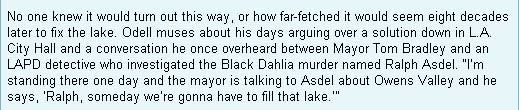
Imagine my surprise—no, my shock—to read this in L.A. Weekly. Here’s a screen shot to show I’m not making this up.

A writer named Jeffrey Anderson is exploring the legacy of Owens Valley and interviewed a man named Don Odell, identified as: “a semi-retired lawyer and former member of the Inyo County grand jury.”

“Odell muses about his days arguing over a solution down in L.A. City Hall and a conversation he once overheard between Mayor Tom Bradley and an LAPD detective who investigated the Black Dahlia murder named Ralph Asdel. “I’m standing there one day and the mayor is talking to Asdel about Owens Valley and he says, ‘Ralph, someday we’re gonna have to fill that lake.’ ”

It’s a nice picture; Odell overhearing a conversation between Bradley and Asdel, a former LAPD detective who was loaned to the Black Dahlia investigation.

But you’re not going to like this.


Large ImageRalph was a friend of mine. I was a pallbearer at his funeral in 2003. He was working in Boyle Heights when he was loaned to the Dahlia investigation. He later worked as a detective in the San Fernando Valley, before going to motors.

And according to his obituary in the Los Angeles Times:

“Asdel, who later became a motorcycle officer, injured his leg in an on-duty accident and was forced to go on medical retirement in 1965.”

Tom Bradley was indeed mayor of Los Angeles.

From 1973 to 1993.

Do you think something could something be wrong here? Note: Ralph’s obituary is online and easy to find.

Page 69


Large ImageWolfe is telling the Red Manley saga, using Will Fowler’s yarn virtually intact. In Will’s version, he goes to the Manleys’ home in Huntington Park, interviews Manley’s wife, Harriette, and tells her not to open to the door to nosy reporters.

The source for this ought to be either Will’s “Reporters,” or an interview with him. As I said before, one of the most frightening phrases in the English language is “Will Fowler recalls….” but let’s check.

Yep, “Reporters,” Page 81 and 82.

Should I take the time to see if this is screwed up? OK, I will.

Watson, to the haz-mat pile of Dahlia books!

Why am I not surprised?

Now with any other writer, I wouldn’t bother. This seems to be a straight lift job. But I swear, Wolfe can’t read what’s in front of him.

Here’s Will’s version:

“While I was there, the phone rang. It was Red and Harriet put her hand over the mouthpiece and asked: ‘Do you want to talk to him?’ ”

“ ‘You better not tell him I’ve been here,’ I said.”

Compare this with “Mogul”:


Large Image“When Harriet learned that her husband was being sought by the police, she became nervous but cooperative. She told Fowler that she had just heard from her husband, who had telephoned from San Francisco.”

OK, Will, let me get this straight: Every police officer and every reporter in California is looking for the mysterious red-haired man in the murder of Elizabeth Short. You’re at the man’s home, talking to his wife. He calls. She asks if you want to speak to him.

And you say:

No.

If that were a true story and I were your editor, you would be out the door.

And here we see Wolfe’s skill in creating quotes for conveniently dead people:

“Reporters,” Page 82

“She didn’t seem to object when I asked for them all [family photographs] and instructed her—a bride of only 15 months—not to talk to anyone, especially if newspaper reporters started coming around the house.”

“Mogul,” Page 69

“Electing not to inform Mrs. Manley that her husband was the number one suspect in the murder of Elizabeth Short, Fowler cautioned her not to talk to anyone about her husband—especially ‘any nosey reporters who may come knocking at your door.’ ”


Large ImageOf course, Will’s story (which I heard from him countless times) was that he bamboozled his way in the door by flashing his badge (reporters were indeed issued badges by Sheriff Eugene Biscailuz that were later confiscated by Sheriff Peter Pitchess) and claiming that Red had lots of unpaid parking tickets.

Was there any truth to it at all? I don’t know. Maybe. Will also claimed that he was on the stakeout when Red was arrested in Eagle Rock and present when police showed up at the Examiner with Elizabeth Short’s luggage. Since those events occurred at roughly the same time, he couldn’t have been in both places.

Time for my walk.

Shout out to:

Dark Horse Comics (70.96.128.8) man you guys are really going nuts on this site!

Grimstad, Norway (62.101.234.10) (say hi to my homies in Andoya!)

Oecd.org of France (80.124.192.14)

Mysterious visitor (75.1.5.136)

Chicago Linux user (4.252.208.102)

Hurry back!

Labels: , , , , , , , , ,

Saturday, February 04, 2006

Blogging the Wolfe Book, Extra! Extra!

P. 5

Extra! Extra!

I was raised on the wrong side of the tracks in Beverly Hills.

This is the most marvelously amusing statement. I suppose there are people—somewhere—who might find this believable. But for anybody local, especially a homebuyer, a comment like this is almost indescribably hilarious and I’m starting to wonder if Wolfe was a comedy writer at some point in his career.

In the 1940s, Beverly Hills was a ritzy, exclusive, lily white enclave separate from the city of Los Angeles, with rigidly enforced deed restrictions to keep out non-whites. The only people of color ever seen in Beverly Hills in this era were the maids and chauffeurs. The deed restrictions were so vital to the people of Beverly Hills that several of them filed lawsuits that forced non-whites out of their homes; a very ugly period in Los Angeles history.

The average reader would probably skip by this comment en route to more important things, but then I’m not the average reader and I have a few extra tools at my disposal. So let’s pull the comps on all of Wolfe's riff-raff neighbors on South Camden Drive. (Note to out-of-towners, Camden is one block west of Rodeo Drive).

On Feb. 18, 1940, the house at 473 S. Camden Drive sold for $13,000 or $172,992.24 USD 2005.

May 25, 1941, a real estate sales report describes a nine-room Spanish home being sold at 309 S. Camden Drive.

June 10, 1941, a report described the sale of a two-story Colonial at 474 S. Camden Drive.

Jan. 31, 1943, the two-story Monterey home at 426 S. Camden sold for $11,500 ($130,353.54 USD 2005).

July 25, 1943, two-story Spanish home at 416 S. Camden sold for $15,000 ($170,026.35 USD 2005)

Aug. 21, 1949, two-story Colonial home, four bedrooms, two baths, den with a half-bath, breakfast room and servants quarters (ahem) at 446 S. Camden Drive. No price listed.

Mind you, even the inflation-adjusted prices are misleading. Anything with four walls and a roof in Beverly Hills goes for megabucks today. For example, the starter house at 344 S. Camden Drive is currently on the market for a little over $2 million.

What’s especially interesting in "Mogul" is that Wolfe's neighbors included “strictly name below the title folks” like Joe E. Brown. In 1940, Brown sold his house at 707 N. Walden for $35,000 ($465,748.34 USD 2005), a considerable sum for the era.

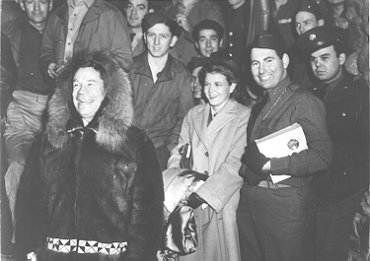
And if I were writing this story, I wouldn’t be so hard on Brown. A little research shows that he pretty much abandoned his movie and stage career after his son Don was killed on a training flight in 1942 and Brown, shown with servicemen in Alaska, devoted the following years to entertaining the troops in his son’s memory.

Now granted, I don’t read most books at the molecular level as I’m doing here. But most books don’t need to be read at the molecular level either. I warned you this would be tedious. But when Wolfe complains about his pitiful youth on "the lower depths of the south side" it's a bit much. Of all the Dahlia authors, I'd say Steve Hodel, whose mother went to jail for child neglect, has a genuine right to talk about a harsh childhood. But the wrong side of Beverly Hills? Oh really. It is difficult to generate much sympathy for someone who first saw “Gone With the Wind” in the living room of the producer’s home.

But wait…. there’s more

Page 6

After my parents divorced in 1943, my mother married Jeffrey Bernerd, a movie producer, and we moved north, across the tracks to the land of the majors, where we lived behind one of those mansion doors where “there’s often a great deal of unhappiness.”

The name Jeffrey Bernerd means nothing today, but imdb.com lists him as working on such cinematic triumphs as “Women in Bondage” (1943) and “Black Market Babies” (1945). Bernerd’s Aug. 11, 1950, obituary says that he lived—what’s this?—at 226 S. Camden Drive.

Time to go to the files and dig out the 1946 map of streetcar routes and see exactly where these horrid tracks were (again, not everybody has a 60-year-old streetcar map just sitting around waiting to be consulted, but as I think we’ve conclusively established, not everybody is me and certainly most people don’t read a book this way).

Ah! The map shows a Red Car headed west along Santa Monica Boulevard. Those poor people living in the ghetto south of Wilshire Boulevard—how did they ever make ends meet?

But let’s have a little more fun. We find with a little digging that Wolfe’s mother, Elizabeth, married Bernerd on April 2, 1945, at Bernerd’s home. We also learn that Wolfe’s father was Sailing Wolfe, a real estate salesman who was a nephew of Bernard Baruch. (Sailing Wolfe was apparently named for Baruch’s grandfather).

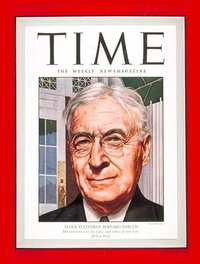
I’m blogging this as I read, so I have no idea what’s coming up. But I just flipped to the index to see if maybe we’re going to learn something about Sailing Wolfe or Bernard Baruch, left, in one of his three appearnces on the cover of Time magazine.

Not a word.

Hm. This is starting to look bad. I think if I were the grand-nephew of one of the world’s leading financiers I might just drop it in somewhere. Not make a big deal out of it but maybe I’d allude to it.

And about that impoverished childhood? We find that in 1941, Mrs. Sailing Wolfe was a member of Beverly Hills Assistance League (helping the less fortunate, presumably) and seemed to have had enough disposable income to collect Currier and Ives prints.

I have to go for a walk.


Labels: , , , , ,

Tuesday, February 15, 2005

Johnny Carson and the Art of Magazine Writing

The New Yorker recently republished Kenneth Tynan's 1978 profile
after the death of Johnny Carson on Jan. 24, 2005, and I spent some time picking it apart since magazine writing is a formula that I've never mastered, although I can't say I find it appealing, despite the cachet it bestows on writers.

To me, magazine stories are longwinded set pieces published on slippery paper, written to a rigid formula, beginning with the obligatory anecdotal lead and working their well-worn path from Point A to Point B to Point C and beyond, never intended to be read in their entirety, but existing as something a reader can pick up in a waiting room and plow halfway through before having one's name called, and not feel cheated by never knowing any more.

Tynan's piece is a hefty work, printing out at 32 single-spaced pages, and begins with a long, typical scene-setter in the present tense, so it seemed a perfect candidate for dissection. What better exercise than to read about a writer turning the tables on a master interviewer; at least that could be the "high concept" although in the final analysis, Tynan falls short with a subject who obviously was a difficult interview.

The first thing that struck me, aside from the shameless name-dropping that litters the piece ("I get memory flash of cable sent to me by Gore Vidal when he agreed to accept my younger daughter as godchild") is the stunning amount of time Tynan spent on it, about two years before publication, judging by internal evidence. Long enough, in fact, that some of his sources died while it was being prepared.

I also noted Tynan's dubious ability to quote long conversations from cocktail parties, presumably without notes, and his uncanny luck in having people materialize at his elbow to supply just the right quote at just the right moment and then vanish.

But the other thing, even more remarkable, though not as apparent on first reading, is that Tynan portrays a landscape utterly devoid of women. Except for a few quotes from Carson's third and then-current wife, Joanna, the women are anonymous starlets, receptionists and party hostesses; nameless, faceless extras dressing the piece.

Despite all that, Tynan is a gifted and engaging writer; which makes the exercise worthwhile; if I had merely wanted to punish myself I could have selected a story from any current magazine. One of my deeper reasons in picking this profile apart is the recurring notion that there was some reflective, thoughtful, contemplative--maybe even profound--side of Johnny Carson that he kept hidden from TV audiences, his fellow performers and even his friends.

The operating assumption of this piece, like many of the Johnny Carson tributes, was that there was a "there, there." I'm not entirely convinced. Maybe he was no different than the toys shown with Saturday morning cartoons: Comes with everything shown here.

Unlike Carson, Tynan hasn't held much cultural currency since the article appeared in 1978. In an admittedly arbitrary test, Carson's name appears 403 times in Factiva's archive of the New York Times between Jan. 1, 1980, and the day before his death. Tynan appears 112 times, often in obituaries of people whom he covered as the influential theater critic of The Observer, and of course his own obituary, which appeared July 29, 1980, three days after he died of emphysema in Santa Monica at the age of 53, and a little more than two years after this profile was published.

He survives today as the first person to say "fuck" on television (1965); co-author of Roman Polanski's "Macbeth"; author of a published anthology of show business profiles, including Carson's; the subject of a number of biographies; and as assembler of "Oh! Calcutta!"of which Carson might have been speaking when he told Tynan that he found British comedians "unfunny, infantile and obsessed with toilet jokes."

Many articles on Tynan note that he was an avid diarist, and indeed much of the Carson profile is cast as a diary, including the opening scene-setter, and the conclusion, in which he joins the entourage as Carson goes to Harvard to receive an award as Hasty Pudding Theatrical's Man of the Year.


There is also a tremendous amount of research underlying the profile. Tynan (or someone) has not only gone to the clips to read Betty Rollin's 1966 article in Look, and Robert Blake's interview in Playboy, he's consulted: Woody Allen; George Axelrod; Mel Brooks; David Brenner; Fred de Cordova; Dom DeLuise; Nunnally Johnson; Irving "Swifty" Lazar; Jackie Mason; Arley D. "Pat" McCormick; Ed McMahon; Paul Morrissey; Don Rickles; Mort Sahl; David Tebet; Orson Welles; Billy Wilder.

The names and cultural references fly thick and fast: Frank Sinatra and Paul Newman; the Pinter plays, the books by Robert Ardrey, the Uffizi Gallery in Florence, at a certain point the irrelevant references become rather amusing, especially when Tynan drags in Franklin P. Adams' newspaper column "The Conning Tower," which began in 1914 and ended in 1941, 37 years before publication of the Carson profile.

Before proceeding, I should let Tynan speak for himself. Here's his opening to the Carson piece:

July 14, 1977: There is a dinner party tonight at the Beverly Hills home of Irving Lazar, doyen of agents and agent of doyens. The host is a diminutive potentate, as bald as a doorknob, who was likened by the late screenwriter Harry Kurnitz to “a very expensive rubber beach toy.” He has represented many of the top-grossing movie directors and best-selling novelists of the past four decades, not always with their prior knowledge, since speed is of the essence in such transactions; and Lazar’s flair for fleet-footed deal-clinching—sometimes on behalf of people who had never met him—has earned him the nickname of Swifty. On this occasion, at his behest and that of his wife, Mary (a sleek and catlike sorceress, deceptively demure, who could pass for her husband’s ward), some fifty friends have gathered to mourn the departure of Fred de Cordova, who has been the producer of NBC’s “Tonight Show” since 1970; he is about to leave for Europe on two weeks’ vacation. A flimsy pretext, you may think, for a wingding; but, according to Beverly Hills protocol, anyone who quits the state of California for more than a long weekend qualifies for a farewell party, unless he is going to Las Vegas or New York, each of which counts as a colonial suburb of Los Angeles. Most of the Lazars’ guests tonight are theatre and/or movie people; e.g., Elizabeth Ashley, Tony Curtis, Gregory Peck, Sammy Cahn, Ray Stark, Richard Brooks. And even Fred de Cordova spent twenty years working for the Shuberts, Warner Brothers, and Universal before he moved into television. The senior media still take social precedence in the upper and elder reaches of these costly hills.

There are any number of lessons to be learned here, and I can almost envision the opening page of a play, for Tynan was, after all, a theater critic: "The curtain rises on the Beverly Hills home of IRVING LAZAR. It is evening and a large cocktail party is underway."

But unlike a play, absolutely no one in the opening scene appears in the profile, aside from de Cordova, who resurfaces from time to time, and Lazar, who magically materializes at Tynan's elbow to provide a few necessary quotes and vanishes for the rest of the piece. A writer might well be expected to go off in any number of directions from here, and indeed the opening could just as easily preface a profile on Lazar as Carson. What, then, is Tynan up to?

First of all, he's establishing the primacy of the theater, that is Broadway, for this is a New York audience, and of films against the marginal legitimacy of television and the rather crass and somewhat unnatural practices of California and Californians.

It is only now that he introduces the subject of his piece:

One of the rare exceptions to this rule is the male latecomer who now enters, lean and dapper in an indigo blazer, white slacks, and a pale-blue open-necked shirt. Apart from two months in the late nineteen-fifties (when he replaced Tom Ewell in a Broadway comedy called “The Tunnel of Love”), Johnny Carson has never been seen on the legitimate stage; and, despite a multitude of offers, he has yet to appear in his first film. He does not, in fact, much like appearing anywhere except (a) in the audience at the Wimbledon tennis championships, which he and his wife recently attended, (b) at his home in Bel Air, and (c) before the NBC cameras in Burbank, which act on him like an addictive and galvanic drug. Just how the drug works is not known to science, but its effect is witnessed—ninety minutes per night, four nights per week, thirty-seven weeks per year—by upward of fourteen million viewers; and it provoked the actor Robert Blake, while he was being interviewed by Carson on the “Tonight Show” in 1976, to describe him with honest adulation as “the ace comedian top-dog talk artist of the universe.” I once asked a bright young Manhattan journalist whether he could define in a single word what made television different from theatre or cinema. “For good or ill,” he said, “Carson.”


To be continued...

Labels: , , , , , , , ,