Wednesday, January 17, 2007

The Changing Face of the City

Jan. 17, 1907
Los Angeles

On a trip from Utah to visit his daughter, H.E. Gibson keeps getting lost as he wanders around Los Angeles. No, it’s not because Gibson is 80, for his mind is still sharp. It’s because he hasn’t been back since 1848 and things have changed just a bit.

Even the old familiar landmark of Ft. Hill is covered with homes, he says. About the only spot in town he recognizes is the Plaza, where he keeps returning to get his bearings.

Gibson came to California with the “Flash Emigrant Colony” to establish Mormon settlements. The group couldn’t raise the money to buy Rancho Cucamonga, so they bought a parcel of land in San Bernardino, The Times says.

Land was “dirt cheap” in 1848, with entire blocks selling for $500 to $1,000, ($9,910.34-$19,820.69 USD 2005), Gibson said. But instead of becoming a real estate speculator, he left for Utah to bring the news (published in a New York newspaper that came around the Horn) proclaiming that Brigham Young had been appointed governor of the Utah Territory.

Note: Today presented a difficult decision, but I passed on some incredibly offensive caricatures of an African American who had been arrested, accompanied by quotes in dialect: “Ah dunno nothin’ about no stolen chickens” indeed.

Lmharnisch.com
Lmharnisch.blogspot.com

E-mail: lmharnisch (AT) gmail.com

Labels: , , , , , ,

Friday, December 29, 2006

The City Grows

Dec. 29, 1907
Los Angeles

The Times real estate pages feature homes under construction around Washington Boulevard west of Hobart Boulevard. “This section is just being built up with a splendid class of dwelling houses,” The Times says. “There are several car lines within a short distance, furnishing a rapid transportation service to the center of the city, and as the whole section is on a mesa, it is high above the fogs and occasional floodwater caused by rain, which obtains a few blocks farther south.”

One home features a bit of whimsy: A Mission-style house on the northwest corner of Washington and Westmoreland Boulevard with an automobile garage designed like a Dutch windmill, including a conical top and sails. Of course, the garage and the house are long gone.

J.H. Lapham is building a two-story, seven-room home at 2045 S. Oxford while the California Bungalow Co. is building a two-story frame home at 1732 S. Oxford that “will compare well with the surrounding homes.” Note that while the neighborhood in the 1700 block of South Oxford appears to be generally intact, The Times apparently erred in the street numbers, which go from 1728 to 1734 S. Oxford.

Stay tuned more architectural ramblings to South Oxford. By the way, here are the “New Ha Apartments.” Apparently the signage once read: “New Hampshire,” but I like it better this way.


And a random snapshot of ABC Letter Art on South Vermont. Maybe the folks who own the "New Ha" should pay a visit.


Lmharnisch.com

Lmharnisch.blogspot.com

e-mail: lmharnisch (AT) gmail.com

Labels: , , , , , ,

Thursday, December 07, 2006

The Confession of Morris Buck

Dec. 7, 1907
Los Angeles

“I asked if she received the letter. She said she had. I asked her if she would loan me a sum of money to be paid back monthly and I was going to open a bakeshop.

“She said that she had so many—several calls for money, that she didn’t see how she could loan me any and she says: ‘Why can’t you work?’

“I said I had been working but I never got anything ahead to start up in business. She says: ‘Have you any relations? Can’t you borrow any money from Will?’

“He is my brother. I told her that he was poorer than I was.

“I told her I was different from the others.

“She says: ‘You wait here’ and she went in the hall and she came out again. I was standing up.

“She came over toward me and I says: ‘Who did you ring up?

“She says: ‘I rang James, the coachman.’

“At the same time, she placed her hand in her vest and I moved to the left....

“As soon as I saw her hand in her vest I turned to the right and I pulled my gun and I says: ‘Throw up your hands.’

“And she says: ‘Put down that gun’ and she turns and says ‘Go back, he has got a gun’ and she would not put her hands up.

“And I says: ‘Would you strike an old man?’

“And she says: ‘Yes.’

“I says: ‘Would you put me into an asylum?’

“And she says: ‘Yes.’

“And I pulled the trigger and she hollered: ‘Help!’

“I pulled the trigger the third time. It only went off twice. I pulled it twice and then I pulled it the third time and it wouldn’t fire. I was about two feet from her. I was afraid of my own life. I didn’t see any weapon that she had. But I didn’t want to take any chances.”

.... “She fell and I said something over the body. I don’t remember what.

“Then I went toward the railing and I saw a lot of men in the road and I put the gun up to my head and I said: ‘Gentlemen, must I blow it out?’

“Nobody said anything that I could hear. I said: ‘Gentlemen, it relies on you.’

“Somebody says: ‘Who has got a gun? Shoot him.’ And then somebody says: ‘Give me the gun.’

“I was sitting down on the rocking chair. Then I got up and I says... I was sitting down and says: ‘Don’t any of you shoot. Let an officer take charge of this.’

“Then they says: ‘Kill him. Hang him.’

“And I got up and I pulled my gun. I had two guns. And they says: ‘Look out, he has got another gun.’

“I stepped back and I run. I jumped over the rope on the side porch and run to the next corner. I must have lost my other gun. It dropped out of my pocket. I ran down on 4th Street and then down as far as Westlake.”

... “I run into the ice cream parlor and I says; ‘There is a fellow after me.’ And I says: ‘Close the door and don’t let him in till an officer comes.’

“And he says: ‘We know it. Lean over’ and she [he?] shut the door. And an officer came and brought me here.”

Morris Buck was convicted in the Jan. 27, 1906, slaying of his former employer, the wife of Charles A. Canfield, an oil executive and partner of E.L. Doheny, at the Canfield home at 8th and Alvarado. According to The Times, Buck shot her once after she refused to loan him $2,600, and her young daughter screamed and ran into the house. The wounded woman wrestled with Buck as he shot her again.

Buck claimed that he was insane, having once been kicked in the head by a horse. He had been held in the mental ward at the County Hospital for two months in 1903, but the insanity plea was rejected as a ruse.

An expert on Bertillon criminology said: “Buck is one of the most interesting criminals I ever saw. I do not believe he is insane; he is, in my opinion, a low degenerate from the effect of vicious personal habits.

“His eyes are dull and perfectly lifeless; his lower jaw lops open and his scrawny, limp body seems to be giving away at the knees. It seems as though there is not a drop of real life in him.”

The criminologist warned: “If that man is ever hanged you can be prepared for something horrible. I have seen men of just his stamp hanged—weak degenerates. Awful! They break down and are dragged to the gallows weeping and sobbing like children and are held up to have the noose put on.”

In fact, Buck went quietly:

“This morning, he awoke early, and after dressing himself in the clothes in which he was to be executed, he ate a hearty breakfast,” The Times says. “Father Callopy remained with him until he was declared dead.”

“A few moments before the time set for the execution, the warden entered the condemned cell and read the death warrant. Buck’s hands were then strapped to his sides and the march to the gallows was begun at 10:50. Warden Hoyle took the lead, then came the priests, chanting prayers for the dying and following came the condemned man, a guard on each side.

“He then stood upon the trap. Guard Albrogast placed the rope around his neck, drew the black cap, the signal was given and his body dropped.

“Below the trap stood the prison physician, Dr. Stone, and Dr. Galehuse of San Rafael. In 14 minutes, the condemned man was declared dead. The body was cut down and placed in a prison coffin.”

In an interesting footnote, five of Canfield’s children received $500 a piece from her estate. Another woman named Hattie Elizabeth Bryant or Dorothy Canfield was given $5. “It is not my desire that she be recognized as one of my children,” Canfield’s will said. Years later, it was revealed that Dorothy was a foundling taken in by the Canfields.

In 1911, Canfield’s son, Charles, fled to Mexico after passing worthless checks. His father said: “I don’t know where he is and I don’t care.”

In 1917, the five Canfield daughters, as trustees of $100,000, sought to sell their late father’s real estate to establish a school for girls.

In 1933, daughter Daisy Canfield Moreno died when the car in which she was riding plunged off Mulholland Highway on her way home from a late-night party at the Beverly Wilshire Hotel.

In 1972, the Canfield Foundation dissolved, giving $700,000 to Mills College and $1 million each to Pepperdine and Stanford.

And nowhere, in any of these news stories, do we learn Mrs. C.A. Canfield’s first name. It is almost beyond belief.

Lmharnisch.com

Lmharnisch.blogspot.com

e-mail: lmharnisch (AT) gmail.com

Labels: , , , , , , , ,

Saturday, December 02, 2006

A Vintage Development

Dec. 2, 1907
Los Angeles

The Times real estate section features an apartment building at 2nd Street and Figueroa—no point in even going to look for it. But there’s also a large ad for the Erkenbrecher Syndicate’s Glendale Valley View Tract.

An unknown development today, the Glendale Valley View Tract is located west of Central Avenue in Glendale and north of Riverdale on what was once Judge Andrew Glassell’s vineyards. Part of it is apparently occupied by the Glendale Galleria, but some homes remain south of what is now Colorado Boulevard and was then 6th Street.

“Planted by Judge Glassell to vineyards some 30 years ago,” The Times said in 1907, “and kept by him in the highest possible state of cultivation, the Glassell vineyard of 146 acres was looked upon and pointed out as the ‘show place’ of the Glendale Valley.”


The homes are modest and the streets are narrow, probably not what Henry Huntington and L.C. Brand had in mind when they tried to acquire the property, “looking upon it as the choicest of subdivision property in that entire section,” The Times said.

The development offered five miles of oiled streets, curbs and sidewalks. The ads noted that the neighborhood was closer by streetcar than the West Adams District.

Here’s what the neighborhood looked like then:


And here are some homes today:


Lmharnisch.com

Lmharnisch.blogspot.com

e-mail: lmharnisch (AT) gmail.com

Labels: , , , , , ,

Saturday, November 25, 2006

Roving to Monrovia

Nov. 24, 1907
Monrovia

The Times real estate section takes a look at what was then the distant suburb of Monrovia, 22 miles from downtown Los Angeles. The writer notes the increasing use of concrete and stone, explaining that the cost of lumber is forcing builders to use other materials. The writer also notes the broad, shaded verandas of three featured homes as well as the outlines of their roofs.

The story highlights the home of B.R. Davisson on East Orange Avenue, H.M. Slemmons (or Slemon) on North Myrtle Avenue and the home of John C. Rupp at Ivy and Greystone, built for $6,500 ($133,403.21 USD 2005).

Without exact addresses, it would be difficult for me to locate the Davisson and Slemmons homes, but I took a pleasant drive out to Monrovia recently to look for the Rupp house and was happy to find
that it is still standing and in beautiful condition. In fact, it was nice to discover that the neighborhood has quite a few well-maintained historic homes; a contrast to the condition of the houses I located in Pico Heights.

I had a brief chat with the homeowner who gave me a tour of the grounds. He said that Rupp, a financier, built the home for his wife, but that she decided it was too far from Los Angeles and wouldn’t live there. That’s apparently true, because Rupp put the home on the market in 1911.

Note that the ad for the home mentions a solar heater. I have no idea what this was and the homeowner didn't know anything about it. Obviously a subject for further research.

The homeowner also mentioned the Monrovia Old House Preservation Group, which has a website and offers a self-guided tour. I cannot vouch for these folks, but it does sound interesting and the area has some lovely old homes.

To get to the Rupp house, take the Foothill Freeway and get off at Santa Anita in Arcadia. Turn north and go to Foothill Boulevard and then turn right (east) and then left on Ivy. The home is at 269 N. Ivy. While you’re there, look at the large stone house on the northeast corner, built in 1894. I’ll post some pictures when I get the film developed (we’re old school around here).

Lmharnisch.com
Lmharnisch.blogspot.com

e-mail: lmharnisch (AT) gmail.com

Labels: , , , , , , , , , , , ,

Friday, November 10, 2006

Dislocation, Dislocation, Dislocation

Nov. 10, 1907
South Pasadena

What sort of monument do we leave for real estate developers? For John B. Althouse, who built hundreds of homes in the Wilshire district, as well as the West Adams district and the San Gabriel Valley, the answer might be nondescript offices and vacant lots.


Here’s the house he built for himself at Oxley and Fremont in South Pasadena, a few blocks from my home. In fact, I pass the corner every day.

Here’s another one he built on Manhattan Place.

Don’t rush out to look for them, though. They’re gone, although the wall around Althouse’s home survived.

Born in Baltimore, Althouse died in July 1939 at the age of 72 at his home, 230 S. Gramercy Place. He arrived in Los Angeles in 1886 and spent 37 years in the real estate business after operating a fruit store at 1st and Main Streets for many years. He constructed hundreds of homes in the Wilshire district and was one of the first members of the Los Angeles Realty Board.

What’s this? One has survived in the West Adams district, 1415 S. Gramercy Place. Also read here. And here. Zillow link.

Lmharnisch.com
Lmharnisch.blogspot.com

e-mail: lmharnisch (AT) gmail.com

Update: Further research reveals the home of Daniel T. Althouse, a partner in Althouse Brothers, at 2125 S. 4th Ave., where he died of blood poisoning in 1914.


Labels: , , , , , , ,

Saturday, July 22, 2006

Real Estate


Note: $90 a month is $1,847.12 USD 2005

Labels: , , , ,

Sunday, May 21, 2006

Fleenor Talks

In a jailhouse interview before he was taken to San Quentin, James G. Fleenor, the barefoot burglar, set the record straight on his escapes, his relationship with a white woman and how he began a life of crime.

It had been rumored that Fleenor returned to Los Angeles after escaping from a San Francisco jail because of his relationship with Mrs. B.J. Byres of 1669 Tennessee St. He insisted that he hopped the first freight train leaving the yard and discovered later that it was going to Los Angeles.

Fleenor, who used a real estate business as a front for his burglaries, said that she was one of only three customers who continued paying on her property after he was sent to jail. “She came to the jail and asked where the payments were to be made,” he said. When asked what became of the money, he replied: “The lawyers got it and crowded me for more.”

Then he began the story of his life. Born in a free state to a father who was a freed slave, Fleenor said he was raised in a town that was predominately white. “There were only three families of colored people and we were all thought everything of by the white people. My mother was the old mammy of the whole neighborhood,” he said.

“I was ambitious. I wanted to paint pictures or do something of that sort. But I learned the trade of cabinetmaking. I learned it well, too.

“Then I decided I would go out in the world. I thought I would get the same treatment I had in the town where I was born. I didn’t know any better,” he said.

“In place after place I offered to do a day’s work for nothing just to show what I could do. People seemed to like me. They wanted to give me work—gardening or shoveling coal or something like that. But, well, how would a lawyer feel if someone offered him a job taking care of chickens?

“Many places I was told they’d like to put me to work but that if they did all their other workers would walk out of the shop. I am not saying anything against the unions but that was how it was. That was all. It was simply the way fate was working with me.”

Sheriff Hammel and Jailer Aguirre were to escort Fleenor to San Quentin, but refused to say when they would leave.

“When I have landed Fleenor in San Quentin and have my receipt for him, then I will telegraph to Los Angeles that it is done,” Hammel said.

* * *

The engineer of a Southern Pacific freight derails his train because a naked lunatic throws himself on the tracks. A Bible from a mission at 145 N. Main St. found with his clothes gives his name as C.H. Clenin of Australia... A gray colt commits suicide in Echo Park lake rather than pull a cart. “There will be no inquest, for they do not hold inquests over colts, but out on Bellevue road, they will remember for many a day the little gray colt to which death was preferable to slavery,” The Times says... W.W. Garvin stabs fellow real estate dealer George Cunningham over a bad debt at the entrance to the Grant Building at 4th Street and Broadway.

The City Council approves a law limiting wholesale liquor stores to the saloon district. Dealers have been given 11 months to move their businesses inside the district. Apparently the saloon zone was so well-known that The Times didn’t need to report the boundaries; the southern border was the north side of 9th Street. The western boundary was extended in 1907 to the west side of the 3rd Street tunnel. The others are unclear.

Lmharnisch.com


Lmharnisch.blogspot.com


Labels: , , , , , ,

Thursday, April 06, 2006

Blogging the Wolfe Book, Request Line IV


Large ImageI have ceased blogging in real time as I read Donald H. Wolfe’s “The Black Dahlia Files: The Mob, the Mogul and the Murder That Transfixed Los Angeles.” Wolfe is using the “Laura” format in which the anonymous, butchered body is discovered and the narrative proceeds in flashbacks.

Now I’m taking a few requests before I wrap it up. Yesterday, we looked at Pages 118-119

Today, Pages 121-122 at the request of Mary Pacios.

Wolfe is discussing Ann Toth, one of Elizabeth Short’s roommates at the home of Mark Hansen, the business manager of the Florentine Gardens.

The contention here, which is mostly accurate, is that Hansen didn’t want Elizabeth Short going out with other men while she was living at his house. That’s true. Not that there was any deep relationship between Hansen and Elizabeth. Of course, after her murder, he denied any interest in her whatsoever, which is probably untrue. On the other hand, judging by the accounts in the district attorney’s files, she had adequate skills for keeping him at bay. Toth said that one of Elizabeth’s ploys for keeping men at a distance was that she was a virgin (Gasp!!! What? Elizabeth Short, the femme fatale who cruised across L.A. clad in black, leaving a path of destroyed men in her wake, used to say she was a virgin???!!! Yep).


Large ImageAha. Now here’s the fictionmeister at work:

“Ann Toth told the 1949 Grand Jury
[note to ReganBooks, the publishing house without proofreaders or fact-checkers, that shouldn’t be capitalized] that when Mark wasn’t around Elizabeth would make secretive, outgoing calls on the house phone. Toth recalled that she often called somebody in Beverly Hills and she often called Maurice:”

Brown: Clement, was it?

Toth: Maurice Clement. Did you ever talk to him again?

Brown: Talked to him several times.

Toth: What is Clement?

Brown: Clement is a teacher…

I suppose you’ll be checking the end notes, Holmes?

A good place to start, Watson. Shall we?

Oh let’s!

Watson, I’m fairly sure you’re going to enjoy this. See what Wolfe does:


Large ImagePage 371

“Beth had to be cautious…” Ann Toth’s testimony for the 1949 Grand Jury—District Attorney’s Black Dahlia files.

Now what could be wrong with this, eh? Seems fine? But no! It’s not testimony before the grand jury. Let’s check the actual document, shall we?

What’s this? The document says Ann Toth was interviewed twice, once by Frank Jemison of the district attorney’s office with Police Lt. Ed Barrett (Dec. 13, 1949) and by Jemison and Detective Sgt. Finis Brown (identified as Officer Brown) Feb. 28, 1950. And it certainly wasn’t sworn testimony before the grand jury.

Ann Toth was interviewed at 1959 N. Wilcox in Hollywood. Sort of an odd place for the Los Angeles County Grand Jury to meet, wouldn’t you say?

Now let’s see what she actually said. This is from Page 9 of her second interview. Note that because the interview was transcribed, many names are written phonetically, i.e. Clemens for Clement. This is a typical and maddening phenomenon of the district attorney’s files.


Large ImageBrown: Do you remember the time she moved away when she called those people. Do you recall her calling any number in the PR ospect or PA rkway or AX minster area? [note: AX minster is the telephone prefix for Leimert Park, where the body of Elizabeth Short was found—lh]

Toth:
She called somebody in Beverly Hills—that impressed me at the time.

[Note: Not secretive, outgoing calls. Of course one can only make outgoing calls, can’t one? lh]

Brown:
Did she call somebody at a CR estview number?

Toth:
Also she called that real estate man.

Brown:
Johnson?

Toth:
She called the teacher

Brown:
Who is Oterro—was it or Clemens was it?

Toth:
Maurice Clemens. Did you ever talk to him?


Large ImageBrown: Talked to him several times. And Otero, that’s the little Spanish teacher.

Toth:
What is Clemens?

Brown:
Clement is a teacher too but Oterro works for the public schools.

Toth:
Then it was Otero then. It was a Spanish teacher, little, on the dark side.

Brown:
Little fellow

Toth:
Was he driving a Ford

Brown:
Little Ford, two-door sedan.

Toth:
Yes.


Now Wolfe goes on to say:
“Finis Brown was fully aware that Maurice Clement was an employee in the Talent Department at Columbia Studios, and he knew of Clement’s contacts with Brenda Allen as a Syndicate procurer.”

In fact, as far as I can tell, Clement was “Maurice the Voice Teacher,” often described as Elizabeth Short’s roommates at the Chancellor Apartments as “her favorite boyfriend.”

I invite anyone in L.A. who has the desire to do so to swing past Maurice’s little apartment on Normandie just south of Hollywood Boulevard. It’s a very modest, ordinary two-story building. Not the opulent pad of a mobster and Syndicate procurer.


Large ImagePage 122

Now this is really choice work. A master fabricator in action:

Actual quote:

Toth:
Then it was Otero then. It was a Spanish teacher, little, on the dark side.

Wolfe version:

Toth:
Clement… Little… on the dark side?

In other words, Wolfe isn’t even talking about Clement. She’s talking about an entirely different man.

Oops.

Remind me again what a well-researched book this is. I keep forgetting.

But of course Wolfe is only warming up.

This is what follows:

[Finis quickly changes the subject]

Brown:
Do you recall of her ever going to a doctor? Did you ever know of a time when she ever rode with you or anybody that you know of, and let her off on Hollywood at any doctor’s place?

Toth:
Mark [Hansen] might have driven her down. She was going to one on Hollywood Boulevard. I think maybe the teacher [Maurice] brought her down there once. It seems to me she said she was going to meet him one Sunday afternoon. But of course, he wouldn’t be in his office on a Sunday afternoon.

This is the work of a real card shark, folks. In fact, Finis didn’t “quickly change the subject.” Wolfe is the one who is changing the subject, jumping from Page 9 to Page 11 in the second interview.

I guess we’re not supposed to know that, eh?

Here’s what actually followed:

Brown:
You don’t recall any numbers down around the AX minster or Inglewood area?

Toth:
Well I said that real estate man. She called him in Inglewood. She called two or three numbers, but she didn’t get any answers, see, so naturally I wouldn’t know.

Brown:
See what, Ann, I am trying to figure is if there is some possibility of someone she might have called down in that area there. She ever talk to Brant Orr?

Toth:
No, not that I know of. She spoke about this flier out at the—supposed to be flying two weeks out of here, two weeks from somewhere else. I don’t know, she was going to move out to Burbank or something, out to a base.

And note Wolfe’s handiwork in this:

Toth:
Mark [Hansen] might have driven her down. She was going to one on Hollywood Boulevard. I think maybe the teacher [Maurice] brought her down there once. It seems to me she said she was going to meet him one Sunday afternoon. But of course, he wouldn’t be in his office on a Sunday afternoon.

OK, that’s not Maurice. That’s a man named Otero who was a Spanish teacher.

This is really devious work, folks. These aren’t unintentional mistakes, rather they are scheming, calculated, malicious lies used to prop up a fictitious premise.

Time for my walk.

Shout out to:

Buenos Aires, Argentina (200.122.97.113)

Springfield, Mo. (68.92.121.183)

Procter and Gamble in Belgium (192.229.17.113)

Norman, Okla. (69.154.25.87) Windows 98? Upgrade!

Hey, you in Kerkira, Greece. 47 visits? What’s with deal?

Hurry back!

Labels: , , , , , , ,

Tuesday, March 14, 2006

Blogging the Wolfe Book, the Whole Nine Yards


Large ImageI’m blogging in real time as I read Donald H.Wolfe’s “The Black Dahlia Files: The Mob, the Mogul and the Murder That Transfixed Los Angeles.” Wolfe is using the “Laura” format in which the anonymous, butchered body is found and the narrative is told through flashbacks.

At this point in the story, Wolfe is exploring Elizabeth Short’s time in Hollywood in late 1946, about a month before the murder.

Page 59

After deftly handling the nebulous role of Sgt. Chuck, whom investigators and reporters could never locate—or even determine that he existed, Wolfe moves on to the apartment house on Cherokee where Elizabeth stayed briefly in late 1946.

Wolfe begins the next phase of the story: “Will Fowler recalled,” three words that make me shudder. I liked Will; he was charming, funny, outrageous and bright, and I considered him a friend. But he was also an incredible teller of tall tales. Wolfe refers to Will’s “Reporters,” Page 81, which says that an anonymous tip sent newsmen poking around Hollywood trying to sniff out anything about Elizabeth Short.

In fact, in the days after Elizabeth Short’s murder, an almost countless variety of sightings were reported; as if she had been a regular at every bar in Los Angeles. Of course, not a single person ever conclusively identified her as far as police were concerned—and even the more conscientious newspapers hedged their accounts:

The Daily News of Jan. 21, 1947, said of the reporters’ club crawling: “Other results of the nightlong canvass indicated that the Black Dahlia had lent her beauty to innumerable swank and tawdry night spots in the months before her death—that is if the eyes and memories of bartenders and waiters are sound.”

Note also the date: Nearly a week after the murder. It’s interesting to see how storytelling collapses time, erasing the intervals between events until they appear to be related.


Large ImageOf course, Wolfe is going to treat this all as solidly established truth because that’s where this story is heading. Let’s see where he attributes this. Hm. Still using “Reporters.” But what’s this? Will drags in his old drinking buddy Paul Burke, a bartender and sometime actor who appeared in the TV show “Twelve O’Clock High.” (Sorry, amazon only has the movie, not the TV series). One time, many years ago, Will and Burke called me up absolutely snockered and talked to me about the Black Dahlia case. They were flying high and having a good old time.

Now I’ve talked to Burke, who according to “Reporters” says: “Years later, when I was with 20th Century-Fox, actor Paul Burke told me he’d known the Dahlia when he was a Hollywood bartender. He had corroborated the fact that lesbians had been interested in Elizabeth but she hadn’t responded to them.”

So does Burke appear in “Mogul”? Let’s just see for the fun of it. Nope, he doesn’t. I wonder why not. Maybe we’ll find out.

And now we enter very deep and troubling waters.

“Reporters found Elizabeth Short’s name still on the mailbox of Apartment 501. There were five other girls sharing the apartment, which was on the top floor overlooking the street below. The building was managed by Glenn Wolfe, a suspected narcotics dealer who recruited girls for the Syndicate brothels.”

Let’s dissect this little item (truncated, because it runs over to the next page).

Minor quibble, as the photograph shows, the name on the mailbox is “Betty Short.” One of the first decisions anybody has to make in writing about Elizabeth Short is what to call her: Elizabeth, Beth, Bette or Betty.
Also, estimates of the number of young women in the apartment vary, some sources say four, others say eight. Wolfe is the first as far as I know to say five.

But what we really need to look at is Glenn Wolfe. He’s called “a suspected narcotics dealer,” although we’re not told who suspected him.

Not the blasted end notes again, Holmes!

Forward, my dear Dr. Watson.


Large ImagePage 366

“Glenn Wolfe was also listed as a suspect within the Black Dahlia Case files, which profiled his narcotics and procuring activities. The files indicate that the Chancellor [was] owned and managed by the Syndicate.”

I suppose what Wolfe means by this is that if you dig through the two boxes of jumbled paper at the district attorney’s office you will eventually find Glenn Wolfe’s name. OK, well you’ll find that his name was really Glynn Wolfe.

Now usually in such a case, you might expect a line like “Glenn/Glynn Wolfe, no relation to the author,” so I’m not sure if this is an oversight or if Donald H. Wolfe is going to claim him as some sort of distant relative with mob ties. Recall that Donald H. Wolfe has been very circumspect about certain members of his family, namely his father, Sailing Wolfe, and great-uncle, Bernard Baruch.

For the benefit of those who don’t have the Examiner files on Glynn Wolfe, let me pull my material and see what we’ve got:

Yow! The Examiner and The Times had great fun with our friend. He had at least 17 different wives (no, that’s not a typographical error) and married a couple of them several times according to a March 18, 1969, story in The Times.

But the newspapers are curiously silent on his alleged drug dealing and procuring for the Syndicate.

As we found yesterday in exploring the story of Sgt. Chuck, we know that Frank Jemison summarized a list of about 22 suspects. And yes, Glenn/Glynn Wolfe is one of them.

What does the D.A. actually say? I’m referring specifically to Jemison’s Feb. 20, 1951, memo. Page 6.


Large Image“Glenn Wolfe is the owner of the Chancellor Apartments, 1842 Cherokee, Hollywood. It was the last place where victim resided in Los Angeles before she met Carl Balsiger and then left for San Diego. He was residing at 1617 North Las Palmas in an apartment house owned by Kate Harris at the time of the murder. He admitted knowing victim. She lived in a six bed apartment at the Chancellor Hotel and left there on December 6, 1946, as she did not like the place. Wolf is known as a sexual maniac by other women. Ray Pinker, LAPD Crime Laboratory chemist, checked the rooms in which he resided for blood and got no positive reaction. This was done upon request of the undersigned. Marvin Hart, now living at Lido Apartments, Hollywood, lived at the Chancellor Apartments at the time of the murder. He has not been questioned. Alyce Lebedeff, private investigator, 1967 Carmen Strett, HI llside 6279 states that a Miss Schell, who runs a hot dog stand on Santa Monica boardwalk, slept in the upper bunk of the bed occupied by victim on December 1, 1946, at the Chancellor Apartments. Further that Polly Blits, Hollywood real estate broker is a known queen queer and knows plenty. There is reliable information that some of the five girls in the room at the Chancellor living with victim were queers. Victim stated on several occasions, however, that she had no use whatsoever for queers.”


Large ImageHm. Note that I have preserved the wording exactly as it appears in the memo, down to the frequent use of “queer.” Nothing about Glynn Wolfe being a drug dealer. Nothing about Glynn Wolfe being a procurer for Syndicate brothels. Nothing about the Chancellor being owned by the mob. This is all fabricated by Donald H. Wofe, aided and abetted—according to his acknowledgements—by his agent, Alan Nevins of the Firm; and editors Cal Morgan and Anna Bliss. And ReganBooks, known as the publishing house without proofreaders.


Time for my walk.

Shout out to:

Allstream Corp. (216.123.180.34)

City of Los Angeles (161.149.63.203)

CBS.com (170.20.96.116)

Kindred Healthcare (207.15.10.211)

O/S breakdown

Some flavor of Windows: 81%

Mac OS X 18%

Unknown: 1%

Hurry back!

Labels: , , , , , , , ,

Wednesday, February 08, 2006

A "C" From the Health Inspector

Page 8

In those days Leimert Park was a nice, middle-class neighborhood on the fringe of the more fashionable Adams District west of downtown Los Angeles.

Here, in a few words, “Mogul” demonstrates its lack of familiarity with two historic Los Angeles areas that are nearly three miles apart, a definition of “West Adams adjacent” that even the lowest real estate agent would find excessive. Wolfe’s psychological map of Los Angeles (an exercise wonderfully described in “Shotgun Freeway”) is a little distorted. (Here’s a clip of the movie).

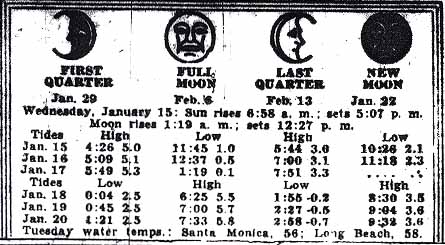
Sunrise was at 6:53 a.m. on Wednesday, January 15, 1947.

Incredibly, even this simply verified fact is wrong. Does this matter by itself? Not unless your faith dictates that you make a religious observation at a particular time. Does it become worrisome when added to all the other errors? Absolutely. More important, if a researcher can’t get simple things correct, how can he be trusted with far more complicated material still to come?

What “Mogul” is setting up in all of this is the discovery of the body, which I assume (remember I’m blogging in real time and not reading ahead) will be followed by the rest of the story told in flashbacks.

This is the standard “Laura” treatment of the Black Dahlia murder, following the structure of the Vera Caspary novel made into the 1944 movie with Gene Tierney, Dana Andrews and Clifton Webb. As Caspary discovered, this is a wonderful structure for a novel—which is quite good and I recommend it—a classic film noir, a crummy play and above-average radio play that aired on the Lux Radio Theatre several times.

Flashbacks are the standard structure used in “Severed,” John Gregory Dunne’s “True Confessions” and James Ellroy’s “The Black Dahlia.” Even Robert Lenski used it in the Lucie Arnaz TV movie “Who Is the Black Dahlia?” Of course the problem is that although this is fine for fiction, it’s terrible for history because the investigation wasn’t linear or chronological. So we’ll see how Wolfe handles this.

At about 10:30 a.m. a Leimert Park resident, Betsy Bersinger….

Uh-oh. This is bad. Really, really bad work. In our mythical restaurant inspection, this would be like the health department discovering roaches in the guacamole. The woman who found the body (a very gracious lady whom I interviewed) is named Betty, not Betsy. This is like writing a history of World War II and referring to Arnold Hitler.

The literary health inspector has just slapped a C on “Mogul.” One more slip and I’m closing you down.

Labels: , , , , , , , , , , ,

Saturday, February 04, 2006

Blogging the Wolfe Book, Extra! Extra!

P. 5

Extra! Extra!

I was raised on the wrong side of the tracks in Beverly Hills.

This is the most marvelously amusing statement. I suppose there are people—somewhere—who might find this believable. But for anybody local, especially a homebuyer, a comment like this is almost indescribably hilarious and I’m starting to wonder if Wolfe was a comedy writer at some point in his career.

In the 1940s, Beverly Hills was a ritzy, exclusive, lily white enclave separate from the city of Los Angeles, with rigidly enforced deed restrictions to keep out non-whites. The only people of color ever seen in Beverly Hills in this era were the maids and chauffeurs. The deed restrictions were so vital to the people of Beverly Hills that several of them filed lawsuits that forced non-whites out of their homes; a very ugly period in Los Angeles history.

The average reader would probably skip by this comment en route to more important things, but then I’m not the average reader and I have a few extra tools at my disposal. So let’s pull the comps on all of Wolfe's riff-raff neighbors on South Camden Drive. (Note to out-of-towners, Camden is one block west of Rodeo Drive).
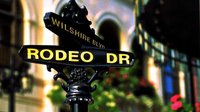
On Feb. 18, 1940, the house at 473 S. Camden Drive sold for $13,000 or $172,992.24 USD 2005.

May 25, 1941, a real estate sales report describes a nine-room Spanish home being sold at 309 S. Camden Drive.

June 10, 1941, a report described the sale of a two-story Colonial at 474 S. Camden Drive.

Jan. 31, 1943, the two-story Monterey home at 426 S. Camden sold for $11,500 ($130,353.54 USD 2005).

July 25, 1943, two-story Spanish home at 416 S. Camden sold for $15,000 ($170,026.35 USD 2005)

Aug. 21, 1949, two-story Colonial home, four bedrooms, two baths, den with a half-bath, breakfast room and servants quarters (ahem) at 446 S. Camden Drive. No price listed.

Mind you, even the inflation-adjusted prices are misleading. Anything with four walls and a roof in Beverly Hills goes for megabucks today. For example, the starter house at 344 S. Camden Drive is currently on the market for a little over $2 million.

What’s especially interesting in "Mogul" is that Wolfe's neighbors included “strictly name below the title folks” like Joe E. Brown. In 1940, Brown sold his house at 707 N. Walden for $35,000 ($465,748.34 USD 2005), a considerable sum for the era.
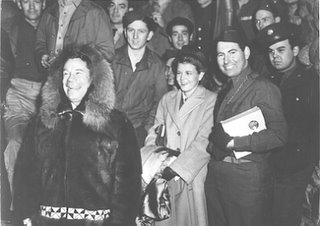
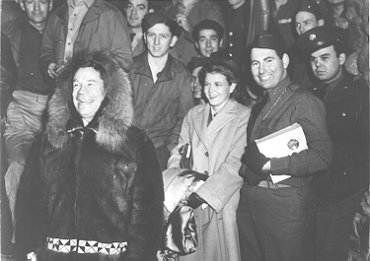
And if I were writing this story, I wouldn’t be so hard on Brown. A little research shows that he pretty much abandoned his movie and stage career after his son Don was killed on a training flight in 1942 and Brown, shown with servicemen in Alaska, devoted the following years to entertaining the troops in his son’s memory.

Now granted, I don’t read most books at the molecular level as I’m doing here. But most books don’t need to be read at the molecular level either. I warned you this would be tedious. But when Wolfe complains about his pitiful youth on "the lower depths of the south side" it's a bit much. Of all the Dahlia authors, I'd say Steve Hodel, whose mother went to jail for child neglect, has a genuine right to talk about a harsh childhood. But the wrong side of Beverly Hills? Oh really. It is difficult to generate much sympathy for someone who first saw “Gone With the Wind” in the living room of the producer’s home.

But wait…. there’s more

Page 6

After my parents divorced in 1943, my mother married Jeffrey Bernerd, a movie producer, and we moved north, across the tracks to the land of the majors, where we lived behind one of those mansion doors where “there’s often a great deal of unhappiness.”

The name Jeffrey Bernerd means nothing today, but imdb.com lists him as working on such cinematic triumphs as “Women in Bondage” (1943) and “Black Market Babies” (1945). Bernerd’s Aug. 11, 1950, obituary says that he lived—what’s this?—at 226 S. Camden Drive.

Time to go to the files and dig out the 1946 map of streetcar routes and see exactly where these horrid tracks were (again, not everybody has a 60-year-old streetcar map just sitting around waiting to be consulted, but as I think we’ve conclusively established, not everybody is me and certainly most people don’t read a book this way).

Ah! The map shows a Red Car headed west along Santa Monica Boulevard. Those poor people living in the ghetto south of Wilshire Boulevard—how did they ever make ends meet?

But let’s have a little more fun. We find with a little digging that Wolfe’s mother, Elizabeth, married Bernerd on April 2, 1945, at Bernerd’s home. We also learn that Wolfe’s father was Sailing Wolfe, a real estate salesman who was a nephew of Bernard Baruch. (Sailing Wolfe was apparently named for Baruch’s grandfather).

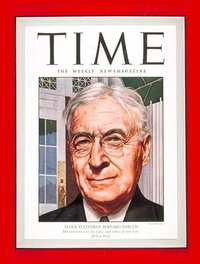
I’m blogging this as I read, so I have no idea what’s coming up. But I just flipped to the index to see if maybe we’re going to learn something about Sailing Wolfe or Bernard Baruch, left, in one of his three appearnces on the cover of Time magazine.

Not a word.

Hm. This is starting to look bad. I think if I were the grand-nephew of one of the world’s leading financiers I might just drop it in somewhere. Not make a big deal out of it but maybe I’d allude to it.

And about that impoverished childhood? We find that in 1941, Mrs. Sailing Wolfe was a member of Beverly Hills Assistance League (helping the less fortunate, presumably) and seemed to have had enough disposable income to collect Currier and Ives prints.

I have to go for a walk.


Labels: , , , , ,