Saturday, March 03, 2007

A Page From the Past


March 3, 1907
Los Angeles

Stroll into the Los Angeles Public Library on Central Avenue with me for a moment, over to the children’s section. The librarian says there are about 15,000 to 16,000 books, only half of what is needed, because about third of them are checked out every month.

The most popular titles are “Little Women,” “Little Men” and “Old-Fashioned Girl,” The Times says. Although the library has 25 copies of each book, it’s rare to find them on the shelves.

Among boys, Civil War stories are the most popular, “the Henty books, Barbour’s athletic tales, ‘Tom Sawyer’ and Dunn’s Young Kentuckian series of which there are a dozen copies each in stock,” The Times says.

“The children delight to search through the card catalogue and select their books,” The Times says. “It is interesting to watch the youngsters as they stand, pad and pencil in hand, and with a grownup air of importance, write down the names of the books they want.”

The story describes several young library patrons, but this is the one that stays with me:

“One of the constant patrons of the juvenile department is a tall, pale-faced lad who walks on crutches. A cruel accident so injured him that he is unable to attend school, but he has found an excellent substitute in the serious study of electricity at the library.

“He greedily devours everything he can lay his hands on about electricity. Day after day this delicate, white-faced boy pores over the books. He talks intelligently about induction coils, ohms, volts and motors.

“ ‘I intend to be an electric engineer,’ he declares as he limps away on his crutches. And the chances are that he will be.”

Lmharnisch.com
Lmharnisch.blogspot.com

E-mail: lmharnisch (AT) gmail.com

Labels: , , , , , ,

Sunday, January 21, 2007

If They Had Only Known

Jan. 21, 1907
Los Angeles

Mayor Arthur C. Harper addressed the crowd for a moment, reminiscing about a teacher who used to tell his pupils that someday, long after he was gone, people would get around Los Angeles in self-propelled vehicles.

And with that, Harper threw the switch, illuminating 10,000 electric lights at Morley’s Skating Ring on Grand between 9th and 10th Streets and beginning the insanity, formally unveiling the automobile in the first car show not only in Los Angeles, but on the West Coast.

More than 3,000 people poured through the exhibits in the first three hours of the show, which featured 97 gas-powered autos and two electric cars, as well as all manner of accessories such as odometers, speedometers, dashboard clocks and gas lamps. There was a personal appearance by Barney Oldfield with his famous “Green Dragon” racecar.

Not all of the exhibitors arrived in time for the opening night. The railroad car carrying the shipment of Pope-Toledos caught fire near Barstow and the Ford was delayed, although Henry Ford did attend the show, The Times says.

Great preparations had been made to display the vehicles: 9th and 10th Streets, as yet unpaved, were muddy from recent storms, but Grand was cleared of mud and a wooden causeway was built to the entrance. The Times notes that a canopy had been erected for people arriving in carriages.


The autos’ technical innovations were breathtaking: “At the space of the White garage a constant crowd looked over the Christman, a car built for the hardest kind of place, the desert,” The Times says. “The car is built for carrying passengers over no roads at all, for jumping off rocks and climbing over gullies and generally being abused.

“The Christman is a large, heavy, rugged-looking machine, with broad tread, large wheels and a body fitted with three seats, like an old-fashioned buckboard. Its frame is built like a railroad car, with truss rod underneath. In front is the motor, a Brennan double-opposed rated at 40 horsepower. This size is used in the car on exhibition, but the next ones turned out with have a 60 horsepower motor, capable of taking them anywhere.

“A peculiar system of individual clutch transmission is used, which has been changed a little since the first car was made. Formerly the car had no reverse and when Christman wanted to turn the machine around in the narrow streets of Goldfield he rushed at the curb, hit and bounced back and then continued the operation until he had bounced himself around.

“This operation seemed to have no deleterious effect on the car, but it was thought better to have a reverse as the method was rather strenuous on the passengers.”

There were many questions and after a few days, salesmen became exhausted from explaining why a car engine needs pistons and why a manufacturer can’t leave off the differential to save weight. The show was extended because of its popularity, and was forced to close in part because most of the exhibition cars had been sold.

If anyone asked about mass transit, pollution or traffic, the comments were not recorded. No, the first thing people did when they got hold of their cars was to see how fast they could go.

Lmharnisch.com
Lmharnisch.blogspot.com

E-mail: lmharnisch (AT) gmail.com

Labels: , , , , , ,

Friday, October 20, 2006

The Imp


Oct. 20, 1907
Los Angeles

Windsor McCay and his cartoons never completely go out of fashion and are periodically rediscovered—as in the current Taschen anthology. He was a fabulous artist and his Sunday panels remain a marvel of fantasy and rebellion against the tyranny of pigeonhole boxes. Living as we do in the era of legacy comics (Charles Schulz has been dead since 2000); bland, humorless writing; weak drawing; and panels shrunk to the size of postage stamps, it’s easy to think that comics aficionados 100 years ago were fortunate to get strips that ran a full page.

And then there’s Imp.

Imp is a caricature; McCay’s notion of an African cannibal who speaks in nonsense words that the other characters interpret, and he runs through much of “Little Nemo in Slumberland.” Whenever McCay’s strips are discussed, there’s usually some sort of passing reference to “unfortunate racial stereotypes” and something about “not uncommon for the period.” Those statements, although true (and the pages of The Times in this era are full of ethnic caricatures), gloss over material like Imp and turn it into nothing more than a slightly guilty pleasure.

So what to do? Frankly, no matter how much I know about the period and the cultural values of the era, Imp always makes me quite uncomfortable, especially in light of a post earlier this year about Elijah Washington being killed because he fought back after being called one of the most problematic slang terms in the English language. But one thing history is not about is sanitizing the past or ignoring uncomfortable issues. So here is Imp in all his finely drawn glory. And check out those lions.


Lmharnisch.com
Lmharnisch.blogspot.com

Labels: , , , , , ,

Monday, September 11, 2006

The Fall Collection


Sept. 11, 1907
Direct Wire From New York

Wow! Now this is the kind of quote one simply doesn’t see every day, at least in the 21st century. The Victorians certainly had a different attitude toward women’s physiques:

“The woman who gets the proper sort of corset will have the fashionable figure, even if she weighs a ton.”

The source of that sentiment, Elizabeth A.C. White, is president of the Dressmakers’ Protective Association of America and although The Times notes that she weighs 220 pounds, says “she is not fleshy.” The reason, White says: “It’s all in the corset.”

What will the well-dressed woman wear this fall?

“A demi-tailored skirt of gray, reddish purple, lavender or light blue, with black coat and waist, not embroidered, to match the skirt. Her hat will be of a mild mushroom type, trimmed with morning glories, orchids and roses.”

And ladies, please note: Hips are out. Straight-line figures are in.

What became of the 220-pound Elizabeth A.C. White? Alas, her fate is unrecorded.

Lmharnisch.com
Lmharnisch.blogspot.com

Labels: , , , , ,

Wednesday, July 19, 2006

Vegans Avert Your Eyes

July 19, 1907
Covina

Lavish preparations are underway for an enormous, free picnic to celebrate the opening of a Pacific Electric streetcar line to Los Angeles. “Covina had long awaited the approach of those shining iron bands that connect the pretty little valley town with the metropolis of the West, and is very happy,” The Times said.

E.H. Fabrick has created a gigantic coffeepot for the occasion, holding 250 gallons. “A large man looks like a pigmy beside this immense urn, fashioned for a race of giants,” The Times said. It’s accompanied by an equally enormous, 300-gallon bean pot patterned after an original (presumably normal size) pot in a Boston museum.


A 45-foot trench has been dug to barbecue 10 steers and a dozen sheep and pigs and a quarter-mile of picnic tables has been constructed. Events for the grand celebration include sack races, climbing a greased pole, catching a shaved pig and band concerts.

As a special treat, Ellen Beach Yaw, “The California Nightingale,” will give a vocal recital.

Bonus factoid: Ellen Beach Yaw, who founded the Lark Ellen Home for Boys, died in Covina on Sept. 9, 1947.

Lmharnisch.com


Lmharnisch.blogspot.com

Labels: , , , , , , ,

Tuesday, July 04, 2006

Can This Be the Fourth of July?


July 4, 1907
Los Angeles

And how does Los Angeles celebrate Independence Day? With cricket matches and bagpipe contests.


“The Times said: Oratory and music are to replace firewater and fireworks in this year’s celebration of Independence Day. The official program as arranged by the local celebration committee was announced last night.

“Chairman Humphreys says it is arranged so as to present a treat for lovers of music; it consists chiefly of band concerts in different parks and playgrounds, with some speaking, but no fireworks.”

Apparently, there was quite a cricket match between Los Angeles and Santa Monica, as The Times said: “Then came the greatest partnership Southern California has witnessed in first-class cricket for many a long day.”

A sample of The Times’ cricket reportage: “Nash now came in, but only to see Sommerville’s off stump knocked clean out of the ground by Hunt, the ball coming back fast. The score sheet at this time showed 4 overs, no runs, 2 wickets and 4 maidens. The rot was temporarily stopped by Nash and Morris, the former hitting Hunt to square leg for 3 and the latter sent Mather to long leg for 4. In the ninth over, Nash, in hitting out to a straight one from Hunt, misjudged the pace and was bowled.”

There were a few informal fireworks displays: Ah Sing was arrested for setting off firecrackers as he walked along Broadway. He told police he didn’t understand officers’ warnings to stop. Five more men were arrested for setting off firecrackers on Main Street, three of whom were celebrating after midnight.

And there you have it: an old-fashioned Fourth of July.

Lmharnisch.com


Lmharnisch.blogspot.com

Labels: , , , , , , ,

Sunday, June 18, 2006

Who Poisoned Baby?


June 18, 1907
Los Angeles

The victim: A collie named Baby

The plaintiff: Hazel G. (or Ella M.) Schurger, 1156 S. Flower.

The suspect: J.J. Brady of the Immigration Bureau, a next-door neighbor.

Baby’s agonizing death scandalized residents of the fashionable homes around 12th Street and South Flower, because everyone—except for J.J. Brady—loved the dog.

In May, Schurger found Baby in convulsions on the front lawn. Analysis determined that it was given strychnine. She suspected Brady because he had threatened the dog and thrown rocks at it. Schurger said that shortly before the death, she saw Brady throw some meat to Baby over the back fence. Schurger said: “I will not let the man who killed my pet go free if I can help it.”

Brady said: “I had a grudge against the dog because she barked at me, but I didn’t poison her.”

Brady was freed after a chemist testified that Baby had been given strychnine, but in such a small dose that it would have taken hours for the dog to die, not immediately, as Schurger said.

Lmharnisch.com


Lmharnisch.blogspot.com


Labels: , , , , , ,

Friday, June 16, 2006

Her Own Client

June 16, 1907
Los Angeles

Despite the old saying—a lawyer who represents himself has a fool for a client—Edith Foulkes is a smart woman, at least in the courtroom. She can’t make the same claim about her trip to the altar, however, which is what brings before Judge Bordwell.

Although she had known her husband, Ralph, for eight years, they were only engaged for a week before they got married in 1905. His family was coming to visit and he wanted to be married when they arrived, he said.

A member of the California bar who had practiced law in San Francisco and Tulare County, Edith had previously worked as a proofreader in Los Angeles and presumably that’s how she met Ralph, who had been the foreman of a printing shop on Los Angeles Street.

Edith had spent a fair amount of time in Mexico and Porterville, Calif., so most of what she knew about Ralph was by correspondence. If she had spent more time with him, she might have known that he had a tendency to steal and pawn whatever he got his hands on. And he drank all the time.

In fact, once he lost his job, Ralph drank constantly, Edith and a pressman from the print shop told the judge. The rest of the time, he was in a bad mood, they said.

“Suspecting that his wife was beginning to consider her marriage a failure, he had talked in melancholy fashion of murder and suicide, somewhat to the martial discomfort of Mrs. Foulkes,” The Times said.

The judge ruled in her favor.

Lmharnisch.com


Lmharnisch.blogspot.com


Labels: , , , , , ,

Monday, May 08, 2006

Kissing, the Old-Fashioned Way

Friday, April 07, 2006

Blogging the Wolfe Book, Request Line V


Large ImageI have ceased blogging in real time as I read Donald H. Wolfe’s “The Black Dahlia Files: The Mob, the Mogul and the Murder That Transfixed Los Angeles.” Wolfe is using the “Laura” format, in which the anonymous, butchered body is found and the narrative proceeds in flashbacks.

Now I’m taking a few requests before I wrap it up. Yesterday, we looked at Pages 121-122, today, we’ll examine Page 131 at the request of Mary Pacios.

Recall that yesterday we found some particularly nasty, scheming misuse of the district attorney’s material on Ann Toth, one of Elizabeth Short’s roommates. Wolfe actually skipped several pages with the note “Finis quickly changes the subject” and altered a name in the material to make it appear as if Toth were referring to Maurice Clement when she was referring to another man.

Not trivial errors, folks. This is a scheming, calculating, cynical lie intended to prop up a fictitious premise.

Let’s see what Wolfe has in store for us today:

Hm. Wolfe is talking about Maurice Clement. Let’s back up a bit to Page 130.

Witnesses said Elizabeth Short frequented Brittingham’s Restaurant. That’s true. Wolfe says it was around the corner from Columbia Studios. That’s also true. Brittingham’s was next to KNX in Columbia Square but is now closed.

Wolfe quotes George Bacos, and says he was an usher at CBS, also true. But then he quotes Nina Blanchard, a name I don’t recognize.

To the end notes, Watson!

But my dear Holmes, there’s no attribution!

Not a word, Watson. Now where do we get this Blanchard woman?

Well that’s a mystery and a half:


Large Image“George Bacos, an usher at CBS across the street, stated to police that he had often seen her there, as had Nina Blanchard, who later became a famous modeling agency executive. At that time, Nina Blanchard was a waitress at Brittingham’s, where many of the Columbia Studio executives and employees socialized. According to Blanchard, Elizabeth used to frequent Brittingham’s and was also seen with studio executive Max Arnow, who was in charge of the Talent Department.”

OK, let’s do what any decent researcher would do and check Blanchard’s clips.

Blanchard indeed ran a modeling agency. In 1967, Brenda Lee Meinsenheimer, one of her models, died in a bizarre accident while filming a Pontiac commercial. Meinsenheimer was driving toward a camera truck, which was coming the other way. The camera boom was supposed to rise, but didn’t and she crashed into it. Raffael John Esposito, the camera operator, also died.

Hm. In 1965 Blanchard lived at 2045 Stanley Hills Place.

Hm. Looks like Blanchard was working as a model in 1965. Let’s do some math. If she was working as a waitress at Brittingham’s in 1946, let’s say she was 18. That would make her born in 1928. If she were modeling in 1965, that would make her 36. A bit old for the modeling game, I’d say. But wait. Hollywood High School’s alumni page says she graduated in 1946.

Hm. 1960. Teenage fashion show, Nina Blanchard provides the commentary.

With Jan and Dean? Oohh.

Hm. Junior League’s annual fashion tea, 1961.

1985, she pronounces Don Johnson sexy with or without “Miami Vice” stubble.

Sold modeling agency to Ford in 1995. Founded in 1961. Apparently still alive. That’s quite interesting. Wolfe usually relies on conveniently dead people. And this is the only reference in the book to Nina Blanchard.

Hm. Arnow was at Warners, then Columbia, died 1984. Nothing but a paid obituary in The Times.

Well, as far as I can tell, there was a Nina Blanchard, although it’s unclear she was a Brittingham’s waitress, let alone whether she saw Elizabeth Short. And there was a Max Arnow. So far, Wolfe is way ahead of John Gilmore’s “Severed,” which relies heavily on nonexistent people. But neither Blanchard nor Arnow appear in the district attorney’s files and since Wolfe gives no attribution for this little nugget I’m at a loss as to where he got it.


Large ImagePage 131

Hm. In discussing Toth, Wolfe says:

“In her testimony to the district attorney investigators, Toth had estimated that it was at least two weeks before she left the city—sometime in November—that she had dropped off Elizabeth near the Biltmore, where Toth believed she was meeting Maurice. And Toth thought it may have been Maurice who had driven her to a doctor’s office on Hollywood Boulevard shortly before Elizabeth suddenly left for San Diego.”

OK, well there’s a couple things wrong here.

First, Toth didn’t say that Maurice took Elizabeth Short to the doctor, it was a fellow named Otero, as we saw yesterday. Wolfe is faking the evidence to say it was Maurice.

Here’s Wolfe’s excerpt:

Toth: Mark
[Hansen] might have driven her down. She was going to one on Hollywood Boulevard. I think maybe the teacher [Maurice] brought her down there once. It seems to me she said she was going to meet him one Sunday afternoon. But of course, he wouldn’t be in his office on a Sunday afternoon.

Not Maurice Clement, but Mr. Otero.

Oops.

Second, Elizabeth Short didn’t suddenly leave for San Diego. Her departure from Los Angeles was well known and she spoke of it frequently. The only wrinkle, and it’s a major one, is that she claimed all along she was going to spend Christmas with her sister Virginia in Berkeley and went to San Diego instead. But the departure wasn’t sudden.

And finally and most important, let’s see what Toth told the district attorney’s investigators about taking Elizabeth Short to the Biltmore.

Here’s the actual quote from Page 12 of the second interview, with Finis Brown. Notice that Toth says “schoolteacher,” meaning Otero, who taught high school Spanish.

Brown:
You drove her downtown in Los Angeles there near the Biltmore hotel on one occasion didn’t you? Near there?

Toth:
Yes

Brown:
About how long was that before she left for San Diego do you have any idea?

Toth:
About two weeks.

Brown:
Didn’t she give you any reason whatsoever to be to ask to be taken down there to the Biltmore Hotel? Didn’t she tell you who she was going to meet?

Toth:
I thought she was supposed to meet the schoolteacher there. She might not have been telling me the truth either, you see. It didn’t mean a thing, later I would up getting her a place over here anyway because she was without means of any kind.

Brown:
Did you ever take her down to the Biltmore Hotel more than once?

Toth:
No

By the way, there is no attribution for Page 131 whatsoever. Poor work, folks.

Regular Anonymous Commenter asks me to add Page 162. Consider it done.

Time for my walk.

Shout out to:

Boca Raton, Fla. (69.172.135.25)

Linux user (4.252.208.188)

Aol user (207.200.116.65) 14 hours!

Brea, Calif. (68.234.184.255) 6 hours!

Hurry back!

Labels: , , , , , , , , , , ,

Wednesday, March 29, 2006

Blogging the Wolfe Book, The Lady in Red


Large ImageI’m blogging in real time as I read Donald H. Wolfe’s “The Black Dahlia Files: The Mob, the Mogul and the Murder That Transfixed Los Angeles.” Wolfe is using the “Laura” format, in which the anonymous, butchered body is discovered and the narrative proceeds in flashbacks. We’re at the point in the story when police are questioning Robert M. “Red” Manley, the last person known to have been seen with Elizabeth Short.

I took a holiday from the Dahlia last night to attend a lecture at the Huntington Library, Art Collections and Botanical Gardens by Elliott Gorn on John Dillinger. Given the pouring rain, it was a fairly small crowd, but we were rewarded with an interesting portrait of the famous Depression-era bank robber. Gorn’s lecture was quite a change of pace from the Huntington’s usual fare, especially the long discourse on the myths about what precisely is (and is not) in the Dillinger archives at the Smithsonian.

For those who are interested, here’s a lo-fi version of Gorn’s presentation.


Large ImagePage 81-82

Wolfe is in the middle of lifting Aggie Underwood’s jailhouse interview with Red. Recall that Wolfe offered a snippet from the material in the district attorney’s files, merging a quote from Page 3 with a quote from Page 6 without warning.

Oh, that confusing California geography.

“The Greyhound bus station was on Sixth and Los Angeles Street—just four blocks from the stately Biltmore, a fashionable luxury hotel on Olive between Fifth and Sixth Streets that had been built in 1929 by Harry Chandler and a group of wealthy Los Angeles businessmen.”

Here’s the Google map
(note that Google takes account of the one-way streets in planning the route).

Now maybe it’s the aging process, but I don’t recall hearing anything about Harry Chandler when I took the L.A. Conservancy’s tour of the Biltmore. (A fine tour it is, and I highly recommend it. I’m a member of the L.A. Conservancy and a big fan of its “Last Remaining Seats” movie series).


Large ImageThe end notes, Holmes?

Lead on, Watson.

But my dear Holmes!

Yes, yes, Watson, I know. No attribution.

Just for fun let’s see if Harry Chandler had anything to do with the Biltmore.

Of course, Wolfe is entirely wrong in saying that the Biltmore opened in 1929. It actually opened in 1923 (Los Angeles Times, Sept. 23, 1923). Even the simplest of facts seem to be very slippery things for Wolfe. Remind me again how well-researched this book is, will you?

Now what about the Harry Chandler connection? I mean I really don’t want to get derailed into the complicated financing behind construction of the Biltmore. Ah. Apparently Harry Chandler was among a raft of people involved in the Biltmore.


Next, another straight lift from the Underwood interview.

Hm. What’s this?

“As Manley walked toward the Olive Street door, he glanced back to wave at Elizabeth, but she had already turned and was talking to the clerk at the tobacco stand and getting telephone change. She was still standing there when Robert ‘Red’ Manley exited the hotel at approximately 6:30 p.
m. on Wednesday, January 9, 1947.”

Now isn’t that just too, too interesting. Red turned to wave but she was getting “telephone change.” That, presumably, would be change for the pay phone. I’ve never read a word about Red turning to wave and I’ve been through the original material fairly closely. It’s certainly not in Underwood’s jailhouse interview with Red, nor in any other original source. So where does Wolfe get it?

My dear Holmes! Why, there’s no attribution whatsoever!
Large Image
It appears, Watson, that our friend Mr. Wolfe has an extremely active imagination.

Let’s compare:


Page 82


“ ‘That is the last time I ever saw Miss Short,’ Manley told Aggie Underwood. ‘I’ll take truth serum or anything they want to give me. And I’ll swear on a stack of Bibles, and tell my minister, too—that was the last time I saw Beth Short. I did not kill her!’”


Herald-Express, Jan. 20, 1947

“That is the last time I ever saw Betty Short. I’ll take the truth serum or anything they want to give me. And I’ll swear on a stack of Bibles and tell my minister too that was the last time I ever saw Betty Short. I did not kill her.
“But brother I’ll never cheat on my wife again!”

Note that Wolfe drops the important last line of the interview and note the discrepancy between “Miss Short” and “Betty Short”; and “Beth Short” and “Betty Short.” Now whom do we know who refers to Elizabeth Short as Beth?

Hm. Wolfe attributes this to the Herald interview. Let’s check John Gilmore’s “Severed,” which is unique in referring to Elizabeth Short as Beth.

Well isn’t this just too interesting:
Large Image


“Severed,” Page 117

“She [Elizabeth Short] was just looking at him—smiling at him. Her eyes looked very clear and blue and they seemed to be shining. He [Red Manley] said, ‘Well…all right,’ and told her she could send him a letter at the business address and let him know where she was going to be. She said she would do that and he turned around and headed for the Olive Street door. He glanced back to wave to her, but she was talking to the cashier at the cigar stand. She handed him a dollar and he returned some change. She was still standing there when Red left the hotel.”

It is a continuing mystery how Gilmore can call this book “crap” when so much of it is based on his own work. Of course he also called it a “destined to become true crime classic.” I guess he’s got all the bases covered that way.


Large ImageHm. “Severed” isn’t indexed and I can’t find Underwood’s jailhouse interview with Red. I don’t want to spend more time poking through the nonsense in “Severed,” so let’s press on. I want to finish this chapter today. Maybe the “Miss Short” and “Beth” thing is simply Wolfe’s error. Lord knows they wouldn’t be his first.

“Biltmore Hotel employees recalled noticing Elizabeth Short in the lobby and the ladies room attendant remembered seeing her at the ladies’ room mirror, where she had lit a paraffin candle and applied the melted paraffin to her teeth.”

This has to be pure Wolfe. Nobody else is quite so wordy (“a ladies room attendant remembered seeing her at the ladies’ room mirror”? “she had lit a paraffin candle and applied the melted paraffin”? Cal Morgan, Anna Bliss or some other editor at ReganBooks was taking a nap to let that get through).

As I recall, there was speculation that Elizabeth Short might have put wax on her teeth in a Biltmore restroom, but nobody saw her do it.


Large Image“Bellboy Captain Harold Studholme told the police that he saw her make several telephone calls and wait in a chair near the Bell Station for some time before crossing the lobby and walking out of the Olive Street door at about 10:00 p.m.—approximately three-and-a-half hours after her arrival. The doorman remembered greeting her as she exited the hotel and walked toward Sixth Street before vanishing into the night.”

Now this is what’s actually in the district attorney’s files, from the LAPD summary of the case:

“She was observed alone by employees of the Biltmore until approximately 10 p.m. Jan. 9. Mr. Studholme of the Biltmore Hotel stated that he observed the girl get up from the lobby as if she had been signaled by someone on the outside and walk out of the Olive Street entrance. He last saw her walking south toward 6th Street on Olive, on the west side of the street. Investigators were unable to determine whether she made a phone call while there or not, but witnesses state they observed her on several occasions go toward the telephone booths.”


Large ImageAnd there’s nothing in the district attorney’s files about the fictitious noble doorman tipping his hat as Elizabeth Short went out into the night. In fact, the noble doorman was concocted by Jack Webb in “The Badge” as a way to write the Black Dahlia out of the picture.

Time for my walk.

Shout out to:

Nebraska State College Board (198.133.245.253)

Tennessee Board of Regents (198.146.213.139)

Rutgers University (204.52.215.12)

University of Windsor (137.207.132.38)

France (193.47.80.87) What’s this? Using Linux and a browser called Konqueror 3.4?? Tiens!

Labels: , , , , , ,

Friday, March 24, 2006

Fashion Week

Clarence Westfall, 22 years old, was taken into custody at San Pedro yesterday afternoon when a boat from San Diego docked. He was arrested for having masqueraded in female attire and was taken to the Central Police Station, where he told a story that nearly resulted in his being liberated. When the police received the report from the station at San Pedro, however, that Westfall, in posing as a woman, had endeavored to be assigned to a woman’s stateroom, he was locked up.

He said he was frequently obsessed with the desire to don women’s clothing, do fancy work and generally “act like a girl.” He had about convinced the detectives that he was a fit subject for alienists to examine when he was recognized as a former prisoner. He was locked up on a charge of vagrancy.

Dec. 4, 1911

A random discovery too good not to share.

Lmharnisch.com


Lmharnisch.blogspot.com

Labels: , , , , , ,

Saturday, February 11, 2006

Blogging the Wolfe Book, the Riddler


Pages 12-15

Here's a riddle: Let’s suppose for a moment that you are writing a historical piece; nothing terribly esoteric for a scholarly journal but something for the average reader. You have a choice between a schlocky, sensational paperback and original documents that few people are allowed to see.

Wrong.

If you’re Donald H. Wolfe, you’d forget the LAPD summary in the district attorney’s files and pick the schlocky, sensational paperback, “Severed.”

“Mogul,” Page 12; “Severed,” Page 9

“By the time Hansen and Brown reached the new location, reporters from L.A.’s newspapers had converged on the area, littering the street and sidewalk with cigarette butts and blackened flashbulbs from cameras. Several more police and onlookers had found their way to the site—some were driving around the block while others parked and stood on the roofs of their cars for a better view.”

Let’s have fun with this. Here’s a better picture of Aggie Underwood at the crime scene. Note 1) that she is standing in the street. Note 2) the police officer next to her also isn’t permitted to get any closer to the body and 3) notice that the news photographer has to stand on the roof of a car because he isn’t allowed any closer to the body. Also note that nobody is tromping through the crime scene. The books that insist the crime scene was violated are lying.

We turn to Wolfe’s bibliography to check his sources and Ach! Mein Gott this is worse than I thought! Wolfe reproduces the first two pages of the police summary (“Mogul,” Page 325-326) and totally ignores it. In-cred-i-ble.

As clearly stated in the LAPD summary as reproduced on “Mogul,” Page 325, police officers present at the crime scene included, along with responding Officers Perkins and Fitzgerald: “Sgts. Wynn, Vaughn, Forensic Chemist Ray Pinker, photographer Laursen from Sci. Investigation Division, and representatives and photographers from the newspapers. Pictures had been taken by the newspapers of the body. They were later joined by Lt. Leland V. Jones of the Scientific Investigation Division.”

Do any of these people appear in Wolfe’s treatment of the crime scene? Except for Pinker, no. For an alleged history, this is extremely poor work. It’s one thing not to have access to material and quite another to be granted access and ignore it.

Instead Wolfe recycles “Severed’s” treatment of the crime scene, with Hansen bellowing at Pinker in the best Moe Howard fashion “Get over here!” (Cue SFX: bop, slap, bonk!). I almost expect Gilmore to have Hansen say: “Spread out!

More important, the contention in “Severed” and all the books that follow is an insult to the men who worked the Black Dahlia case. This was not a case of dozens of police officers tromping through the grass, as portrayed in either “Who Is the Black Dahlia?” or more likely “True Confessions” (sorry, I know it’s in a film, but I forget which one).

For the record, there isn’t a single crime scene photo showing anyone in the grass and weeds to the west of the body except for the two lead investigators, Harry Hansen and Finis Brown, and they don’t approach the body until they have been cleared by Gilbert Laursen, the gent in the sweater seen in so many gruesome pictures on the Internet.

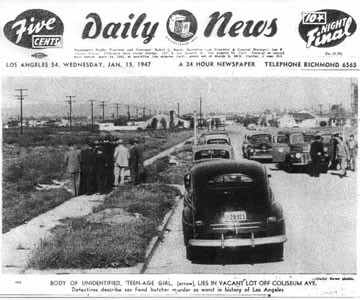
Take a look at the picture above: Nobody is standing in the grass but keeping carefully on the sidewalk. People aren't circling the block to get a better view. There's nobody standing on a car except the photographer who took this picture, and that was because he couldn't get any closer. Bonus fact: This picture is from a website that doesn't reveal its extreme manipulation of photos. This image has spread and is now deemed an authentic picture of the Daily News front page. In fact, the real Daily News front page had a large white arrow painted on the picture to indicate the body.

If you’ll notice in the pictures, Ray Pinker—one of the leading forensic chemists of his day—has his hands either in his pockets or otherwise secured so he won’t touch anything. These investigators were the elite of their era. Any statement other than that is simply not supported by the facts.

This is why I keep saying "Severed" is 25% mistakes and 50% fiction.

(And let’s backtrack for a moment to “Mogul,” Page 11. Wolfe puts the Hollywood Citizen-News at the crime scene, but that’s not so easily established. The Citizen-News’ Page 1 story reads like a rewrite of the Herald but makes a significant error, wrongly stating that Elizabeth Short’s right leg was broken, virtually ensuring that the writer didn’t see the body. This error gets picked up in a few minor treatments of the Dahlia case, but luckily hasn’t assumed the status of an Internet virus).

"Watson, you see, but you do not observe."--"A Scandal in Bohemia"


Labels: , , , , , , ,

Friday, February 10, 2006

Blogging the Wolfe Book, a Moment of Silence, Please


Today is the anniversary of the Feb. 10, 1947, Jeanne French murder. Frequently linked to the Black Dahlia in the popular imagination and absurdly claimed as one of the umpteen victims of Dr. George “Evil Genius” Hodel in “Black Dahlia Avenger,” French was a tragic, broken-down alcoholic. Spending the last night of her life in a Westside cafe, she dumped the contents of her purse on the bar and picked through the debris in hopes of finding enough money for just one more drink. She had no paper money, nothing more than a few coins. Whoever killed her beat her with the handle of a socket wrench, pushed her out of his car into the street and stomped on her until a rib broke and punctured her heart. A bleak, terrible death.

Her son, David Wrather, told the coroner’s inquest: “She’s gone now and I’m sure she would want me to say the right thing—she made a lot of her own trouble.”

Incidentally, I’m not the only one faulting “Mogul.” Carolyn See’s Washington Post review calls the book: “Old-fashioned porn for those who look at a pretty girl and think of a chain saw.”

Pages 9-11

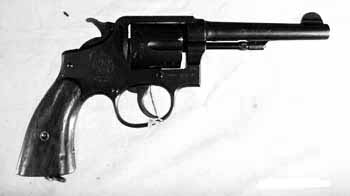
Now it’s time for Will Fowler’s well-worn story about being the first person at the crime scene, Felix Paegel taking a picture of him with the body (“all aloonnnnnee” “nooooobody around”), the cops showing up and pulling their guns (below a Smith & Wesson .38 Victory Model), Will distracting the police with the boy on the bicycle, heading back to the Examiner to put out an extra and then returning to the crime scene to “throw off the competition.”

I fell for this story, even though Will couldn’t produce the picture of himself with the body—and it turns out nobody has ever seen it. He always claimed "somebody swiped during a drinking party or I gave it away or something."

But like most of Will’s yarns (closing Elizabeth Short's eyes, loading the body into the hearse, walking through the crime scene so he could fire off the quip: “You know how much these suicides upset me” and the infantile genatalia) it’s simply not true. Will wasn’t the first person at the crime scene and the Examiner never put out an extra. Of the dozens of crime scene photos, not a single one shows him or any reporter anywhere except the sidewalk or the street.

Wolfe lifts Will’s explanation of a 390W, right down to the erroneous meaning of a 415. Will calls it indecent exposure, but any fan of Jack Webb knows it’s disturbing the peace (“The Badge,” Page 305). Will made sure anyone who interviewed him knew it was a 390W as an attempt to get that detail in a story. He once asked me: “Isn’t it amazing that I remember the radio call after all these years?” He fooled me with some of his tall tales, but even I recognized that as an obvious plant.

“Mogul” takes Will’s story pretty much verbatim from “Reporters,” but even here mangles some of the quotes:

“Reporters,” Page 72: “Jesus, Felix, this woman’s cut in half!”

“Mogul,” Page 9: “God, Felix, this woman’s been cut in half!”

And “Mogul’s” facts are wrong too, referring to Officer William Fitzgerald instead of Wayne Fitzgerald, but this is to be expected since Wolfe is referring to “Severed,” Page 3. (If I didn’t mention it, although I’m fairly sure I did, “Severed” is 25% mistakes and 50% fiction).

Good grief! Wolfe can’t even quote from “Severed” without making an error.

Actual name: Wayne Fitzgerald

“Severed”: Will Fitzgerald

“Mogul”: William Fitzgerald

Yet another lesson in why any good writer should do his own research. And avoid secondary sources.

More important, Wolfe ignores Will’s time line.

In “Reporters,” Page 71, Will puts himself at the crime scene at 9:05 a.m., nearly 90 minutes before Betty Bersinger discovered the body, according to Elizabeth Short’s inquest.

Uh-oh.

Instead, “Mogul” rolls the clock ahead to place Will at the crime scene at 10:45 a.m. This is still a neat trick, because according to the inquest, police didn’t get the original call reporting the body until a little before 11 a.m.

What's this? My eyes just fell on Page 11, in which Wolfe calls it a 309W. (Did I mention this is a $30 book? Where are ReganBook’s proofreaders?)
And I have to come to the defense of Aggie Underwood. Wolfe picks up Will’s story about her kneeling over the body when Will made his second trip to Norton Avenue. In reality, Underwood had been to the crime scene and was long gone by the time Will got there, as shown in pictures taken by the police and news photographers.

Worse yet, Wolfe picks up “Severed’s” claim that “You could see the color drain right out of her like you’d opened a spigot on her bottom side.” Although Aggie had seen many murder victims in her career, the sight of the mutilated body lying in the weeds near the sidewalk knocked her off balance, and [Officer] Perkins remembered that she “staggered backwards, almost right off the edge of the curb—and almost fell down on her keester.”

Can Wolfe quote “Severed” correctly? Of course not.

“Severed” Page 6

“It sort of tickled us standing there,” he says, “and watching her back up—walking backwards almost right off the edge of the curb—almost down on her keester.”

Luckily, we have Underwood’s own account of the Black Dahlia, in her 1949 biography “Newspaperwoman,” written with Foster Goss.

“Newspaperwoman” Page 6.

“One of the four radio patrolmen, who had arrived ahead of homicide detectives, tried to stop me. I said I was from the Herald-Express and brushed past him. I’ve learned that to halt for explanations brings arguments and wastes time.

“In a vacant lot amid sparse weeds a couple of feet from the sidewalk lay the body. It had been cut in half through the abdomen, under the ribs. The two sections were ten or twelve inches apart. The arms, bent at right angles at the elbows, were raised above the shoulders. The legs were spread apart. There were bruises and cuts on the forehead and the face, which had been beaten severely. The hair was blood-matted [note: this is wrong, lrh]. Front teeth were missing [also wrong]. Both cheeks were slashed from the corners of the lips almost to the ears. The liver hung out of the torso, and the entire lower section of the body had been hacked, gouged and unprintably desecrated. It showed sadism at its most frenzied.

“Some of the police argued that she was a woman of thirty-six. Noting the youthful condition of the breasts and the smooth thighs, I said she was much younger.”

Not exactly the account of someone who nearly fell on her keister (note proper spelling).

For the record, here’s a shot (swiped off the Internet) of Aggie Underwood at the crime scene. I have a better version but you don’t need to see it. Nobody does. But note that she’s standing out in the street, well away from the body. The police protected the scene much better than crime authors would have you believe.

Will did get one thing right about the Dahlia case, however. He dispensed with the books in one word: "Lies!"

Labels: , , , , , , ,

Wednesday, February 08, 2006

A "C" From the Health Inspector

Page 8

In those days Leimert Park was a nice, middle-class neighborhood on the fringe of the more fashionable Adams District west of downtown Los Angeles.

Here, in a few words, “Mogul” demonstrates its lack of familiarity with two historic Los Angeles areas that are nearly three miles apart, a definition of “West Adams adjacent” that even the lowest real estate agent would find excessive. Wolfe’s psychological map of Los Angeles (an exercise wonderfully described in “Shotgun Freeway”) is a little distorted. (Here’s a clip of the movie).

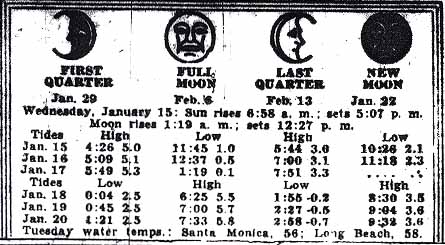
Sunrise was at 6:53 a.m. on Wednesday, January 15, 1947.

Incredibly, even this simply verified fact is wrong. Does this matter by itself? Not unless your faith dictates that you make a religious observation at a particular time. Does it become worrisome when added to all the other errors? Absolutely. More important, if a researcher can’t get simple things correct, how can he be trusted with far more complicated material still to come?

What “Mogul” is setting up in all of this is the discovery of the body, which I assume (remember I’m blogging in real time and not reading ahead) will be followed by the rest of the story told in flashbacks.

This is the standard “Laura” treatment of the Black Dahlia murder, following the structure of the Vera Caspary novel made into the 1944 movie with Gene Tierney, Dana Andrews and Clifton Webb. As Caspary discovered, this is a wonderful structure for a novel—which is quite good and I recommend it—a classic film noir, a crummy play and above-average radio play that aired on the Lux Radio Theatre several times.

Flashbacks are the standard structure used in “Severed,” John Gregory Dunne’s “True Confessions” and James Ellroy’s “The Black Dahlia.” Even Robert Lenski used it in the Lucie Arnaz TV movie “Who Is the Black Dahlia?” Of course the problem is that although this is fine for fiction, it’s terrible for history because the investigation wasn’t linear or chronological. So we’ll see how Wolfe handles this.

At about 10:30 a.m. a Leimert Park resident, Betsy Bersinger….

Uh-oh. This is bad. Really, really bad work. In our mythical restaurant inspection, this would be like the health department discovering roaches in the guacamole. The woman who found the body (a very gracious lady whom I interviewed) is named Betty, not Betsy. This is like writing a history of World War II and referring to Arnold Hitler.

The literary health inspector has just slapped a C on “Mogul.” One more slip and I’m closing you down.

Labels: , , , , , , , , , , ,

Tuesday, February 07, 2006

Blogging the Wolfe Book, the Boy on the Bicycle

Page 7

What’s this? Another day on Page 7? Theological scholars don’t scrutinize the Bible this carefully and this is a book you could read in a few hours waiting for a plane at LAX. Don’t give up, we’re closing in on Page 8. I warned you from the beginning that this would be tedious. But you asked why I don’t read Black Dahlia books. This is why. It’s painful.

In the small hours after midnight, Bobby Jones, a young man in his early teens, wheeled his bicycle through a vacant lot near Thirty-Ninth Street and Norton Avenue in Leimert Park.

This is the elusive story about the Boy on the Bicycle at the crime scene. It’s one of Will Fowler’s yarns and the original version goes like this: Will was at the crime scene with photographer Felix Paegel (Will usually threw in lots of distracting details about what kind of flashbulbs Paegel used to divert attention from the fact that Will didn’t have a copy of the picture Paegel supposedly took of him with the body. “And nooooooobody around,” Will always said. “All alooonnnnne.”

In his often-told tale, the cops showed up, pulled their guns and Will explained who he was, suggesting they go talk to the Boy on the Bicycle who was standing nearby.

My first hint that anything was wrong with this was when I told Will I’d found one of the first two police officers at the scene and was going to interview him (which I did). Will became extremely uncomfortable and said something like: “Gee, (nervous laugh) I wonder if he’ll remember pulling his gun?”

When I sat down with the officer, Wayne Fitzgerald, he said: “Bullshit!” And then to make sure I got the point, he said it again: “Bullshit!”

And as time proved, Will wasn’t the first reporter at the crime scene. It took me years to untangle the truth and by then Will was in terrible shape, dying of cancer and in mental decline. One time I was coming over to visit and asked if there was anything I could bring him. Will asked me to pick up some Kleenex and toilet paper. At his apartment on Stern in Sherman Oaks, Will told me where to put the items and when I opened the cabinet, the shelves were full of Kleenex and toilet paper. He was embarrassed and said: "I guess I forgot."

He got even worse. Before his death in 2004, Will called up and said he’d been institutionalized for six months because he had become violent with someone (Will was a boxer—or at least claimed he was a boxer in his early years. His father, Gene, was friends with Jack Dempsey so I assume at least some part of his boxing stories is true). I never had the heart to call him after that.

I have never located the Boy on the Bicycle, but it isn’t for lack of trying. He’s never mentioned in any of the news reports or documents in the Los Angeles County district attorney’s files.

Here’s Will’s version of the Boy on the Bicycle from “Reporters,” Page 75: “As [the officers] started their investigation, I pointed toward Crenshaw. There was a pre-teenager straddling his bike a block away. 'Why don’t you question that kid over there? Maybe he knows something,' I said. I was anxious to get to a phone.”

He next turns up in “Severed,” Page 1:

“Shortly after six o’clock that morning, a boy walked his bicycle through the weeds of a stretch of vacant lots south of Hollywood.”

I read something like that and I just sigh. Leimert Park, despite what you read elsewhere is nowhere near Hollywood.

“Severed” continues: “The boy slowed down to glance back at the sound of a car, an older black sedan, possibly a Ford. The early morning light reflected on the windshield and he couldn’t see anyone behind the wheel…. Almost late for his paper route, the boy gave no further thought to that lone car on Norton. But soon he would find out that someone—whoever had been in that car—had left something so terrible in the vacant lot that for the rest of his life the boy would remember that windshield. He would try to picture a face behind the glass but he never could see one.”

Note that Will puts the Boy on the Bicycle a block from the crime scene on Crenshaw at the time the body is found while John Gilmore, in “Severed,” rolls the clock back to dawn and puts him on Norton Avenue. Wolfe places the Boy on the Bicycle even earlier, “in the small hours after midnight.” And “Severed” never identifies him or gives his age, while Will gives his name as Bobby Jones and calls him a preteen. Wolfe, however, makes him a bit older.

But of course there’s more to the story. Let’s flip back to Todd (also known as Tod) Faulkner’s 1971 feature in The Times. Aha! It’s our friend, the Boy on the Bicycle. But wait. Here’s what Faulker says:

"[Harry] Hansen remembers that reporters and photographers were already on the scene when he and [Finis] Brown arrived. So was a man who had been out walking his dog. So was Bobby Smith, an 11-year-old from down the street who usually played in this field and who now sat quietly astride his bicycle and watched and would remember."

Nothing about a paper route, nothing about him seeing a car, nothing about spending the rest of his life trying to visualize the face behind the windshield of the car, as portrayed in “Severed.” Faulker wraps up the story of the Boy on the Bicycle by saying: “Bobby Smith, the 11-year-old who sat and watched it that morning from his bike, works for a motor home company out in Van Nuys.”

I’ve never found this kid, nor the motor home company in Van Nuys where he supposedly worked. The Times did publish his picture, however.

Here’s the genealogy of the Boy on the Bicycle story:

1971, Todd Faulkner, Los Angeles Times (making his debut as Bobby Smith)

1991, Will Fowler, “Reporters” (name changed to Bobby Jones)

1994, John Gilmore, “Severed” (not identified)

2006, Donald H. Wolfe, “Mogul” (using the name Bobby Jones), crediting “Severed” and a 2003 interview with Will, who was barely coherent at that point in his life—at least when I spoke with him.

Fortunately “Black Dahlia Avenger,” either misses or ignores this story, or the Boy on the Bicycle (evil genius George Hodel in disguise perhaps?) would be swept up in the vast, shadowy conspiracy in which the LAPD concealed dozens of murders because Dr. Hodel knew who was walking around Los Angeles with a case of VD. I hope that sounds as absurd to you as it does to me.

So how does the story go from Will Fowler to John Gilmore? Through Mary Pacios, author of “Childhood Shadows.” Will describes his encounter in “Reporters,” Pages 88-91:

“Then there was a 13-year-old boy named John Gilmore, the son of a Los Angeles policeman at the time of the Dahlia murder. The elder had little to do with the case then. But after many years of listening to his father recount the unsolved slaying over and over, young John finally published a Black Dahlia piece in what is known in the industry as a ‘junk magazine.’ ”

“It was my impression that John finally succumbed to the fictional bizarre when he claimed to have met Elizabeth [Short’s] killer, ‘Mr. Jones.’ And… heavens to Betsy… John’s informant, who led him to Mr. Jones, was no other than the reliable source: nationally respected ‘Mr. Smith.’ ”

Will continues to describe meeting Mary Pacios, (then Mary Humphrey).

“As a down payment in order to more closely study this woman who desperately yearned for some kind of recognition, I offered to guide her along the difficult route of writing a first book. In good faith, I handed her my Dahlia chapter, the Crane scenario [too much Dahlia insider stuff even for me—lrh] some photo negatives and John Gilmore’s erroneous magazine piece. This, with the proviso that the material would serve only as a guide, and that she would not publish or publicly refer to any of the same until after ‘Reporters’ was published.”….

“It wasn’t until 1990 when Mary sent me her final letter. She wrote that she and John Gilmore had met and the two were going to collaborate on a Dahlia book.”

“My God,” I thought, “now two confused Dahlia nonentities have coupled.”

“Some time later I happened to catch the two on a television talk show where they starred as the ultimate Black Dahlia authorities. They had unblushingly enlarged on their fancies. Now John claimed the murderer had confessed to him before death, and not to police. And Mary had raised Elizabeth in her social station, having had her double-dating with Marilyn Monroe and appearing at fashionable Hollywood nightclubs with the likes of Franchot Tone.”

Does the Boy on the Bicycle really exist? The Times ran a picture of somebody in 1971. But the smart money says he is fiction.

The larger question, however, is why Wolfe draws on "Severed" as well Will Fowler and "Reporters," which is so dismissive and sarcastic about John Gilmore. Since I'm blogging this as I read in real time, I don't know the answer. Maybe we'll find out and maybe not.

Whew. I have to go for a walk. But as promised we are on Page 8.

Labels: , , , , , , , ,