Wednesday, January 10, 2007

The Floods


Jan. 9-10, 1907

The worst storm in 23 years blew across Southern California with the force of a gale, dumping more than an inch of rain in Pasadena, killing an Orange County rancher, washing out railroad tracks and collapsing tunnels, and leaving nearly every small ship in Santa Barbara sunk, driven ashore or pounded to pieces.

Floodwaters destroyed a railroad bridge under construction near Ventura, cutting off the Southern Pacific’s coastal rail service, and at Summerland, oil rigs along the shore were ripped to pieces. The San Fernando Valley was especially hard hit: The Times reports that a bridge over the Big Tujunga Wash was underwater and that the river was a mile wide and impassible. The roar of water at Pacoima can be heard two miles away, The Times says.

The Arroyo Seco tore out a railroad line and threw freight cars as if they were toys, carrying a torrent of trash and broken trees down from the mountains through Pasadena.

South of downtown, the Los Angeles River was at flood stage and threatening to destroy the 7th Street Bridge, where pedestrians were warned that they crossed at their own risk.

Many avenues were flooded from curb to curb and churning water threw aside heavy iron manhole covers and flowed from the storm sewers, turning streets (paved and unpaved) into rivers. Streetcars plying the flooded boulevards looked like ships sailing in canals and gallant conductors carried female passengers through the water to the curb.

A 75-year-old Santa Ana rancher was killed when the buggy in which he and his brother were riding was washed away as they tried to trying to cross Santiago Creek. The horse panicked in the raging flood and the buggy overturned. Ralph Williams, who was visiting from the East, was able to grab a willow branch and save himself, but his brother Charles was carried downstream, where his body was eventually found.

“The fording of torrents on the hill streets has seemed fraught with peril,” The Times says, “but the thousands of hardy adventurers, who have braved the currents all live to tell the tale. None has been swept away to a watery death in the many deep lakes which were formed about the city.”

Lmharnisch.com
Lmharnisch.blogspot.com

E-mail: lmharnisch (AT) gmail.com

Labels: , , , , , , , ,

Wednesday, April 26, 2006

Runaway Flats


Water is not the only thing that flows downhill, as switchmen at the downtown Southern Pacific freight yard discovered when two runaway flatcars made a 13-mile trip from the San Fernando Valley in 10 minutes.

Although the runaway cars sent people scrambling as they crossed the tracks, there were no trains running at the time, so a serious accident was avoided.

The flatcars, part of a gravel-hauling operation in Roscoe [Sun Valley], inexplicably came loose and had a four-mile downhill start before blazing through the Burbank station. The Burbank operator sent warning ahead that he saw something rip past—he thought it was two flatcars but wasn’t sure—before the runaway cars sped through west Glendale. At this point, the cars reached an estimated 120 mph, covering the two miles from west Glendale to Tropico in a minute, The Times said. The operator in the Glendale switch tower said he saw nothing more than a cloud of dust as the cars passed.

“With wonderful tenacity, the runaways clung to the rails, though at some of the sharpest curves, the wheels on the outer side were in the air most of the time,” The Times said.

“Rattling across the river bridge near Elysian Park, the two flats, with journals smoking and platforms rocking like cradles, struck the maze of switches at the upper end of the Los Angeles yards and then beat it straight for the Buena Vista [Broadway] Street bridge and the tangle of tracks below,” The Times said.

“Just before the cars entered the yards a signalman who had been out on the line inspecting the semaphores was poking leisurely along on his railroad velocipede, which was moving east on the westbound track.

“He heard no warning from the oncoming runaways, but as was his custom at that point, he lifted his velocipede over to the eastbound track. An instant later the two flats whizzed by him. Had he remained on the westbound track half a minute longer he would have been dashed to death.”

Alerted by the Burbank operator, several switchmen in the downtown yard attempted to put the runaway cars onto other tracks. Although the first man didn’t act fast enough, the second man threw a switch in an attempt to send the runaways onto the sidetrack leading to Standard Oil’s warehouse. The front wheels of the first runaway car went onto the side track, but the rear wheels remained on the main track, crashing into a railroad car loaded with machinery.

The crash from the first runaway car cleared the way for the second runaway car to keep racing through the rail yards at 40 mph. A switch was thrown and it was diverted onto a side track, where it grazed a freight train pulling into the yard before crashing into a box car.

“At almost any other time yesterday the runaways would have encountered a heavy freight or a speeding passenger train, and no earthly power could have prevented a horrible crash with numerous fatalities for there was no time to hold trains after the alarm was given,” The Times said.

Labels: , , , , ,

Thursday, March 23, 2006

Blogging the Wolfe Book, Trying to Make It Real Compared to What


Large ImageI’m blogging in real time as I read Donald H. Wolfe’s “The Black Dahlia Files: The Mob, the Mogul and the Murder That Transfixed Los Angeles.” Wolfe is using the “Laura” format, in which the anonymous, butchered body is discovered and the narrative proceeds in flashbacks. We are in the last few weeks of Elizabeth Short’s life, in which she met Robert M. “Red Manley,” a traveling salesman from Los Angeles who picked her up on a trip to San Diego.

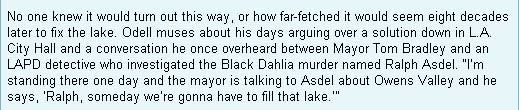
Imagine my surprise—no, my shock—to read this in L.A. Weekly. Here’s a screen shot to show I’m not making this up.

A writer named Jeffrey Anderson is exploring the legacy of Owens Valley and interviewed a man named Don Odell, identified as: “a semi-retired lawyer and former member of the Inyo County grand jury.”

“Odell muses about his days arguing over a solution down in L.A. City Hall and a conversation he once overheard between Mayor Tom Bradley and an LAPD detective who investigated the Black Dahlia murder named Ralph Asdel. “I’m standing there one day and the mayor is talking to Asdel about Owens Valley and he says, ‘Ralph, someday we’re gonna have to fill that lake.’ ”

It’s a nice picture; Odell overhearing a conversation between Bradley and Asdel, a former LAPD detective who was loaned to the Black Dahlia investigation.

But you’re not going to like this.


Large ImageRalph was a friend of mine. I was a pallbearer at his funeral in 2003. He was working in Boyle Heights when he was loaned to the Dahlia investigation. He later worked as a detective in the San Fernando Valley, before going to motors.

And according to his obituary in the Los Angeles Times:

“Asdel, who later became a motorcycle officer, injured his leg in an on-duty accident and was forced to go on medical retirement in 1965.”

Tom Bradley was indeed mayor of Los Angeles.

From 1973 to 1993.

Do you think something could something be wrong here? Note: Ralph’s obituary is online and easy to find.

Page 69


Large ImageWolfe is telling the Red Manley saga, using Will Fowler’s yarn virtually intact. In Will’s version, he goes to the Manleys’ home in Huntington Park, interviews Manley’s wife, Harriette, and tells her not to open to the door to nosy reporters.

The source for this ought to be either Will’s “Reporters,” or an interview with him. As I said before, one of the most frightening phrases in the English language is “Will Fowler recalls….” but let’s check.

Yep, “Reporters,” Page 81 and 82.

Should I take the time to see if this is screwed up? OK, I will.

Watson, to the haz-mat pile of Dahlia books!

Why am I not surprised?

Now with any other writer, I wouldn’t bother. This seems to be a straight lift job. But I swear, Wolfe can’t read what’s in front of him.

Here’s Will’s version:

“While I was there, the phone rang. It was Red and Harriet put her hand over the mouthpiece and asked: ‘Do you want to talk to him?’ ”

“ ‘You better not tell him I’ve been here,’ I said.”

Compare this with “Mogul”:


Large Image“When Harriet learned that her husband was being sought by the police, she became nervous but cooperative. She told Fowler that she had just heard from her husband, who had telephoned from San Francisco.”

OK, Will, let me get this straight: Every police officer and every reporter in California is looking for the mysterious red-haired man in the murder of Elizabeth Short. You’re at the man’s home, talking to his wife. He calls. She asks if you want to speak to him.

And you say:

No.

If that were a true story and I were your editor, you would be out the door.

And here we see Wolfe’s skill in creating quotes for conveniently dead people:

“Reporters,” Page 82

“She didn’t seem to object when I asked for them all [family photographs] and instructed her—a bride of only 15 months—not to talk to anyone, especially if newspaper reporters started coming around the house.”

“Mogul,” Page 69

“Electing not to inform Mrs. Manley that her husband was the number one suspect in the murder of Elizabeth Short, Fowler cautioned her not to talk to anyone about her husband—especially ‘any nosey reporters who may come knocking at your door.’ ”


Large ImageOf course, Will’s story (which I heard from him countless times) was that he bamboozled his way in the door by flashing his badge (reporters were indeed issued badges by Sheriff Eugene Biscailuz that were later confiscated by Sheriff Peter Pitchess) and claiming that Red had lots of unpaid parking tickets.

Was there any truth to it at all? I don’t know. Maybe. Will also claimed that he was on the stakeout when Red was arrested in Eagle Rock and present when police showed up at the Examiner with Elizabeth Short’s luggage. Since those events occurred at roughly the same time, he couldn’t have been in both places.

Time for my walk.

Shout out to:

Dark Horse Comics (70.96.128.8) man you guys are really going nuts on this site!

Grimstad, Norway (62.101.234.10) (say hi to my homies in Andoya!)

Oecd.org of France (80.124.192.14)

Mysterious visitor (75.1.5.136)

Chicago Linux user (4.252.208.102)

Hurry back!

Labels: , , , , , , , , ,

Tuesday, February 21, 2006

Blogging the Wolfe Book, The FBI Story


There is an individual on ebay who sells copies of Elizabeth Short’s FBI file for $22 and some bidders drive the price even higher. The fact that the files are available online for free has curbed the demand somewhat. But I don’t know which is worse: a seller offering something that anybody can get for free (oh yes, you do get a “bound” version, if you consider a cheap plastic spiral a “binding”) or the people who buy it for $44.89, like sydney20030_3 .

Update: The price on ebay has gone up to $23, plus $5 shipping. Still free on the FBI's website.

Page 28


In his treatment of the Black Dahlia case, Donald H. Wolfe is going to deal with the relationship between the police and the newspapers in the 1940s, which was definitely cozier than it is now.

“While today there is only one daily metropolitan newspaper in Los Angeles, back in 1947 there were five and all were zealous competitors—especially on a major murder case that had captured the public’s attention.”

I’m at a bit of a loss as to which papers Wolfe is talking about. I can think of four majors in 1947: The Times and the Examiner in the morning, the Herald-Express in the afternoon and the Daily News (no relation to the Daily News of Los Angeles). There were suburban papers in Pasadena, Hollywood, Long Beach and elsewhere, but I wouldn’t call any of them major. And of course while The Times is the major paper today, there is still the Daily News of Los Angeles, which covers the San Fernando Valley, and the Orange County Register (nee the Santa Ana Register).

And the next milepost in the Black Dahlia story, wiring the fingerprints to Washington. Again, Wolfe’s got it wrong:

“According to reporter Will Fowler, when the Examiner learned that the crime lab had sent the fingerprint card of Jane Doe #1 to Washington, editor Jim Richardson had managing editor Warden Wollard call Capt. Donahoe and request that the LAPD supply the Examiner with a copy of the prints.”

Oh boy. This is a trifecta of errors.

First of all, in newspaper hierarchy, the managing editor outranks the city editor, Jim Richardson. Second, Wollard didn’t ask Donahoe for a copy of the prints. And third, when you fingerprint a corpse, you obviously can’t use a fingerprint card. Instead individual squares are applied to each finger.

Watson! The end notes!

Just as I thought. Wolfe attributes this to Will, in a 2003 interview (by then Will was pretty far gone, I imagine) and Will’s autobiography “Reporters.” The question is why Wolfe doesn’t use Richardson’s autobiography, “For the Life of Me.” This is especially mysterious since Wolfe cites the book in his bibliography. Of course we have already found instances of Wolfe citing a book in the bibliography or end notes and ignoring it so this isn’t a first, alas. But it is significant.

Let’s see what Richardson has to say (“For the Life of Me,” Page 298):

“I thought I had done everything that could possibly be done. I couldn’t think of an angle we hadn’t covered. But I missed on one. I missed one that Warden Wollard, then assistant managing editor (note: not the managing editor—big difference) and now editor of the Examiner, spotted that gave us the first big jump on the story, the jump that made it our story from then on.”

[snippage]

“After I had left for the night, Warden was still around when a couple of homicide squad detectives came to the Examiner and asked if they could have our artist’s drawing of the girl for use in the police bulletin.”

Wollard overheard the conversation and suggested sending the prints to Washington by Soundphoto. He didn’t call the police; the police came to the Examiner.

Page 29

More nuts and bolts of sending Elizabeth Short’s fingerprints to the FBI. It’s wrong but not worth pointing out. Just take my word for it, the book is wrong.

Ah, but what's the source of Elizabeth Short's fingerprints? Hm. We're not told and material like this should be attributed. Just as I thought, the Examiner only ran a close-up of one print, not all 10. A puzzlement.
Humph. Not in Steve Hodel's "Black Dahlia Avenger" but there's a ratty copy in John Gilmore's "Severed," although the source isn't listed. This is shoddy work, folks.


Page 30


“Elizabeth Short had been arrested on September 23, 1943, with a group of soldiers and other girls who were drinking and causing a disturbance near Camp Cooke, an army base north of Santa Barbara, California.”

Uh. No. She was arrested in Santa Barbara, and unless you consider 53 miles “close,” it wasn’t near Camp Cooke. There was no report of a disturbance, nor was she with a big mob of rowdy people. More correctly, she was on a double date and was a minor in possession of alcohol or a minor in a liquor establishment. There’s no excuse for getting these small details wrong since Wolfe clearly had access to the original Examiner (copies of which are included in his book). More important, this constitutes Elizabeth Short’s entire criminal record.

That’s it for today. Tomorrow, it looks like Wolfe is going right to the autopsy. That should be interesting.

Here’s a shout out to the World Book (208.222.174.2)

Rutgers (204.52.215.23), 4 hours and 57 minutes? I’m flattered.

Hurry back!

Labels: , , , , , , , , ,

Monday, February 06, 2006

Blogging the Wolfe Book, Weather Report

Page 7 (Continued)

If the temperature dropped below 35 degrees F in the San Fernando and San Gabriel Valleys, the ranchers had to go out and light their smudge pots to ward off the frost that could damage the citrus crops.

On the night of Tuesday, January 14, 1947, the fruit frost warning had been posted and broadcasted on the ten o'clock news. At that hour few people were out on the streets.

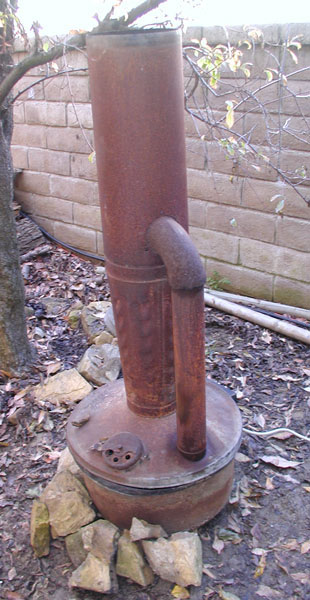
At left, a smudge pot, now nothing but an unpleasant antique in California. In the late 1940s and early 1950s, hundreds of these evil devices, burning diesel fuel, made the air over Los Angeles so polluted that there were days you couldn't see City Hall from across the street.

I just sighed when I saw this. Time to cue the leaden skies from "Severed." (Hm. I'd forgotten I was using a flier on hemorrhoids from the National Institutes of Health as a bookmark in "Severed" Clearly I don't refer to either one very often).

Smudge pots burned for the first night that winter to keep the frost from killing the citrus. The cold had settled in from the cloudless sky that by dawn shone like dull gray metal that revealed no shadows. ("Severed," Page 1).

Now to dig out the files on the weather, because it's always reported incorrectly. First with "Severed" and then everyone who follows.

City

High

Low

Date

Los Angeles

60

39

Jan. 15. 1947

L.A. Ground Temperature

61

38

Jan. 15, 1947

Burbank

60

32

Jan. 15, 1947

Pasadena

61

35

Jan. 15, 1947

San Gabriel

60

32

Jan. 15, 1947

Los Angeles

64

39

Jan. 16. 1947

L.A. Ground Temperature

65

31

Jan. 16, 1947

Burbank

63

51 (probably an error for 31)

Jan. 16, 1947

Pasadena

60

40

Jan. 16, 1947

San Gabriel

63

33

Jan. 16, 1947

Southern California forecast for Jan. 15, 1947: Generally sunny today and tomorrow, but with some scattered cloudiness. Slowly rising daytime temperatures but continued cool.

Sunny today? What about "a cloudless sky that by dawn shone like dull gray metal that revealed no shadows?" A cloudless sky that revealed no shadows? How is that possible? And where are the smudge pots?

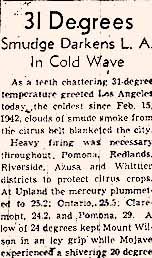
The answer: On Jan. 16, 1947, the Herald-Express ran a story headlined "31 Degrees; Smudge Darkens L.A. in Cold Wave." Of course, since the Herald was an afternoon paper, it was speaking about the day after the body was found: "As a teeth chattering 31-degree temperature greeted Los Angeles today, the coldest since Feb. 15, 1942, clouds of smudge smoke from the citrus belt blanketed the city."

Tsk, tsk, tsk. This is what happens when you trust someone else's research instead of doing your own, especially when you take anything from "Severed," which I'm fairly sure I mentioned is 25% mistakes and 50% fiction.

As everyone who knows me is well aware, I don't like the crime scene pictures, but this photo of Los Angeles Times reporter Marvin Miles at the crime scene is appropriate because he's wearing sunglasses. Regardless of what you read in any of the Dahlia books about brooding darkness and leaden skies, it was a bright, sunny day.

Is it being too petty to note that ranchers have cattle and farmers grow crops? And wonder why Wolfe writes 10:00 p.m. and ten o'clock on the same page instead of 10 p.m. and 10 o'clock? I suppose it is. Broadcasted? ReaganBooks should really hire a couple of good copy editors.

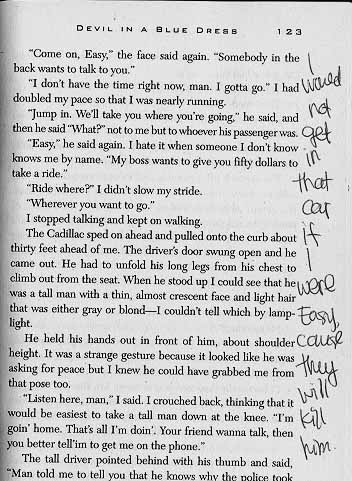
As a writer, I have a visceral reaction to finding books in the trash. They're so much work. Writers should never be allowed to see the overfilled trash barrels at any publication that does book reviews, where prerelease copies are unceremoniously dumped, not even read, like dead leaves in the fall. So when I took some boxes to Out of the Closet over the weekend I had to rescue a copy of Walter Mosley's "Devil in a Blue Dress" that was in the dumpster behind the store. The book was annotated on nearly every page, as follows:

Labels: , , , , , , ,