Friday, March 09, 2007

Random Shots From Our 12-Bore


March 9, 1907
Los Angeles

The Insanity Begins

Led by I. Newerf and J.B. Dudley, the automobile owners of Los Angeles are fighting a new city ordinance that bans parking within 40 of downtown intersections. Newerf, the West Coast representative of Goodyear Tire Co., and Dudley, a car salesman, received citations for violating the law and have pleaded not guilty.

In April 1909, Dudley pleaded not guilty to involuntary manslaughter after hitting street inspector Woodman J. Thomas on Broadway near 5th Street. He was sentenced to five years’ probation in March 1910.

Disgraced Woman

Hazel La Doux, a.k.a. Hazel Rogers, hid her face with a veil as she was tried on charges of forgery.

“Her downfall is said to be due to a man named William Rogers, an alleged Ascot tout who deserted her,” The Times says. “It is charged that Miss La Doux forged the name of Mrs. John Brink on a check for $120 and cashed it.”

La Doux told police that she and Rogers used a scheme in which she took a job with a reputable employer and passed clients’ information to lover. La Doux said she worked at a department store in Oakland and a dentist’s office in Los Angeles, turning over names to Rogers, who forged the checks.

“She had been an honest woman, she said, until Rogers’ oily tongue and smooth ways captivated her and she became his mistress and then a thief,” The Times says.

He Paid $40

Restaurant owner Frank Flood stood over his wife, Annie, as she lay on the floor of their quarters at a Spring Street rooming house and said it would be worth the $25 fine just so he could beat her up.

In testifying against him, “She recited a story of shocking cruelty, saying that she had been mistreated, scorned and finally beaten by the man who promised to love, cherish and protect her,” The Times says.

Flood did not dispute any of the charges, refused to cross-examine her (a husband’s right in those days) and pleaded guilty to battery. “He admitted that he struck her and confessed to having assaulted her with his fist as she lay on the floor,” The Times says.

He paid $40 ($837.08 USD 2005).

Flood skipped town in September 1907. “He made the acquaintance of a fast sot and spent plenty of money, too much, in fact, for a man of his means. Late suppers at swell cafes cost Flood much cash. Then he became possessed of a desire to take long journeys in touring cars. He paid his bills with other people’s money, the new restaurant manager says, by levying on the cash drawer of the restaurant, which is owned by a company,” The Times says.

Lmharnisch.com
Lmharnisch.blogspot.com

E-mail: lmharnisch (AT) gmail.com

Labels: , , , , , , ,

Thursday, March 01, 2007

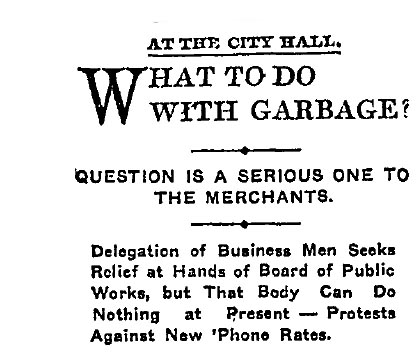
City Fathers Confront an Intractable Problem


March 1, 1907
Los Angeles

Downtown businessmen are at a complete loss over what to do with the garbage from their operations and want the city to either take it or designate a dump they can use.

“They declare that the Board of Health has refused to let further deposits of garbage or refuse be made at the old dumping ground to the southeast of the city and state that if the city does not come forward with a proposition to locate a new dump, or to cremate the stuff, they will be helpless to get rid of the accumulations of each day’s business,” The Times says.

City officials say they don’t know what to do because the local sanitation system is strictly for residential use. The Times says that local ordinances define garbage as “animal and vegetable refuse from the kitchens.” As a result, officials feel no need to deal with commercial waste, although they concede it is a problem.

“We can scarcely take care of the garbage we are now forced to collect, one Board of Public Works commissioner says. “We don’t want to take care of any more of it, even if it is hauled to the crematory without cost to the city.”

Lmharnisch.com
Lmharnisch.blogspot.com

E-mail: lmharnisch (AT) gmail.com

Labels: , , , , ,

Saturday, January 27, 2007

Why Doesn't L.A. Do Something About Traffic?


Jan. 27, 1907
Los Angeles

One thing you can say about Angelenos: We love to talk about traffic. The only thing we love more is to commission studies and draft plans to deal with the problem, and then ignore them.

“With the wonderful growth of Los Angeles as a great city has come to it many problems to be solved. The Owens River and the system of storm drains underway are the solutions of two important ones,” The Times says.

A Traffic Jam in 1907

“But now the city is face to face with another important problem, that of the congestion of its streets in the business section, especially by the electric car traffic, which at certain times of the day causes blockades, loss of time to thousands, loss of business to merchants and discomfort to the public.”

Now this is painful reading:

“This problem of transportation will grow in importance every year during which it is neglected. Swift as has been the extension and shifting of lines of the great electric railway system in and about Los Angeles, the city has grown with still greater rapidity.”


The elevated train proposed for Los Angeles and never built.

The Times says an experimental elevated line was underway from the Pacific Electric Building south on Tennessee with the idea of eventually linking to the beach cities.

“To ride on such a railway, above the smells and dust of the streets, will some day be a delight to the citizens of Los Angeles, if ideas now if the mind of the great railroad builder are carried out.”

Sixty years ago, we again failed to address the problem of transportation, from the blog’s archives for September 1947:

Someday an inquisitive person studying the history of transportation and urban planning will tell the world exactly what became of Los Angeles’ 1947 blueprint for dealing with transit problems. In the meantime, we’ll have to settle for the knowledge that at least they made a valiant effort. They certainly knew what was coming—without much argument, you could call them futurists.

A committee sponsored by the California Chamber of Commerce spent 19 months studying transportation issues and warned that someday Los Angeles would have a population of 5 million (the 2000 population of Los Angeles County was 9,519,338, with 3,694,820 for the city of L.A.).

“High-speed rail transit arteries plus a system of downtown subways alone can save Los Angeles from disintegration into a hodge-podge of unconnected municipalities,” The Times said in quoting the project’s advocates.

“Crux of this preliminary proposal lies in the immediate revamping of express highway projects (today we call them freeways) to include ‘center strip’ tracks capable of whisking trains at 35 to 50 mph.

“These cars, pouring millions of commuters daily into metropolitan Los Angeles, would unload at special downtown stations whence passengers would be shuttled to local destinations by subways tentatively scheduled under Broadway and Spring Street.

“The master plan envisions center strip tracks on the Hollywood, Santa Monica, Olympic, Inglewood, Harbor and East Bypass Freeways.”

The Times notes: “Eventually the master plan would integrate all forms of mass transportation, including operation of rubber-tired vehicles on certain expressways not immediately requiring trains.”

A quick search through Proquest isn’t helpful in determining the project’s fate. William Jeffers, the former Union Pacific railroad president who was to be a consultant on the project, is quoted in 1948 calling for approval of a rapid transit district.

Of course there was a competing proposal. The 1948 Babcock plan, named for consulting engineer Henry A. Babcock, who envisioned a 650-mile subway system at a cost of $1,100,000,000 ($10,410,604,566.50 USD 2005). While there were arguments between the two factions, in the end, neither plan was adopted, as any Los Angeles driver knows.

The original story reveals some obvious clues as to why: The Inglewood, Olympic and East Bypass Freeways aren’t familiar names these days. One could paper the dining room with Times maps of various freeway routes that were never built. (In simple terms, the Santa Monica Freeway was originally envisioned much farther north. To the south, the Olympic Freeway was to go from the Harbor Freeway to Venice and the Inglewood Freeway was to go from the Harbor Freeway to Sepulveda).

And there are other stories in the same issue that offer more hints: A huge petition drive led by Ted Meltzer, publisher of the South Side Journal, against building the Harbor Freeway between Broadway and Figueroa. “Homeowners in an area bounded by 23rd Street and Imperial Boulevard claim that several thousand homes in the built-up area would be destroyed and ask that the project be either abandoned or postponed,” The Times said. And an adjoining story reports on a seven-month investigation of graft and conspiracy in acquiring property for the Hollywood Freeway.

But it is gratifying when wondering what became of the 1947 plan to remember that the new Gold Line tracks run between lanes of the Foothill Freeway. Some things just take time.

Bonus factoid: The Harbor Freeway was realigned to spare the Auto Club headquarters on South Figueroa and USC’s Fraternity Row.

Lmharnisch.com
Lmharnisch.blogspot.com

E-mail: lmharnisch (AT) gmail.com

Labels: , , , , , , , ,

Wednesday, January 10, 2007

The Floods


Jan. 9-10, 1907

The worst storm in 23 years blew across Southern California with the force of a gale, dumping more than an inch of rain in Pasadena, killing an Orange County rancher, washing out railroad tracks and collapsing tunnels, and leaving nearly every small ship in Santa Barbara sunk, driven ashore or pounded to pieces.

Floodwaters destroyed a railroad bridge under construction near Ventura, cutting off the Southern Pacific’s coastal rail service, and at Summerland, oil rigs along the shore were ripped to pieces. The San Fernando Valley was especially hard hit: The Times reports that a bridge over the Big Tujunga Wash was underwater and that the river was a mile wide and impassible. The roar of water at Pacoima can be heard two miles away, The Times says.

The Arroyo Seco tore out a railroad line and threw freight cars as if they were toys, carrying a torrent of trash and broken trees down from the mountains through Pasadena.

South of downtown, the Los Angeles River was at flood stage and threatening to destroy the 7th Street Bridge, where pedestrians were warned that they crossed at their own risk.

Many avenues were flooded from curb to curb and churning water threw aside heavy iron manhole covers and flowed from the storm sewers, turning streets (paved and unpaved) into rivers. Streetcars plying the flooded boulevards looked like ships sailing in canals and gallant conductors carried female passengers through the water to the curb.

A 75-year-old Santa Ana rancher was killed when the buggy in which he and his brother were riding was washed away as they tried to trying to cross Santiago Creek. The horse panicked in the raging flood and the buggy overturned. Ralph Williams, who was visiting from the East, was able to grab a willow branch and save himself, but his brother Charles was carried downstream, where his body was eventually found.

“The fording of torrents on the hill streets has seemed fraught with peril,” The Times says, “but the thousands of hardy adventurers, who have braved the currents all live to tell the tale. None has been swept away to a watery death in the many deep lakes which were formed about the city.”

Lmharnisch.com
Lmharnisch.blogspot.com

E-mail: lmharnisch (AT) gmail.com

Labels: , , , , , , , ,

Saturday, December 30, 2006

The Old Men in Blue

Dec. 30, 1907
Los Angeles

James Sullivan, 64, was a prisoner of the Confederates held at Belle Isle, Libby and Andersonville, where he and war correspondent Albert D. Richardson escaped by tunneling for three months with a spoon.

Henry Russell, formerly of the 4th Cavalry, was held at Andersonville and Benjamin L. Gorsuch of the 1st Maryland Infantry was captured and sent to Belle Isle. James Sherwood was with the 10th New Jersey. John Ryan, 77, was with 7th New York Heavy Artillery.

And then there’s John Smith, 70, of the 8th Illinois who is out of his head most of the time. Smith is so feeble that one of his fellow ex-soldiers has to help him to his cell at night.

The six old soldiers are serving 10 days in jail for public drunkenness in Sawtelle, the settlement outside the gates of the veterans home, and much to their shame were brought downtown in irons on the streetcar.

Smith, Russell and Sullivan freely admit they were drunk on payday, but not causing any trouble. Gorsuch and Sherwood, two former infantrymen, said they were “skylarking” in a harmless scuffle and were jailed because they refused to pay a fine, while Ryan says he was in his room, doing nothing.


The men are no trouble. In fact the sheriff and jailer have refused to lock them up, giving them the run of the place as they serve their 10-day sentences. The men say that the Sawtelle constables “lay for us like a pack of wolves” on payday because they get a bonus for each arrest, plus mileage for every prisoner brought to the County Jail.

Veterans Home officials counter that drunkenness is an increasingly serious problem and that the old soldiers get around attempts to maintain sobriety by pooling their money and designating one man as a runner to buy liquor wholesale in Santa Monica.

“This method of irrigation is practiced to such an extent that one veteran is kept almost constantly on the go between Sawtelle and the beach,” The Times says. “All who travel over the electric line are familiar with the figure and the package bottles. He is seen every day. He gets off the car before it reaches the Sawtelle business center, and always there are lolling tongues and parched throats to welcome his return.”

Read the previous entry
on Ocean Park banning the sale of liquor to soldiers in uniform because of drunk Civil War veterans.

Lmharnisch.com

Lmharnisch.blogspot.com

e-mail: lmharnisch (AT) gmail.com

Labels: , , , , , ,

Saturday, December 23, 2006

On the Frontiers of Mental Health


Dec. 23, 1907
St. Louis, via Direct Wire to The Times

Dr. Henry S. Atkins, superintendent of St. Louis’ insane asylum, has found that Christmas is a perfect time to test his theory that shopping cures insanity.

Atkins and two attendants took 60 women from the asylum “into the world of department stores and the activities which all women enjoy,” The Times said.

The patients and the two female attendants, who wore civilian clothes instead of their uniforms, mingled with crowds downtown, “swallowed up among the thousands of other women bent on the same mission.”

Lmharnisch.com

Lmharnisch.blogspot.com

e-mail: lmharnisch (AT) gmail.com

Labels: , , , , , ,

Sunday, December 10, 2006

Uh-Oh

Dec. 10,1907
Los Angeles

Mayor Arthur C. Harper happens to be in all sorts of trouble. He’s telling the newspapers that he has had enough of politics and won’t seek another term. The district attorney is trying to shut down the local red light district and eventually these efforts will reveal allegations of City Hall corruption involving Harper, Police Chief Kern, a police commissioner, a police captain named Broadwood and Nicholas D. “Nick” Oswald, one of the biggest leaders of the city’s underworld.

The 1909 Broadwood case is complicated (he was found not guilty, by the way, despite accounts of payoffs from the earnings of Los Angeles bordellos) and in researching the mayor’s life, I came across the following incident.

The word “homosexual” is a rarity in The Times, appearing exactly twice in editorial content between 1900 and 1940: a 1912 review of “The Candle and the Flame” by George Sylvester Viereck; and a 1939 health column by Dr. William Brady.

So what does the paper do when “purity squad” raids the former mayor’s home, 1128 W. 28th St.? Like this, from Feb. 1, 1920:

“Twenty Los Angeles men, some said to be prominent in social and business circles, were arrested last night by police at a stag party in the home of former Mayor Harper and were booked at the police station on the charge of social vagrancy.

“Seven of the men, including the host, Joseph Harper, 24 years old, are alleged by the officers making the raid to have been gowned in feminine apparel.”

After a few paragraphs, the paper says: “According to Police Sergeant Gifford and the officers of the ‘purity squad’ who conducted the raid, a degenerate orgy was in progress when they entered the house.”

The men were taken to jail as they were dressed, meaning that some of them spent the night in women’s clothing. Early the next morning, The Times says, the dresses were taken into evidence, so some of the men were given bathrobes and others draped themselves with jail blankets. Of the 16 arrested, four were released to the Navy (they were in uniform, The Times said) and eight were held in custody because they tested positive “for infectious disease.” And yes, their names or pseudonyms, addresses and occupations were published.

When asked about his son Joe, the former mayor said: “The only party he has given lately that I know of was given by him on Halloween night. His mother was present that night and among the guests during the evening, so I know nothing wrong took place.”

One of the sailors said: “I came in for my liberty and met a fellow at a downtown street corner. He asked me if I’d like to attend a nice party with dancing and girls and refreshments and said for me to bring some of my friends along.”

The Times said: “The sailors declare they did not know for a long time that the ‘girls’ were men and when they did learn of the fact, some thought it was just a good-natured masquerade ‘stunt.’ ”

A later story says: “All the men are charged with lewd and dissolute conduct. Seven were dressed as women and the police say their acts were such that the charges against them can be upheld in court.”

Police said that officers learned about the party several weeks ago. “Arrangements were made to have some of the officers in the house,” The Times said.

“The raiding officers in plain clothes gained entrance to the house and mixed with the strange guests. Several other officers climbed into the house by way of a rear window and concealed themselves beneath beds. After watching the ‘party’ for over two hours, whistles were blown and the raiding party rushed into the residence.”

Two months later, the case against the "Lady Men" was dismissed.

Bonus fact: One of the earliest occurrences of “gay bar” in The Times appears in a Oct. 15, 1953, story about the extortion trial of Jimmie Tarantino and refers to a bar on Market Street in San Francisco.

Lmharnisch.com

Lmharnisch.blogspot.com

e-mail: lmharnisch (AT) gmail.com

Labels: , , , , , , , , ,

Monday, December 04, 2006

Ambush in Arcadia


Dec. 4, 1907
Arcadia

Charley Chew, the water superintendent on the Lucky Baldwin ranch, had fired two Mexican workers several months ago and one dark night near the Unruh residence, they ambushed him, shooting him in the back. Chew drew his pistol and shot Francisco Ramirez and Miguel Palamoratz in the stomach, then fled.

Badly wounded, Ramirez and Palamoratz struggled to walk about a mile to a friend’s house in a small settlement near the Baldwin store in Santa Anita, leaving a trail of blood along the railway tracks through Baldwin’s vineyard.

Arcadia Marshal O.C. “ Jack” Berdie, upon learning that Chew had been shot, visited him, dressed his wounds and questioned him about the attack. Chew said it was so dark when he was ambushed that he couldn’t see how badly he had wounded Ramirez and Palamoratz.

“The Mexican and Chinese laborers on the Baldwin ranch are always looking for trouble with each other, and the Mexicans bitterly resented Chew’s action,” The Times said. “Knowing of the bad blood between the Chinese and Mexicans, all of the houses of either side were searched by the marshal and his assistant, Charles Davis, without avail.”

Bertie finally found the men and took them to the county hospital, where Ramirez died and Palamoratz was in critical condition.

The Times never published any further stories about the incident, leaving us to wonder about ethnic feuds on Baldwin’s ranch. By 1914, Berdie had given up his post as Arcadia marshal and was working as a bailiff in downtown Los Angeles. It is difficult to believe that “Palamoratz” is a correct spelling, but California death records are completely unhelpful in locating that spelling or anything more typical, like Palomares.

And in the continuing story of the Mexican revolutionaries, authorities are taking extreme precautions to prevent an escape attempt aided by the crowds surrounding the men during the daily walks to and from court.

Due to fears of an attempted rescue, officials now require people entering the courthouse to state their purpose and sympathizers of the revolutionaries are barred from the corridor outside the courtroom, The Times says.

Lmharnisch.com

Lmharnisch.blogspot.com

e-mail: lmharnisch (AT) gmail.com

Labels: , , , , , , ,

Wednesday, November 29, 2006

Matzo Brawl!

Nov. 29, 1907
Los Angeles

Oh Those Shriners:
Recall, if you will, the grisly train wreck that killed a large number of Shriners returning from their convention in Los Angeles. It seems that one of them, George F. Hageman, inadvertently touched off a legal dispute between two belles of Reading.

Sarah Reber and Maude Weber went before the court insisting that each of them was the rightful heir of the bachelor, who was “tall and handsome and very popular with the fair sex,” The Times says. Both women claim that Hageman “spent his last evening in Reading with them” before he left for the Shrine convention and made promises of $12,000 in stock.

The court awarded the stock to Reber.


The City Beautiful:
By the way, this postcard of Broadway and 7th reflects one of Charles Mulford Robinson’s complaints in drafting a design for downtown Los Angeles: all the low awnings along the streets. (Note the Orpheum Theatre).

“We are very ‘country’ with our low awnings,” The Times says, quoting Robinson. “A man cannot walk a block without having to duck his head more than once. An ordinance would fix things”

Currant Affairs:
And finally, an artistic baker in the Russian quarter has provoked a riot over his preparation of matzo bread, sending five people to jail.

About a month ago, an enterprising baker at Turner Street and Vignes announced that he was going to prepare matzo bread with spice, raisins and currants.

“This was met with some dismay,” The Times says, “and the authorities on Orthodox were sent for. They agreed that this would be a digression from the rules laid down by the Jews.”

Nonetheless, Joe Wasserman liked the baker’s wares and decided he would have them for Thanksgiving dinner, regardless of any ruling. Thus began an argument between Wasserman and his brother Sam, with whom he and his wife had been living rent-free for four months. Sam said that if Joe insisted on eating the matzos, he would tell the grocer that Joe planned to take a trip to San Bernardino despite owing the market $20.

“Yesterday morning, the decorated matzos arrived at the Wasserman home and a family row resulted,” The Times said. “The Jewish [illegible] lined the streets until the Russian grocer, hearing the noise, hurried over, whereupon Yiddish, German, Russian and Odessa were all spoken at once and Turner Street sounded like a Tower of Babel. The decorated matzos were thrown out in the street.”

“Someone picked up the discarded be-decorated matzo and threw it at [Joe] Wasserman and the entire crowd began to fight.”

“The matzo was to have been used as evidence, but a trusty in the jail thoughtlessly ate it yesterday afternoon,” The Times says.

Lmharnisch.com

Lmharnisch.blogspot.com

e-mail: lmharnisch (AT) gmail.com

Labels: , , , , , , ,

Saturday, November 25, 2006

Roving to Monrovia

Nov. 24, 1907
Monrovia

The Times real estate section takes a look at what was then the distant suburb of Monrovia, 22 miles from downtown Los Angeles. The writer notes the increasing use of concrete and stone, explaining that the cost of lumber is forcing builders to use other materials. The writer also notes the broad, shaded verandas of three featured homes as well as the outlines of their roofs.

The story highlights the home of B.R. Davisson on East Orange Avenue, H.M. Slemmons (or Slemon) on North Myrtle Avenue and the home of John C. Rupp at Ivy and Greystone, built for $6,500 ($133,403.21 USD 2005).

Without exact addresses, it would be difficult for me to locate the Davisson and Slemmons homes, but I took a pleasant drive out to Monrovia recently to look for the Rupp house and was happy to find
that it is still standing and in beautiful condition. In fact, it was nice to discover that the neighborhood has quite a few well-maintained historic homes; a contrast to the condition of the houses I located in Pico Heights.

I had a brief chat with the homeowner who gave me a tour of the grounds. He said that Rupp, a financier, built the home for his wife, but that she decided it was too far from Los Angeles and wouldn’t live there. That’s apparently true, because Rupp put the home on the market in 1911.

Note that the ad for the home mentions a solar heater. I have no idea what this was and the homeowner didn't know anything about it. Obviously a subject for further research.

The homeowner also mentioned the Monrovia Old House Preservation Group, which has a website and offers a self-guided tour. I cannot vouch for these folks, but it does sound interesting and the area has some lovely old homes.

To get to the Rupp house, take the Foothill Freeway and get off at Santa Anita in Arcadia. Turn north and go to Foothill Boulevard and then turn right (east) and then left on Ivy. The home is at 269 N. Ivy. While you’re there, look at the large stone house on the northeast corner, built in 1894. I’ll post some pictures when I get the film developed (we’re old school around here).

Lmharnisch.com
Lmharnisch.blogspot.com

e-mail: lmharnisch (AT) gmail.com

Labels: , , , , , , , , , , , ,

Wednesday, November 15, 2006

Imagining the Future


Nov. 15, 1907
Los Angeles

Architect Charles Mulford Robinson has drafted a proposal for downtown Los Angeles that is stunning in its ambition. One portion calls for broad boulevard leading from a proposed Union Station at Central and 5th Street toward Grand, ending at a new public library and art gallery. The other, equally elaborate, calls for a grouping of civic buildings and terraced gardens around North Spring Street, including a new City Hall.

“First of all, and most important in his mind because Los Angeles is a leading tourist center and should strive to make a good impression at the very start, the architect suggests an immense union railroad station with an approach a mile long—a wide thoroughfare lined with beautiful buildings, with spacious parkways, rows of flowering trees and ornamental lamp posts, and with driveways for all classes of traffic,” The Times says.


Robinson’s report is lengthy and detailed, so it’s difficult to deal with in a blog. But it is fascinating to see how early the city was grappling with inventing its future. The library on 5th Street and City Hall on Spring (although on the Temple Block rather than the Bullard Block as Robinson suggested) are quite familiar.

Interestingly enough, Robinson also envisions a network of broad boulevards, including a picturesque drive with elaborate landscaping to Pasadena along the Arroyo Seco.

Search for a copy of “The Improvement of Towns and Cities.”

Lmharnisch.com
Lmharnisch.blogspot.com

e-mail lmharnisch (AT) gmail.com

Labels: , , , , , , ,

Wednesday, April 26, 2006

Runaway Flats


Water is not the only thing that flows downhill, as switchmen at the downtown Southern Pacific freight yard discovered when two runaway flatcars made a 13-mile trip from the San Fernando Valley in 10 minutes.

Although the runaway cars sent people scrambling as they crossed the tracks, there were no trains running at the time, so a serious accident was avoided.

The flatcars, part of a gravel-hauling operation in Roscoe [Sun Valley], inexplicably came loose and had a four-mile downhill start before blazing through the Burbank station. The Burbank operator sent warning ahead that he saw something rip past—he thought it was two flatcars but wasn’t sure—before the runaway cars sped through west Glendale. At this point, the cars reached an estimated 120 mph, covering the two miles from west Glendale to Tropico in a minute, The Times said. The operator in the Glendale switch tower said he saw nothing more than a cloud of dust as the cars passed.

“With wonderful tenacity, the runaways clung to the rails, though at some of the sharpest curves, the wheels on the outer side were in the air most of the time,” The Times said.

“Rattling across the river bridge near Elysian Park, the two flats, with journals smoking and platforms rocking like cradles, struck the maze of switches at the upper end of the Los Angeles yards and then beat it straight for the Buena Vista [Broadway] Street bridge and the tangle of tracks below,” The Times said.

“Just before the cars entered the yards a signalman who had been out on the line inspecting the semaphores was poking leisurely along on his railroad velocipede, which was moving east on the westbound track.

“He heard no warning from the oncoming runaways, but as was his custom at that point, he lifted his velocipede over to the eastbound track. An instant later the two flats whizzed by him. Had he remained on the westbound track half a minute longer he would have been dashed to death.”

Alerted by the Burbank operator, several switchmen in the downtown yard attempted to put the runaway cars onto other tracks. Although the first man didn’t act fast enough, the second man threw a switch in an attempt to send the runaways onto the sidetrack leading to Standard Oil’s warehouse. The front wheels of the first runaway car went onto the side track, but the rear wheels remained on the main track, crashing into a railroad car loaded with machinery.

The crash from the first runaway car cleared the way for the second runaway car to keep racing through the rail yards at 40 mph. A switch was thrown and it was diverted onto a side track, where it grazed a freight train pulling into the yard before crashing into a box car.

“At almost any other time yesterday the runaways would have encountered a heavy freight or a speeding passenger train, and no earthly power could have prevented a horrible crash with numerous fatalities for there was no time to hold trains after the alarm was given,” The Times said.

Labels: , , , , ,

Monday, April 17, 2006

Blogging the Wolfe Book, Request Line XI

I have ceased blogging in real time as I read Donald H. Wolfe’s “The Black Dahlia Files: The Mob, the Mogul and the Murder That Transfixed Los Angeles.” Wolfe uses the “Laura” format, in which the anonymous, butchered body is found and the narrative proceeds in flashbacks.

Now, I am taking a few requests before wrapping up the project. Today, we’ll continue our examination of Pages 213-215 at the request of Regular Anonymous Correspondent.

Here’s the two-minute executive summary. We caught Wolfe in a nasty bit of business, in which he faked a crucial document. In fairness, I e-mailed him and asked if he cared to defend himself. So far, he hasn’t responded. We also discovered a rather bad distortion of Los Angeles geography, and what should be an embarrassing confusion between two sets of prominent people named Murphy. Even worse, Wolfe presents himself as knowing these folks.

In all, a pretty ripe week.

Let’s wrap up Page 215, shall we?

Wolfe is going through a long rigmarole involving a convicted forger named Arthur Curtis James Jr., who claimed he was a struggling artist when he met Elizabeth Short in 1944 and conned her into posing for paintings.

As the district attorney’s files show (recall the title of this book is “The Black Dahlia Files”), Elizabeth Short was nowhere near Los Angeles in 1944. Of course, this hasn’t stopped the claims that appear in John Gilmore’s “Severed,” (25% mistakes and 50% fiction), Steve Hodel’s “Black Dahlia Avenger (a ruthlessly distorted work reverse-engineered to prove Hodel’s original assumption that his father was an evil genius) and “Black Dahlia Files.”

James’ critical role in the Wolfe book is to prove that Elizabeth Short was pregnant with Norman Chandler’s love child.

No, seriously!

Now Wolfe moves from James to Vincent A. Carter, author of the self-published book “LAPD’s Rogue Cops.” Let’s cover something important at the outset. Carter says:

“Rogue Cops,” Page 11

“…although I never worked directly on the Black Dahlia murder, I never lost interest in it.”

My point is this: Carter never worked on the case, so the only material he can provide is locker room scuttlebutt. And indeed, that’s what “Rogue Cops” presents about Capt. Jack Donahoe, one of the most admired men in the Police Department of his day. “Rogue Cops” commits a vicious smear of Donahoe, completely ignoring his actual accomplishments and the high regard in which he was held. Especially this nonsense about courtesy cards. Did I mention that “Rogue Cops” claims Donahoe killed lots of people, but according to one of his best friends, retired Capt. Ed Jokisch, Donahoe never killed anybody?

Well, not only does “Rogue Cops” have a grudge against Donahoe, but it goes to town on the Chandler family:

“Black Dahlia Files,” Page 215:

“According to Administrative Vice officer Vince Carter, it was common knowledge within the upper echelons of the LAPD that Norman Chandler was a womanizer, who carefully guarded his private life from public scrutiny. As publisher of the Los Angeles Times, one of the things Norman Chandler insisted on was that the Chandler name and the Chandler activities be kept out of the paper. Vince Carter stated, ‘a lot of what was not printed about Chandler was common knowledge in Administrative Vice and the upper echelons of the Los Angeles Police Department—a department of city government in which Chandler always had an intense and close, if usually covert, working relationship.’ ”

Here we have another attack on a CDP (conveniently dead person). [Full disclosure: I work for The Times but everything you read here is done on my own as a private individual, using my personal resources and archives, and in no way reflects the newspaper].

Let’s check the old end notes, shall we, Watson?

By all means, Holmes!

Hum! This is interesting. Wolfe says he interviewed Carter in 1998 and 2004. Also cites “Rogue Cops,” Page 47-48.

Notice, Watson. “Rogue Cops” only addresses Norman Chandler as a newspaper executive on these pages. See for yourself:

“A lot of what was not printed about Norman Chandler was common knowledge in the upper echelons of the Los Angeles Police Department, a department of the city government in which Norman always had an intense interest and close, if usually covert, working relationships. He was a man who one biographer thought of as ‘shy,’ an assessment which may have been based on Norman’s habitual personal reticence, his privacy, and the barriers he erected which could not be crossed by personal friends or even by members of his family. His wife, Buff, who became something of a power in her own right in politics, society and the arts, thought that ‘everyone loved him and no one knew him.’ Buff is said to have remarked to a friend after Norman Chandler’s death that in all the years they had been married, she had never really reached him. No doubt this is true. It may even have been an understatement.”

Now Wolfe does pick up a bit more of this on Page 216:

“After Norman Chandler died in October 1973, his wife Dorothy ‘Buff’ Chandler remarked to a friend that, in all the years of their marriage, she had never really reached him. She stated, ‘Everyone loved him and no one knew him.’ ”

OK, Wolfe hangs all of this on Carter. But Carter doesn’t say beans about Norman Chandler womanizing on the pages Wolfe cites. And Carter is incredibly unreliable to begin with.

In fact.

I’ve caught Carter is a doozy.

Pay close attention to this, folks, because this is the kind of source we’re dealing with. This is long, but worth addressing.

“Rogue Cops,” Page 56

“Late in the evening, two homicide detectives came upstairs into the Reserve Unit at Hollenbeck, where I was on duty. They had just killed a man and wanted to find a place where they could come down off their high. They had been drinking. Detectives Henry Crammer and Bob Quella spent about an hour with me. (Both of these detectives were assigned to the Black Dahlia case).

“On Thursday morning, February 27, the newspapers carried stories about the shooting, accompanied by photographs.

“OFFICER SHOT, GUNMAN SLAIN: A policeman was wounded chasing a suspect in an assertedly stolen car.

“Swift and deadly retribution in the shape of three police bullets had struck down a 21-year-old transient as he was being taken from Georgia Street Receiving Hospital in custody for shooting a policeman at Fifth and Main Streets. This happened less than an hour before.

“As his asserted victim lay on the operating table three floors above in the Central Receiving Hospital fighting for his life with a .38-calibre bullet in his spine, John Green fell mortally wounded under the guns of Detective Sergeants Henry Crammer and Bob Quella.

“The youth, who came here from Helena, Montana three days ago, attempted to flee from the two officers as they walked down the hospital’s ramp on the main floor. Quella said the suspect asked for a cigarette as they neared the ramp, then pushed him aside and ran. Green dropped with three heavy-calibre bullets in his body after taking less than ten steps.

“The youthful suspect was under arrest for the shooting of policeman Art Fraide, 26, of 833 W. 82nd Street, who attempted to stop Green in an assertedly stolen car at Fifth and Main Streets.

“In the exchange of shots, witnessed by scores of persons on the busy downtown corner, Fraide was wounded seriously by a bullet that ranged through his chest and lodged in his spine.”

“Detectives Crammer and Quella were working Central Homicide when this shooting took place. Later Quella left the LAPD and Crammer transferred into uniform. A short time after his transfer he was promoted to Lieutenant.”

Did you get through all of that? Because this is where Vincent A. Carter shows his true colors.

This is a notorious incident in LAPD history, and it’s true there was an officer named Arthur Fraide who was wounded and John Green or Greene, the man suspected of shooting him, was killed at Georgia Street Receiving Hospital.

But wait.

First of all, the detectives. Not Henry Crammer and Bob Quella. They were Harry Fremont and Ray Varela. Harry Fremont, who indeed worked the Black Dahlia case, did end up in uniform, but it wasn’t as a reward. He was punished for being involved in “Bloody Christmas” and was busted from detective and sent as a uniform officer to the Highland Park Division. You can read more about his exploits in Daryl Gates’ book “Chief: My Life in the LAPD.”

Let’s dig out the clips.

Oh, this is even funnier. Guess what paper Carter quotes for this story.

Go ahead.

Hint: Not the Los Angeles Examiner.

Hint: Not the Herald-Express.

Hint: Not the Daily News a.k.a. the Illustrated Daily News.

Hint: Not the Hollywood Citizen-News.

Yep. He quotes evil Norman Chandler’s Los Angeles Times, almost verbatim, except Carter only uses the first few paragraphs. Now why is Carter quoting The Times if he hates it so much? I hope that makes sense to you, because it makes no sense to little old me.

Of course, what Carter doesn’t tell you is that Green stole a car from a parking lot at 753 S. Spring St. in downtown Los Angeles. Carter doesn’t tell you that off-duty Officer Charles S. Wyatt saw Green sideswipe a car and chased him. Carter doesn’t tell you that since Wyatt was unarmed, he yelled to Fraide, a traffic officer at 7th Street and Main, to pick up the chase.

Carter doesn’t tell you that Fraide commandeered a car and chased Green, who was trapped in traffic. Carter doesn’t tell you that Green shot Fraide as he approached the stolen car. Carter doesn’t tell you that even though Fraide was shot in the spine, he returned fire and hit Green in the arm, which is why Green was at the hospital. Carter doesn’t tell you that Green was finally caught in heavy traffic and surrendered to two officers who had drawn their guns.

Carter doesn’t tell you that Fraide received last rites because doctors expected him to die, and be paralyzed if he survived.

And Carter doesn’t tell you that Green was a suspect in a string of bank robberies. Or that his partner, Sidney R. Deegan, had just gotten out of San Quentin after serving four years for manslaughter.

Now what does the Herald-Express say?

Oh, I like this:

“Dead was John Green, 21, identified as an auto thief who came here three days ago from Helena, Mont., because he heard Los Angeles was easy picking for holdup men.”

And this in the Examiner:

“After being treated Greene [cq] was taken down to the south portico of the hospital by Detective Sergeants Harry Fremont and R.E. Varela.

“Shoving Fremont, Greene made a dash for the street.

“Fremont and Varela both fired, dropping him before he could take a dozen steps.”

The Hearst papers really knew how to write about crime, didn’t they?

And speaking of Hearst, the Examiner had pictures of Green, first being identified by Fraide, who was on a gurney, and then lying dead in the hospital parking lot with Fremont and Varela a few feet away. And you know what? Fremont and Varela don’t look a bit sorry about it, either.

Man. If there’s anything worse than poking holes in one bad book, it’s poking holes in two bad books.

And I can’t say this too often: Beware of authors who change people’s names without informing the reader. You can’t trust anything they write.

For the record, Office Fraide, that’s Arturo Fraide, by the way, survived being shot. I don’t know whether he was paralyzed, however.

And it’s a beautiful day out. Time for my walk.

Shout out to:

Los Nettos of San Marino? (206.117.237.56)

Union Bank of California? (216.52.215.232)

North Dakota State University Computer Center (134.129.70.113) Fargo North, Decoder!

What’s this?

City of Los Angeles uses Windows 98? (161.149.63.110)

Upgrade!!!


Hurry back!

Labels: , , , , , , , , , ,

Saturday, April 15, 2006

Blogging the Wolfe Book, The Old Spuriousity Shoppe


Large ImageI have ceased blogging in real time as I read Donald H. Wolfe’s “The Black Dahlia Files: The Mob, the Mogul and the Murder That Transfixed Los Angeles.” Wolfe uses the “Laura” format, in which the anonymous, butchered body is found and the narrative proceeds in flashbacks.

Now, I am taking a few requests before wrapping up the project. Yesterday, we examined how the document on Page 198 was faked. Today, we’ll examine Pages 213-215 at the request of Regular Anonymous Correspondent (who e-mailed me with some more pages. I hope I haven’t lost track of them).

About yesterday—faking documents is a serious charge and I did e-mail Wolfe to see if he’d care to comment. Well, I haven’t heard from him as yet and that e-mail address is the only way I have to contact him. So I rooted around ReganBooks’ website to see if I might contact someone there for a response.

And you know, I’m starting to feel sorry for them. I mean here’s a big company and they can’t even spell the name of their own senior vice president in his own press release. I mean, it’s sad, don’t you think?

I’m going to give Wolfe a few more days to respond and then I’ll see if someone at ReganBooks cares to comment.

I mean, it’s not like these pages cut themselves apart and pasted themselves together all on their own. They had to get a little help from somebody, don’t you know.

Pages 213-215

The title of this chapter is “The Control Question” and I haven’t a clue what it means. Maybe I’ll find out.

Hm. Margaret Hamilton handed out diplomas at Beverly Hills High. Gosh I hope Wolfe isn’t going to accuse HER of killing the Black Dahlia.

Ah no. Time to dredge up another CDP (conveniently dead person) or two.

Wolfe is talking about his old amigo Manny Robinson, son of actor Edward G. Robinson.

“It was through Manny that I met Arthur James at the Holiday House in Malibu. Owned by prominent artist Gerald Murphy and his wife Sara, the Holiday House stood on the cliffs overlooking the Pacific Ocean and became a hideaway for Hollywood celebrities who didn’t want to be seen in public with the wrong woman—or the wrong man. Lana Turner and Johnny Stompanato used to stay there, as did Marilyn Monroe, upon occasion, with a young congressman from Boston named Jack Kennedy.

“One evening in the early fifties, at a Murphy Holiday House party, Manny Robinson, Arthur James and I were discussing ephemeral Hollywood lore, when James casually mentioned that he had known Elizabeth Short. What James had to say brought back flash-frames of ‘Werewolf Killer’ headlines, Uncle Vern and Bugsy’s trunk.”

Let’s get rid of some easy stuff. I dispense with Uncle Vern and Bugsy Siegel’s trunk way back near the beginning. I won’t rehash it all now. I’ll just mention that records show Wolfe wasn’t even living near Bugsy Siegel when he says he was. If you really want to get into all the Uncle Vern nonsense, use the freefind search feature on my blog. There’s more than you’ll ever want to know about Uncle Vern, the prosecutor who never was.

Oops!

I wonder if the Murphys’ romantic little getaway ever got written up in The Times. Oh let’s check just for fun. (Fun being a relative term for a total research drudge).

Hm. Poor old Edward G. Robinson Jr. died in 1974 at the age of 40 after a very messy life. His poor dad. But nothing about the Murphys’ celebrity crash pad and tryst joint in The Times.

Let’s try Google.

Hmmmm. Gerald and Sara Murphy seem to be the couple that inspired “Tender Is the Night,” well at least if you can believe anything on the Internet.

Hmmmmmmmm. Well, there is this New York Times review of a joint biography. What’s this? “In 1937 the Murphys returned to New York for good.”

“As an elderly man he lived the life he had fled as a youth, going to an office and lunching every day at Schrafft's. He never spoke about his painting or about his dead sons. Sara threw herself into volunteer work with children.”

Is this the same Gerald and Sara Murphy whom Wolfe is talking about? The ones with tryst central in Malibu? Except they returned to New York? Because I’m a simple man and I’m starting to get a headache.

Let’s keep digging. Apparently the Murphys lived at 1737 Angelo Drive in Beverly Hills, but it was when their children were still alive (they died quite young, sadly, in the 1930s). Not the 1950s.

OK, Amazon.com’s “search inside” feature for “Everybody Was So Young: Gerald and Sara Murphy” turns up nothing for Edward G. Robinson Jr. Just someone’s dog named Robinson. Hm. Don’t find any reference to “Holiday House” either. No Wolfe except “Elsie De Wolfe.” Nothing about Malibu, except the Murphys going to a party given by Marion Davies.

And nothing about Arthur James.

Now my head is really starting to hurt. Apparently the Murphys bought a home in Rockland County, N.Y., that had been built in 1700 by the mayor of New York. Looks like they called it Cheer Hall.

A summer home in the Hamptons
?!

Where is the stupid Malibu party pad Wolfe is talking about!? I’m getting annoyed!

You think it gets better?

Nope.

The next two pages have to do with crackpot Arthur James, who came forward after Elizabeth Short was killed and claimed she posed for a couple of his paintings. He was featured in a Page 1 story in Herald-Express on Jan. 27, 1947, and was never heard from again. He never appeared in any other newspapers, just the Herald.

James, who was 56 and awaiting sentencing on a forgery charge, told the Herald he knew Elizabeth Short for three months after meeting her in a Hollywood cocktail lounge in 1944. Recall that in truth, Elizabeth Short wasn’t even in Los Angeles in 1944, so we know none of this is true.

The Herald notes: “Their friendship ended abruptly in November 1944 when he was arrested in Tucson, Ariz., for violation of the Mann act under the name of Charles B. Smith, James said.”

“For this offense, James commented, he drew a two-year sentence to Leavenworth.

“His present difficulty grows out of a bad check cashed in November 1944 to purchase luggage for ‘the Black Dahlia,’ the artist admitted. He was arrested in September 1946 and later convicted.”

What’s this?

Page 215

“In John Gilmore’s book, “Severed: The True Story of the Black Dahlia Murder (Amok Books, CA, 1998), Gilmore discusses Arthur James’s relationship with Elizabeth Short and his trip to Phoenix, Arizona, with her in November 1944, where he was arrested for transporting a minor across the border and spent time in jail. Elizabeth avoided arrest and briefly returned to Hollywood before heading back to Medford in mid-November.”

As I say with tedious regularity: Proof once again that “Severed” is 25% mistakes and 50% fiction.

And note that James was in Tucson not Phoenix. I swear Wolfe can’t read what’s in front of him.

Oh it gets much, much worse.

Wolfe says Arthur James, the struggling artist, managed rooming houses for Florentine Gardens business manager Mark Hansen. And where does Wolfe get that nugget of information? Because it certainly isn’t in the district attorney’s files.

To the end notes, Watson!

My dear Holmes! No attribution whatsoever!

What else do you expect? Wolfe also claims Hansen had some downtown dance halls. False—he just owned movie theaters.

Aha. Now here’s what Regular Anonymous Commenter had in mind:

“Recalling that Elizabeth had suddenly left town toward the end of 1944, James said that he totally lost track of her until the summer of 1946, when she returned to Hollywood and stayed at Hansen’s place on Carlos.”

OK, now remember, James’ story is completely false because Elizabeth Short wasn’t in Los Angeles.

But according to his story, he and Elizabeth Short were in Arizona in November 1944, because that’s where he got arrested. Not Los Angeles.

Also according to his story, he didn’t lose track of her—he was in prison for two years.

Gosh, isn’t it hard to keep track of stories when they’re not true?

And then we get:

“James said some ‘big shot’ had taken a fancy to Elizabeth and gotten her pregnant, and Hansen had tried to set her up with an abortionist. Instead, she fled to San Diego. The last time James said he saw her was several days before she left the city, and he had heard that the ‘big shot’ was Norman Chandler, heir to the Chandler dynasty. James recalled that he hadn’t heard from Elizabeth again or known what had happened to her until he recognized her picture in the paper and read the gruesome stories.”

Now here is Arthur James, the soul of veracity: a convicted check forger whom we’ve caught lying that he knows Elizabeth Short and further caught in a lie that he bought her luggage. Now we’re to believe that he knows about Norman Chandler?

Please.

I may take another crack at the second part of this tomorrow, as it’s a rather foul bit of work.

Time for my walk. I need to air out my poor brain cells after this one.

Shout out to:

Hewlett Packard (15.252.74.250)

Paramount Pictures

Jones Day Reavis & Pogue

O'Melveny & Myers

USC

Casper Star-Tribune

Hurry back!

Labels: , , , , , , , , , ,

Saturday, April 08, 2006

Blogging the Wolfe Book, Request Line VI


Large ImageI have ceased blogging in real time as I read Donald H. Wolfe’s “The Black Dahlia Files: The Mob, the Mogul and the Murder That Transfixed Los Angeles.” Wolfe is using the “Laura” format, in which the anonymous, butchered body is found and the narrative proceeds in flashbacks.Now I’m taking a few requests before I wrap it up. Yesterday, we looked at Page 131 at the request of Mary Pacios. Today, we’ll look at Page 162 at the request of Regular Anonymous Commenter.

Page 162

This chapter is titled “A Riddle Wrapped in a Mystery…” paraphrasing former Examiner reporter Will Fowler, author of “Reporters.” As stated previously, “Will Fowler remembers” are three of the most frightening words in the English language, as we have caught Will in any number of false statements. I knew Will for years and treated him as a friend, but he lied his head off to me about the Black Dahlia case. I don’t think it was malicious; he just like to tell a good story.

Holy smokes!

I backed up a page to get a running start and have to pick my jaw up off the floor on this one.


Large ImagePages 160-161

“According to Vince Carter, many officers in Administrative Vice knew Donahoe was misleading the press and the public regarding the facts in the Black Dahlia case but they were afraid to come forward because of Donahoe’s underworld friends:

Donahoe had a reputation as a killer and he was a close friend of another killer—Jack Dragna, who was Lucky Luciano’s West Coast representative. Somewhere along the way, Jack Dragna and Captain Jack Donahoe became friends. Dragna had control over the narcotics business and Donahoe was an important contact…. It was Dragna who introduced Donahoe to Chickie Stein, Dragna’s narcotics distributor in L.A., and she and Donahoe became quite close. Chickie was a beautiful Sicilian woman with dark brown eyes who was brought up in a New York whorehouse. Her mother had been one of Lucky Luciano’s whorehouse madams….. Chickie was introduced to Dragna by Luciano when she was in her early twenties. Luciano trusted her completely and when Luciano was arrested by Thomas Dewey, and Chickie’s mother’s prostitution business folded, Chickie came to Los Angeles as Luciano’s West Coast heroin connection under Dragna’s guidance. Donahoe and Chickie became close friends and he presented her with a gold medallion with the Christ crucifixion on one side and the Star of David on the other. Chickie wore this around her neck on a fine gold chain. On one occasion she showed it to me and Captain Jack Donahoe’s name was engraved on one side of the medallion. Chickie was as proud of it as if it had been given to her by one of the mob bosses—which in my opinion was not too far off the mark.”

Wow. That’s about a dirty a deal as I have ever read about Jack Donahoe who in reality was squeaky clean and one of the most admired men in the Los Angeles Police Department.


Large ImageI mean, this is the Jack Donahoe I know:

“Police Captain Jack A. Donahoe, commander of the Robbery Division, was honored by the City Council yesterday for his refusal to retire after 30 years of service to the Police Department.” Los Angeles Examiner, Nov. 11, 1954.

“No police officer in the city has done more or worked more conscientiously for the protection of the community and the riddance of criminals than Jack Donahoe,” Len Jacobsen, head of a charity known as the Roorags. Los Angeles Times, Aug. 18, 1955.

And this:

“He has been repeatedly cited for efficiency, cooperation, leadership, courage, alertness and devotion to duty. The recommendations come from the FBI, Treasury Department, Naval Intelligence, California Highway Patrol, District Attorney’s offices and State and local police throughout the nation.

“On the occasion of Donahoe’s 30 anniversary with the department, Chief of Police William H. Parker cited him for ‘devotion to duty and outstanding police work.’ In all his years as an officer, Donahoe has only missed 20 days on sick leave.” Gene Sherman, Club Magazine, September 1955.

And this:


Large Image“The capacity crowd [for Donahoe’s retirement in 1962] jammed the Police Academy for what was believed to be the largest police retirement dinner in Los Angeles history.” Los Angeles Times, May 3, 1962.

And this:

More than 1,000 mourners attended funeral services for retired Police Capt. Jack A. Donahoe in the Church of the Recessional, Forest Lawn Memorial-Park. About 600 stood outside the church [note: this is in June] in which seating arrangements could be made for only 400, and heard the services over loudspeakers.

Police Chaplain William Riddle said Donahoe was ‘ not just a policeman but a man who was building for us a future freedom which only law enforcement can make possible.’ ” (Los Angeles Times, June 23, 1966)

OK, let’s see Wolfe’s source on this baloney. This is attributed to Carter’s “LAPD’s Rogue Cops Cover Ups and the Cookie Jar,” a self-published book we covered earlier.

“Rogue Cops,” Page 156.

Now recall, before we even look, that Carter started with the LAPD in 1942 said he was working as a reserve officer at the Hollenbeck station while Donahoe worked downtown. Recall further that Carter says he never worked the Dahlia case but always followed it.

OK, let me check that again: “Mogul” Page 160-161 is attributed to “Rogue Cops,” Page 112, 156, 158.

Ready?

Page 112 is too long to quote in its entirety, so I’ll quote the first line of every paragraph:

  1. A gambler like Mickey [Cohen] only bet on sure or fixed bets.

  1. Before Mickey left Cleveland in his early twenties he and some of his friends were arrested on robbery charges.

  1. The old line vice take in Los Angeles was in disarray and was being reorganized by Captain Jack Donahoe in the Robbery-Homicide Squad.

Note: Robbery and Homicide were separate divisions in the 1940s. Oops.

  1. While Luciano, the top mob man in the nation, was in prison, he controlled the New York mob through Frank Costello, Meyer Lansky and other mob leaders.

Here’s Page 156:

  1. big cities, are controlled by those who control vice activities. The prison officials who worked with Nate…

  1. Ron asked Nate where he got women for the men

  1. “We used young men, boys, who came into the prison.”

  1. The war was coming to an end and Nate had a chance to get out of prison.

  1. Ron Hardman told me bits and pieces of his life.

  1. Big Jack Donahoe, Captain in charge of Robbery Division, exercised considerable power in 77th Street Division, an area which was predominately Black. Donahoe controlled narcotics and other vices in the Division. Everyone, crooks and cops alike, was afraid of Donahoe. He was known to have killed several men.

For the record, I can’t find a newspaper story about Donahoe ever killing anybody. In fact he went out of his way to take Edwin Walker alive, even though Walker had killed CHP Officer Loren K. Roosevelt. [The case was the basis for the Richard Basehart film “He Walked by Night.”]

Oops!

Everybody was afraid of Donahoe, cops and crooks alike? I suppose that’s why his retirement party was the biggest in Police Academy history and why there were 1,000 people at his funeral, eh?

Now let’s go to Page 158:

  1. They visited the Division Captain before roll call the following night, Ron said.

  1. The Captain understood the problem fully. Apparently he didn’t believe that he could buck Captain Donahoe either.

  1. Ron said that everything went smoothly at Juvenile.

  1. Ron didn’t know it, but 9th and Broadway was the worst place in the department.

  1. Nate Rubin said that he knew the structure of vice operations in the city well.

  1. Nate trusted Ron Hardman and talked freely to him.

OK to be fair, Carter does drag Chickie Stein into the last paragraph. But I don’t see a word about this gold crucifix/Star of David.

Ha! Got you, Vince Carter:

Page 161

Ron told the two Irish detectives about our visits with Chickie and Bernie at Chickie’s boutique. He described the medallion Donahoe had given her, with his name engraved on the back side, and how she bragged of her relationship with Big Jack. He also told Bain and McGhee that Chickie had bragged about being in bed with Jack Dragna in a Hollywood motel when he died of a heart attack.

In fact, Dragna died in Room 125 of the Saharan Hotel on Feb. 23, 1956, and was found by the maid. He was alone. No “Chickie Stein.”

Maybe you’re thinking of police recordings made with a microphone concealed in the headboard of a bed in 1951. That, Dragna buffs, was 24-year-old Annette Eckhardt. (Los Angeles Examiner, June 6, 1952, cites arrest date of March 11, 1951).

No Chickie, No Washie.

OK, so I didn’t get to Page 162, requested by Regular Anonymous Correspondent. I couldn’t ignore this smear of Jack Donahoe, one of the finest, most admired and most popular officers in LAPD history.

I’ll get it tomorrow.

Shout out to:

Albuquerque Public Schools (209.189.130.15)

Hurry back!

Labels: , , , , , , , , , ,