Tuesday, February 13, 2007

In-Cred-I-Ble


A large (20x30) reproduction of Elizabeth Short’s mug shot has appeared on EBay at a starting price of $250, or $400 under “buy it now” in an auction by mermaidfx. The word “rare” is ridiculously common on EBay, surpassed only by “MIB” and “L@@K.” This is not a rare image, but is widely copied. And folks, the asking price is absurd.

Lmharnisch.com
Lmharnisch.blogspot.com

E-mail: lmharnisch (AT) gmail.com

Labels: , , , ,

Tuesday, January 16, 2007

Also on EBay


Jan. 16, 2007

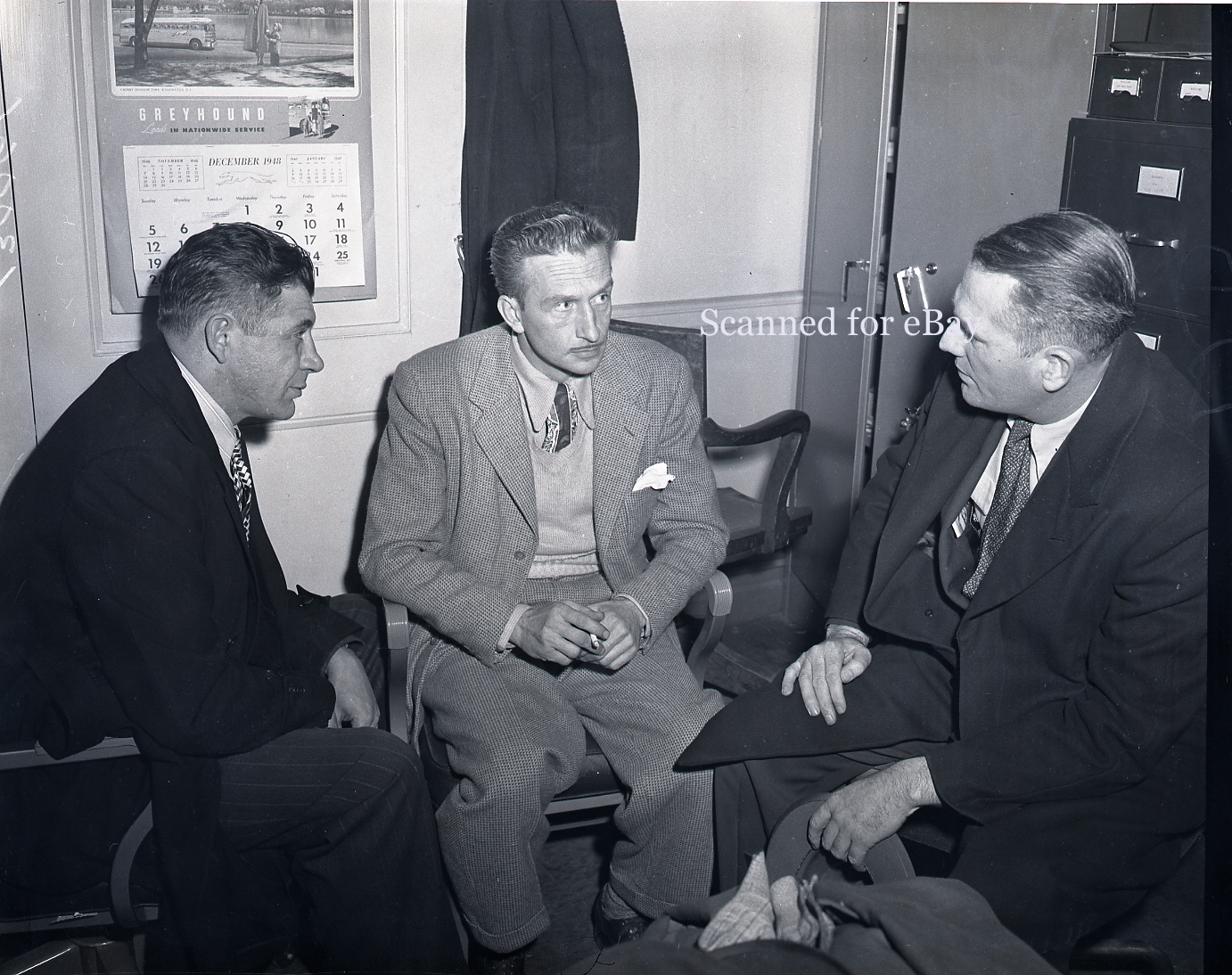
Sfxarchive is selling a 4- by 5-inch negative ostensibly from the Black Dahlia case. I don’t recognize any of these individuals, nor have I ever seen the image. It doesn’t show any of the main suspects, nor does it show the main detectives, Harry Hansen and Finis Brown.

I would say its importance is limited. Note that the seller’s date (January 1949) is contradicted by the calendar in the picture, which says December 1948.

The bottom line: I would not spend any serious money on this image.

Lmharnisch.com

Lmharnisch.blogspot.com

E-mail: lmharnisch (AT) gmail.com

Labels: , , , ,

Monday, January 15, 2007

Another EBay Mystery

Jan. 15, 2007

Los Angeles

While making my daily check of EBay, I found another envelope from 1907, this one addressed to A. Victor Segno, 701 N. Belmont.

A brief check of Proquest reveals—what’s this? A major scam artist, self-help author and wife-stealer.

A. Victor Segno turns out to be the operator of the American Institute of Mentalism. Here’s how it works: Members agree to send Segno $1 ($21.30 USD 2005) a month. In return he sends out a “success wave” twice a day.

According to Segno’s literature: “The vibrations which Prof. Segno is able to produce in people, through being in harmony with their mentalism, is often felt by them, though thousands of miles distant, as a sensation similar to a slight electric shock.”

And a testimonial: “When I commenced taking the treatments with your club I was full of doubts as to the effects, but as I was anxious to be successful and had little to lose and all to gain I continued to take them. I have been a member less than two months and the following are the results:

“At the time I joined the club I was sick, but compelled to work and for very small wages. Shortly after I began to feel better. On the 7th of this month my employer sold me his stock of goods on credit. By the 21st I had paid $100 on the cost of the stock and on the 24th I sold the stock for ($300 or $800) over the cost and reserved an interest in the business.

“You no doubt will be glad to learn that since joining your club I have improved in health, supported myself and little baby girl and made over $1,000, and risen from a servant to be a proprietor. I have also secured a position as traveling agent for a Chicago firm at a large salary. It is wonderful to me.”

Busy though he was sending out success waves, Segno was able to write two books: “How to Live 100 Years” and “How to Be Happy Though Married,” available from the institute for $3 each. Later works included “Personal Magnetism,” The Law of Mentalism” and “How to Have Beautiful Hair.”

Apparently Segno did a thriving business because in a few years he was able to plan a large estate at Belmont and Kane, which was featured in The Times. The letter, addressed to 701 N. Belmont, was presumable sent to the institution on “Inspiration Point” over Echo Park, although I can’t locate it now.

In 1911, however, Segno left Los Angeles, ostensibly to set up a similar school in Russia. Shortly thereafter, his longtime personal secretary, Mrs. Irene Weitzel, a recently married woman whom he had employed since she was a young girl, vanished on an alleged trip to Chicago to visit her parents.

In response to reporters’ questions about whether Segno had run off with his secretary, his wife, Annie Dell Segno, replied: “It isn’t true, unless my husband has lost his senses.”

“An official of the school admitted that Mrs. Segno is greatly perturbed and admitted that there had been talk about Segno and the girl for some months,” The Times says. “She said that when such stories came to her ears she had hotly denied them because Segno’s teaching and life stood out in her mind as everything ideal.”


A. Victor Segno and "success waves" in action, from one of his books.

Divorce eventually followed as Segno set up an identical scheme in Berlin. He returned to the United States about 1915 as the clouds of World War I formed over Europe. Thereafter, Segno vanished from the news while his ex-wife was mentioned in a 1923 story because she had married Harry T. Robinson, apparently a member of a robbery gang.

Thanks, EBay!

Lmharnisch.com

Lmharnisch.blogspot.com

E-mail: lmharnisch (AT) gmail.com

Labels: , , , , , , , ,

Saturday, January 13, 2007

In Cred I Ble

The sale of 1940s mug shots, including one of Elizabeth Short, sold Jan. 12, 2007, for $1,802.77 (more than $78 per picture) to phenomaly. Although EBay now conceals bidders’ identities, we can see that the next highest bid was $1,777.77. Obviously, people are willing to spend serious money for these mug shots.

Please understand, the Elizabeth Short mug shots were printed up in bulk during the investigation and handed out freely. The mug shot was also distributed by the wire services. Translation: There were many copies of this picture. Think carefully before getting into a bidding war over one of them. They turn upon EBay every couple of years.

Lmharnisch.com
Lmharnisch.blogspot.com

Labels: , , , ,

Wednesday, January 03, 2007

For Sale on EBay


“escalante_sandy” is offering an original mug shot of Elizabeth Short, with bidding starting at $50. The seller says this mug shot, among a lot of 23 photos, belonged to a retired detective and is not a reproduction, a claim that appears true.

The most interesting thing about this copy of the mug shot (which was printed up in bulk and handed out freely during the investigation) is what’s written on the back. It’s obvious that the detective was assigned to sweep the neighborhood around the Biltmore in an unsuccessful attempt to see if anyone noticed her.

Note the inscriptions: “Hill St. 2nd to 8th St. W. to Fig. Hotels + Bars” Translation: Visit the hotels and bars between Hill Street and Figueroa from 2nd Street to 8th Street. Apparently the police were checking a period between 4 p.m. on Jan. 9, although Red Manley said he dropped her off at the Biltmore a few hours later, until daylight Jan. 15, the day the body was found.

I don’t recognize any of the other pictures, but one is identified on the back as underworld figure Nick Licata.

Lmharnisch.com

Lmharnisch.blogspot.com

e-mail: lmharnisch (AT) gmail.com

Labels: , , , ,

Thursday, December 07, 2006

Note to "Dahlia Avenger" Fans


Here’s a publicity still of “Maddy” Comfort from “Kiss Me Deadly” for sale on EBay. Her name is also spelled “Mattie” and “Mady.”

Comfort is referred to in the Los Angeles County district attorney’s files on George Hodel. Investigators checking on his possible involvement in the Black Dahlia murder discovered two photos of her, one by herself in which she is nude and another in which she and George Hodel are holding a cat.

When shown the photos
, Hodel’s former wife Dorothy was unable to identify the model. But she is identified elsewhere in the district attorney’s files as “Mattie Comfort, 4028 W. 28th St. RE 2-0207 HO 4-0266.”

By the way, the woman in one of the photos that Steve Hodel claims shows Elizabeth Short has positively been identified as Marya Marco a.k.a. Maria San Marco. Just as I’ve been saying from Day One. I don’t read Steve Hodel’s website, but people who do informed me that Hodel says Marco recognized herself in publicity photos about the case and contacted him. As with all the important witnesses in “Avenger,” she is given a phony a name.

Here's another picture of Comfort in a screen grab from "Kiss Me Deadly."


And another photo for sale on EBay:


Lmharnisch.com

Lmharnisch.blogspot.com

Labels: , , , , ,

Tuesday, November 07, 2006

An EBay Mystery

Nov. 6, 1907
Los Angeles

Here’s a real mystery, although a minor one, and like all real mysteries, it is incomplete and may have no solution.

Exhibit 1: This postcard up for auction on Ebay.

Here’s the front, Burmese fortunetellers.

And the back.


As for the postcard, we find that D.A. Ahuja of Rangoon published a series of Burmese cards. Presumably the card was sent during a voyage because it is stamped “Sea Post Office.” The stamp is from India, a 2 Annas, 6 Pies with the image of King Edward VII. (Here’s one that was used in Bahrain).


Now for the message:

“Kindly accept my sincere sympathies on the loss you have sustained. Was very sorry indeed to hear of the loss.

Kind regards from
Val Leonard 25/11/07”


It’s too bad there isn’t more to the message. Presumably the writer didn’t want to reveal too many details on a postcard. And doesn’t a photo of Burmese fortunetellers seem an odd choice for a sympathy note? Maybe it’s just me.

Note the method of indicating the date, with the day first, then the month and finally the year. The easy guess is that the writer is not an American; but again, only a guess. Who is Val Leonard? A Proquest search turns up nothing.

What’s curious is the cancellation on the stamp “_ASER STREET.” Unfortunately, it’s incomplete, but appears to say rather clearly “25 10 07.” One wonders whether the postal clerk neglected to change the month on the rubber stamp or if something else is afoot.

Also note the address: 150 S. Vendome St., Los Angeles, California, USA is written in dark ink, while the name is so light that it’s nearly unreadable: Mrs. J.F. Hue—something. Or wait. Is it Mrs. J.F. Thie—something?

I recall a Sherlock Holmes story in which the character wrote the name in one manner and the address in another, prompting Holmes to infer that the writer had to look up the address. In this case, however, it seems that the address and message were written at the same time and the name at another. The question of why is one for Mr. Holmes.

Unfortunately, the California death records for 1907 don’t reveal a Hue or a Thie, nor does Proquest, so this line of research comes to an abrupt halt.

We can find out a bit about the address, though. It was a house and was advertised for rent on March 7, 10 and 12, 1907. The question would be whether the loss occurred before March, leaving the house vacant, or after. The answer to that would involve the question of how long it took news of Mrs. J.F’s loss to travel to someone on a voyage and then how long it took the card to arrive. Presumably, it took so long that by the time the card was delivered that Mrs. J.F. had moved to Boulder, Colo. Note that it was a post office box rather than a fixed address. Holmes would have fun with that.


So then, what was the loss? The absence of a Mr. and Mrs. J.F. points toward the loss of a husband, but it could easily be some other loved one.

Now wait a minute. Maybe that’s an “S” as in the capital S of "S. Vendome." Hmmm. Maybe it’s Mrs. J.F. Shie.


Proquest is seemingly helpful here: A mail clerk named Albert W. Shie was killed in a terrible railroad accident at Colton, Calif., on March 29, 1907, which is shortly after the house at 150 S. Vendome was up for rent. The Times says that Shie had been working on the train from El Paso to Los Angeles for five years and lived with his wife at 555 Ruth Ave. in Los Angeles.

Is this Mrs. J.F.’s loss? Presumably she might be Albert Shie’s mother, but given the information available, it may never be clear.

A fun mystery, thanks to Ebay.

Lmharnisch.com
Lmharnisch.blogspot.com

e-mail: lmharnisch (AT) gmail.com

Labels: , , , , ,

Sunday, September 10, 2006

EBay Avenger

OK, I’ve had my fun with Ellroy’s copies of the “Avenger” books. The hardback stands at $38 and the paperback at $29. Despite my minimum bids, there is always the risk that I might end up with these turkeys!

Good luck, folks, I will be watching on the sidelines, listening to John Coltrane’s “Love Supreme.”

ps. Just for fun, I ran the production notes for Brian De Palma's "The Black Dahlia" through the Eve 2.5 essay verification checker, which tests students' essays for plagiarism. And you know what, it was really fun.

Final price:

James Ellroy's copy of the inscribed hardback of "Black Dahlia Avenger": $38. Buyer is emeraldgreenstone.

James Ellroy's copy of the inscribed paperback of "Black Dahlia Avenger": $61. Buyer is Robynbanx.


Lmharnisch.com

Lmharnisch.blogspot.com

Labels: , , , ,

Tuesday, September 05, 2006

Nooooo!!!

I couldn’t stand the thought of James Ellroy’s copies of “Black Dahlia Avenger” going for so little on EBay. After all, don’t people know the book has been optioned by New Line Cinema? Surely books that are inscribed to the Demon Dog of American Fiction are worth more than $20. So I bumped up my bids by 50 cents on the hardback and paperback.

Outbid!

As mentioned on L.A. Observed.

My prediction? Once people see the Brian De Palma movie, the Black Dahlia will be radioactive at the box office for years to come. Read a review from the Venice Film Festival.
During the first hour, the hope that the director has tapped into something really great mounts with each passing minute. Then, gradually, the feverish pulp imagination of James Ellroy, on whose novel Josh Friedman based his screenplay, feeds into De Palma's dark side. The violence grows absurd, emotions get overplayed, and the film revels once too often in its gleeful depiction of corrupt, decadent old Los Angeles. Disappointingly, the film edges dangerously into camp.


Lmharnisch.com


Lmharnisch.blogspot.com

Labels: , , , , , ,

Monday, September 04, 2006

So Rude!


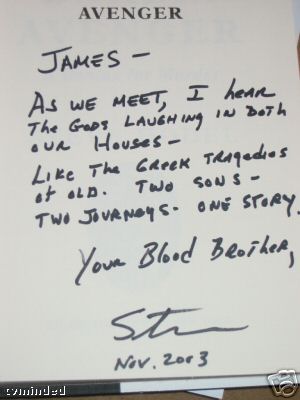
My goodness, one never knows what will turn up on Ebay. This morning I found a copy of “Black Dahlia Avenger” inscribed by Steve Hodel to James Ellroy, who wrote the introduction to the paperback, praising Hodel’s work and endorsing his solution.

And bidding started at $19.99.

Nice way to treat your “blood brother,” James. I don't know whether the gods are laughing--but I am.

Lmharnisch.com

Lmharnisch.blogspot.com


But wait!


Can it be?


Here's the paperback version of "Avenger" inscribed to Ellroy, which carries Ellroy's forward to the case!

With bids starting at $19.99? That's only $5.04 over the original price. I just have to put in a 50-cent bid on this puppy. The happy face alone is worth it.

Labels: , , , ,

Thursday, April 20, 2006

Blogging the Wolfe Book, Request Line XIV


Large ImageI have ceased blogging in real time as I read Donald H. Wolfe’s “The Black Dahlia Files: The Mob, the Mogul and the Murder That Transfixed Los Angeles.” Wolfe uses the “Laura” format, in which the anonymous, butchered body is found and the narrative proceeds in flashbacks. Now, I am taking a few requests before wrapping up the project. Today, we’ll continue with Page 219 at the request of Regular Anonymous Correspondent.

Interested parties have made inquiry as to whether I’ve heard from Wolfe regarding my little note about the faked document on Page 198. Well, “faked” is such an ugly, loaded term. Maybe I should say it has submaximized factuality. No, I haven’t.

Page 219

Let’s see. Wolfe is talking about his stepfather Jeffrey Bernerd, finally mentioning that he died in 1950. Oddly, Wolfe goes on about Bernerd’s many friends—Winston Churchill, Lowell Thomas and Charlie Chaplin—but leaves out his dad, Sailing Wolfe, and his great-uncle Bernard Baruch. I’m baffled that in a book full of name-dropping, Baruch is one name that is never mentioned.

Wolfe’s mother meets Ben Williamson, who is identified as being charge of the Time-Life office in Beverly Hills. Wolfe says Williamson got Howard Hughes’ last public interview, regarding the “Spruce Goose,” a nickname that Hughes hated as I recall.

Wolfe says Williamson played poker with Ben Hecht, Jack Warner, Sam Goldwyn, Joe Schenck, Harry Cohn and Mark Hellinger. Wolfe also claims Hecht was tight with the mob from covering gangsters during his days as a reporter in Chicago.


Large ImageWolfe says Hecht socialized with Bugsy Siegel, Alan Smiley and Mickey Cohen and that in 1950, Hecht and Cohen held a charity gala at Slapsy Maxie’s to raise money for Jews in Palestine.

“Hecht gave an impassioned speech to the crowd of bookies and Hollywood dignitaries and more than $200,000 was raised that evening for the cause—but somehow the money never arrived in Palestine. Mickey Cohen explained that the boat carrying the cash was torpedoed and sunk, but Ben Williamson and Hecht always suspected that the money went down in one of the big game pots up at Hecht’s Angelo Drive castle.”

Hm. Well, frankly, I’d be perfectly happy to take a pass on this one since it has absolutely nothing to do with the Black Dahlia. Still, it presents some juicy targets for a total research drudge.

Even without the end notes, I recognize one familiar story and that’s the old chestnut about the fake fund-raiser for Israel. I can’t recall exactly where I read this story, but I believe it’s in Mickey Cohen’s autobiography. The idea is that Cohen would stage a fake benefit, plant an item with Aggie Underwood at the Herald-Express, and pocket the money. It could be in another mob memoir. I’m thinking the one by Jimmy “The Weasel” Fratianno.

Let’s see where Wolfe got this stuff. Only one source: Ben Hecht’s “Child of the Century,” Pages 610-613. Not one of the books in the haz-mat pile.

Well, let’s put this through the standard fact-checking torture test.

Ready for some ugly research?

Let’s start with Ben Williamson. I expect this material to be true or mostly true. Of course with Wolfe, one never knows. He claimed to be on hiatus from “The Loretta Young Show” during 18 months when it was off the air.

OK, we can confirm Ben Williamson was Time-Life bureau chief in Los Angeles in 1951 (Los Angeles Times, June 15, 1951). Appears to have been in Los Angeles in 1953, based on a search of the Time website. So there was a person named Ben Williamson and he was actually Time-Life bureau chief in Los Angeles. This puts Wolfe way ahead of John Gilmore’s “Severed,” which is loaded with people who don’t exist. I’m not going to chase this any more unless it starts looking fishy.

Ooohh. Howard Hughes on the cover of Time? We can check that on Time’s website. Shall we? Oh lets! Well, Time had Hughes on the cover July 19, 1948. Hm. Seems to be about Hughes at RKO. Now I would love to be able to bring you the entire article, but it costs money to subscribe. Here’s the link if anybody cares to pursue it.

Uh-oh. Hughes gave his last interview in 1958 to Frank McCulloch of Time Life? I guess that’s if you don’t count the 1972 conference call Hughes staged to rebut Clifford Irving’s book. For sale on EBay?


Large ImageSo much for that. Just a little old Hollywood resume padding. Let’s check on Hecht and Angelo Drive. Hm. Beverly Hills. That’s going to be a little hard to confirm with my limited time and it’s really unrelated to the Black Dahlia. I’ll pass.

How about this 1950 bash at Slapsy Maxie’s? Golly. Guess when Van de Kamp’s bakeries took over Slapsy Maxie’s and turned it into a coffee shop? (Los Angeles Times, March 10, 1950). This little fete doesn’t seem to have gotten any ink in The Times. Isn’t that just so peculiar?

AHA! Now this is what makes research so rewarding. I refer to Robert Rockaway’s “American Jews and Crime: An Annotated Bibliography,” found in American Studies International, February 2000, Vol. 38, No. 1.

Oh I like this. Rockaway does my kind of research:

“Mickey Cohen’s book, ‘In My Own Words,’ while something of a
classic, must be used with caution. Although Cohen presents useful
insights and reminiscences about his life in crime and his Jewish
underworld associates — among them, Benjamin “Bugsy” Siegel —
a number of his assertions must be treated with a healthy dose of
skepticism.

“This is good practice with regard to all criminal memoirs, since mobsters tend to justify their actions, distort their motives, and lie. For example, Cohen writes that he always believed that “Jews should behave differently and more correctly.” Yet he threatened, extorted, and beat Jews when it suited his purposes.

“Another example involves Cohen’s activities on behalf of the Irgun,
the underground Jewish organization in Palestine led by Menachem
Begin. According to Cohen, he “would do anything for a cause that
was right, especially Jewish causes.” Cohen became especially enthusiastic about helping the Irgun when he learned that “these guys actually fight like racket guys would. They didn’t ask for a quarter and they gave no quarter.”

“Accordingly, Cohen helped stage fund-raising affairs that raised thousands of dollars to purchase weapons and had them shipped to Israel. Cohen’s account remained the generally accepted version until the publication, in 1984, of the memoirs of Jimmy “the Weasel” Fratianno, a self-confessed Mafia killer turned government informer.

“Fratianno knew Cohen well. When he was not trying to kill Cohen, Fratianno socialized and worked with him. Cohen invited Fratianno to one of his fund-raisers, which was held at Slapsy Maxie’s restaurant in Los Angeles. Fratianno admitted being awed by the affair. “The place is packed. I’ve never seen so many Jewish bookmakers in one place in my life,” he remembers. “They’re all there. Famous actors, producers, big shots in the community. It’s a full house.” Fratianno claimed that nearly $800,000 was raised that evening.

“Because he distrusted Cohen, Fratianno remained suspicious of his motives. Fratianno asserted that Cohen would never let hundreds of thousands of dollars slip through his fingers. His doubts increased when he read a story in the Los Angeles Herald that reported that an unnamed ship carrying arms for the Jews in Israel sank in the Atlantic Ocean during a storm. These were the weapons supposedly purchased by Mickey Cohen.


Large Image“According to Fratianno, Cohen had a girlfriend who worked at the Herald. “This broad would walk on hot coals for Mickey,” he claims. Consequently, she printed anything Cohen gave her. “The way I see it,” says Fratianno, “Mickey called her and made up a story about buying guns and ammunition
for the Jews with the million raised at the benefits and then told her
the boat sank. A few unknown people died, some were saved, and
she prints it on his say-so.”

“Other sources disparage both men’s claims. Yitzhak Ben-Ami
headed the Irgun’s European-based illegal immigration operations.
In 1947, the Irgun sent him to the United States and he helped organize the fund-raising affairs Cohen and Fratianno spoke about.

“Ben-Ami claims that “between $50,000 and $60,000 was raised,” not
the hundreds of thousands that Cohen and Fratianno refer to. “The
Jewish underworld contributed all together about $120,000 for the
Irgun,” says Ben-Ami.”

This is worth repeating:

“His assertions must be treated with a healthy dose of skepticism. This is good practice with regard to all criminal memoirs, since mobsters tend to justify their actions, distort their motives, and lie.”

Time for my walk

Shout out to:

Pollo Loco? (64.164.183.65)

Hearst (65.212.0.194)

Department of Defense Information Center, Olongapo, Philippines (214.1.3.248)

Hurry back!

Labels: , , , , , , , , , , , ,

Thursday, April 13, 2006

Blogging the Wolfe Book, Request Line IX


I have ceased blogging in real time as I read Donald H. Wolfe’s “The Black Dahlia Files: The Mob, the Mogul and the Murder That Transfixed Los Angeles.” Wolfe uses the “Laura” format, in which the anonymous, butchered body is found and the narrative proceeds in flashbacks.

Yesterday, we looked at a particularly foul and nasty installment, Page 167, at the request of Mary Pacios. Today we’ll do Pages 197-198 at Mary’s request. I hope you are ready for a shocker. Even for Donald H. Wolfe, this is nasty, nasty work. A ruthless, conniving, calculating and cynical attempt to pull off a fraud.

You are so busted, Donald H. Wolfe.

To the haz-mat pile of Dahlia books….

This chapter is titled. Hm. Well Page 196 is labeled “Inside an Enigma” and Page 197 is “Sunshine and Shadow.” OK, Part II is “Inside an Enigma,” echoing Will Fowler’s favorite comment on the case. Of course, Wolfe doesn’t actually credit Will, but you’ll find it on Page 92 of “Reporters.” The chapter is titled “Sunshine and Shadow.”

Page 196 is about organized crime in Los Angeles: Jack Dragna and Bugsy Siegel. And there’s a lot of mumbo-jumbo and Brenda Allen, Mickey Cohen, the mob assassination of Paul “Paulie” Biggons, blah blah blah.

Oh “a hail of bullets.” Now there’s an original phrase. The only thing missing is “shots rang out.”

OK, well here’s an untrue statement:

“The gangland killings and attempted assassinations made headlines for days but remained unsolved. Although neither Homicide nor the press seemed to have a clue about who was responsible, the average cop on the beat and the below-average man on the street knew it was the Mafia Capo of Los Angeles, Jack Dragna.”

Now this is just Wolfe being nasty for the sake of being nasty. I would say that for the vast majority of gangland murders in Los Angeles of the 1940s, there was no mystery as to the killers or their motivation. The problem for the police is locating cooperative witnesses, because oddly enough, most people find it unhealthy to testify in court about mob murders. And although publishing capricious and unverified murder accusations against conveniently dead people (oh, say Bugsy Siegel or Dr. George “Evil Genius” Hodel) may sell lots of books, allegations against living people will get you sued.

Well let’s see, Page 197 is mostly boilerplate about innocent, wide-eyed Elizabeth Short returning to bad old Los Angeles in July 1946 with “little comprehension of the dark side of the movieland maze, where the studios, the nightclubs, the unions and many of the major talent agencies had been infiltrated by the mob.”

The only thing missing is: “Run, innocent little girl, run like the wind back to home and hearth in safe old Boston as fast as your shapely milk-white legs and trademark black suede pumps can carry you!!!”

Now I am skipping around so I may have missed the bogus stuff from “Severed” about Elizabeth Short being at the Hollywood Canteen in 1944 and all that rot (note: she was actually in Florida and Boston). And doesn’t Wolfe have her being a prostitute at some point? And then he turns around and makes her into a lazy tramp. I mean Wolfe really doesn’t have a handle on who she was, does he?

“When her bisected body was found on Norton Avenue in Leimert Park, it wasn’t mentioned by Capt. Jack Donahoe or the press that her remains were found in the weeds approximately 250 yards from the backyard of Jack Dragna’s house at 3927 Hubert Street, near the corner of Thirty-Ninth and Norton.

Nor was it ever mentioned that the letter “D” had been carved by a knife into the pubic area of the victim’s flesh. The D is clearly visible in police photographs held today in the Black Dahlia files of the Los Angeles District Attorney’s Office. Did the D stand for Dahlia—or could the D have stood for Dragna? Whatever the meaning of the psychopath’s message, the silent scream from the sacred setting was certainly heart at the nearby home of the Mafia Capo, Jack Dragna—and La Famiglia.”

And then there’s the this memo. Mary asked if Wolfe cut off something important in reproducing it.

But first. It’s true the police and the press didn’t mention the proximity of Jack Dragna’s house to the crime scene. As I recall, it’s about five blocks. Dragna’s house, by the way, is still there and fairly modest for a mob chieftain.

Luckily, we have Google Earth and Google Maps. So let’s see. Isn’t it weird that Wolfe talks about the distance to Dragna’s backyard? Hm.

More like 6½ blocks. Google Maps says it’s 0.6 of a mile. Now look. This is really important. Out of consideration for the people who own the house, I absolutely never give out the actual address of the crime scene. I always say 54 feet north of the fire hydrant in the middle of the block. I have made up an address for Google purposes that’s fairly close to where Elizabeth Short’s body was found.

How about a little math? Hm. 1,760 yards in a mile, makes it more like 1,056 yards. So Wolfe owe us 806 yards—nearly half a mile off.

This is really funny. Page 375: “Dragna’s address in the 1946 telephone directory place him three short blocks from Thirty-Ninth and Norton [forgetting, of course, that the body wasn’t found there]. Isn’t it interesting that Dragna’s HQ of evil is listed in the phone book? Like maybe people could call him up ask about the latest mob hits or something.

Of course, those of use who have a 1946 L.A. phone book can check. (Thank you, Ebay). Guess who’s not listed.

Go ahead and guess.

Maybe I should check under Evil, H.Q.

Oops.

Whew. Nothing like wrestling with the technology to get the satellite picture I need. Again, note that I have intentionally fed Google the wrong address for the crime scene. IGNORE it.

Now while we’re at it, who else isn’t mentioned by police or the press. Who is it that lives at 3944 S. McClung?

Would you believe it? Detective Lt. Paul W. Freestone, the University Division watch commander who was actually at the crime scene.

<sarcasm>

A coincidence? I think not.

</sarcasm>

So the following are lies:

Jack Dragna’s house wasn’t 250 yards or three short blocks from the crime scene.

Jack Dragna’s address is not listed in the 1946 Los Angeles telephone directory.

Not exactly a good showing is it? Not a real confidence-builder.

Now for Part II.

“Nor was it ever mentioned that the letter “D” had been carved by a knife into the pubic area of the victim’s flesh.”

You know what I like about this paragraph?

Did the D stand for Dahlia—or could the D have stood for Dragna?

Gosh, I don’t know. Maybe it stood for Donald Duck or Donald H. Wolfe.

Wolfe is having fun here because the district attorney’s office won’t let anybody copy the body photographs. I’ve seen them all and I don’t recall anything like that, but then I wasn’t looking for the letter “D” either.

So let’s check this memo Mary was asking about. Because I do have that.

Gosh, this is kind of hard to find.

Weird that it’s not dated. It should be.

Uh-oh.

I’m starting to get a really, really bad feeling about this document.

My spider-sense is tingling.

Now the text is found on Page 13 of “Evidence and Declarations Tending to Connect or Disconnect Leslie Dillon to the Murders of Elizabeth Short, Jeanne French and Gladys Kern.”

The full text is:

ITEM NO. XIII:

SOME PEOPLE BELIEVED that the “D” cut in the shaved pubic region of Elizabeth Short is of the same type as found on the body of the French woman. [Aha. That explains the reference. Jeanne French].

Facts reveal that the pubic region of Elizabeth Short’s body was not shaved.

Experts in handwriting have stated that it would be impossible

[page break]

to determine any type of handwriting from the so-called “D” cut into the pubic region of Elizabeth Short’s body.

ITEM NO. XIV….

The really bizarre thing is the header Wolfe shows:

M E M O R A N D U M

To: H.L. Stanley, Chief of the Bureau of Investigation

ATTENTION: Arthur L. Veitch, Deputy District Attorney

IN RE: Elizabeth Short Murder—Los Angeles Police Department Records, Reports, Statements, Correspondence, Evidence and Information

FROM: Frank B. Jemison, Lieutenant—Bureau of Investigation

Because it’s not there.

I’m starting to think Photoshop, folks. Let’s hope I’m wrong.


BUSTED!

Gosh, it looks like someone lifted the header off an unrelated Oct. 29, 1949, memo from Frank Jemison to H.L. Stanley. Snipped off the inconvenient date and pasted on the material about Leslie Dillon.

I’m short on time so I won’t scan in the material today, but you can rest assured, the document produced on Page 198 of “The Black Dahlia Files” is fraudulent and pasted together from two unrelated reports.

Would someone please remind me again what a well-researched book this is? I keep forgetting.

Shout out to:

National Internet Backbone (59.92.54.60)

Hurry back!

Labels: , , , , , , , , , ,

Monday, April 03, 2006

Blogging the Wolfe Book, Request Line


Large ImageI have stopped blogging in real time as I read Donald H. Wolfe’s “The Black Dahlia Files: The Mob, the Mogul and the Murder That Transfixed Los Angeles. Wolfe is using the “Laura” format, in which the anonymous, butchered body is discovered and the narrative proceeds in flashbacks.

The two-minute executive summary:

As promised, I went through the Wolfe book page by page until I finished with Elizabeth Short’s funeral. As throughout the book, we have found any number of errors, fabrications and instances in which Wolfe cites a source and then contradicts it. For example, he states that Harriette Manley divorced Robert M. “Red” Manley (the last person known to have been seen with Elizabeth Short) a year after the murder.

In fact, as shown in the district attorney’s files (remember that this is called “The Black Dahlia Files”) they were not only still married in 1950, she was present when he was interviewed by Frank Jemison of the district attorney’s office.

Further, Wolfe ignores what’s in the district attorney’s files about Elizabeth Short’s mother, Phoebe, identifying the body, in favor of a maudlin scene from John Gilmore’s “Severed,” embellishing it so that instead of stoically containing her grief (as portrayed in the Examiner) Phoebe collapses, sobbing “She was a good girl! She was a good girl!,” prompting a pledge from Detective Harry Hansen that he would find the killer—alas, the district attorney’s files show that Harry Hansen wasn’t even there.


Large ImageOops.

My daily blog concludes with a quotation from Deuteronomy that was read at Elizabeth Short’s funeral.

Now the request line is open and I’m going to take them in order.

So far I have:

Pages 101-103 (Regular Anonymous Correspondent)

Pages 108-111 (Regular Anonymous Correspondent)

Page 119 Mary Pacios

Pages 121-122 Mary Pacios

Page 131 Mary Pacios

Page 167 Mary Pacios

Page 197-198 Mary Pacios

Pages 213-215 (Regular Anonymous Correspondent)

Page 218 Mary Pacios


Large ImagePages 219 (Regular Anonymous Correspondent)

Pages 226-227 (Regular Anonymous Correspondent)

Pages 239-258 (ColScott)

Page 277-281 Mary Pacios

Page 284 Mary Pacios

Pages 293-296 (Regular Anonymous Correspondent)

Page 296 Mary Pacios

Page 311 Mary Pacios

Pages 345-357 (Regular Anonymous Correspondent)

So let’s start with Page 101

The title of this chapter is “By a Person or…”

Wolfe is dealing with the “lost week” between the time Elizabeth Short was left at the Biltmore in downtown Los Angeles and when her body was found Jan. 15, 1947.

“Detectives [Harry] Hansen and [Finis] Brown concluded there was no viable identification of her whereabouts during that missing week, and they deduced that she had been abducted and held captive at a secluded location until the murder and subsequent transportation of the body.”

That’s probably somewhat true. At least none of the many purported sightings were ever conclusively verified. I’m not sure Hansen and Brown (and recall that Wolfe has grossly reduced the number of detectives working the case to the two lead investigators) ever decided that she had been abducted but that is one possible scenario. Not the only one, but it certainly is an option.


Large ImageHm. I don’t recognize this quote:

“No matter how questionable each lead appeared on the surface,” Finis Brown stated, “we had to track it down, and in this case, each lead seemed to open into something else, and it went on and on, and none of them were giving a clue to the missing week, or to the murder itself.”

OK, now this could have come from Brown’s lengthy statement in the district attorney’s files (and recall this is titled “The Black Dahlia Files”) or it could be from “Severed.” Brown was occasionally quoted in the newspapers, but not frequently.

I’ll guess “Severed.”

Holmes! Why are you never wrong?

Because I’m an author’s creation, Watson. As are you.

But let’s check Wolfe’s homework, shall we? “Severed,” Page 150.

(Isn’t it amazing that this book draws so much from “Severed” and so little from the original sources? I wonder if Wolfe ever considered calling this book “Severed 2006” or something).


Large ImageUh-oh. Let’s check that again.

Chapter 7, Page 101. “No matter how questionable each lead…” Gilmore, Severed, P. 150

Actually, Page 150 of “Severed” has nothing to do with any of this. But it is one of my favorite, favorite, FAVORITE pages. Why?

Because it’s about one of the invented characters, cleverly named “Martin Lewis.” Gilmore’s claim is that police found Lewis’ business card in the Elizabeth Short items mailed to the Examiner. Of course, nobody knew then exactly what was in the envelope, so it was a safe claim. The district attorney’s files, however, give an exhaustively detailed inventory. And guess what. No business card from Martin Lewis or anybody else running a shoe store in Hollywood.

But this is my favorite part:

“… if it had not been for a good friend with the Hollywood Citizen-News who was very close with the Hollywood chief of police, they may have continued to badger me.”


Large ImageLet me run that quote again:

“very close with the Hollywood chief of police”

Now think. Where is Hollywood?

Los Angeles.

Is it part of the city of Los Angeles?

Yep.

Then isn’t it under the jurisdiction of the Los Angeles Police Department?

Yep.

And then Hollywood wouldn’t have its own police chief—would it?

Uh. Nope.

Wouldn’t you expect a crime author whose father was a Los Angeles police officer to know an elementary fact like that?

Objection! That calls for a conclusion on the part of the witness!

OK. That’s a totally blind lead. I don’t know where Wolfe got the quote and I’m not going to dig through “Severed” looking for it.


Large ImageOhhh. “Investigators learned….” This is almost as scary as “Will Fowler remembers,” perhaps the three most frightening words in the English language.

“Investigators learned that prior to Elizabeth Short’s return to Los Angeles on January 9, 1947, with Red Manley, she had been a resident of Los Angeles on three separate occasions. Her brief initial visit with Cleo and Mrs. Yanke in January 1943 ended when she traveled to Camp Cooke. She was later arrested in Santa Barbara and sent back to her mother’s home in Medford.”

Now this is sort of true. Except Mrs. Yanke wasn’t there.

Ahhh. Then it’s a straight lift from the “Movements of Elizabeth Short” in the district attorney’s files. I don’t know about Finis Brown’s role in it, but this is more or less her location. Don’t know about the “Victory Canteen” either. That sounds suspicious.

But let’s press on.

“In letters to her family, Elizabeth said she was also ‘modeling’ for a Miami man named ‘Duffy’ Sawyer.”


Large ImageOh? This sounds like one of the bogus people in “Severed.” Sawyer isn’t in any of the official sources. This has to be from “Severed” if it’s from anywhere. Let’s see.

Hm. Not attributed anywhere or to anyone.

Really nice work by ReganBooks, the publishing house without proofreaders or fact-checkers.

Here we have something really juicy for a true researcher.

“Elizabeth traveled to Los Angeles for the second time in August of 1944. She stayed briefly at the Clinton Hotel in downtown Los Angeles at Eighth and Broadway, where she shared a room with a slim, dark-haired girl named Lucille Varela.”

Now this is completely false and Wolfe knows it. How does he know? Because he had access to “Movements of Elizabeth Short Prior to June 1, 1946.”

And what does it say? She stayed at the Clinton Hotel? She knew Lucille Varela?

Try this:

“In December, 1943, she was employed at the Rosedale Delicatessen, 1437 Washington Ave., Miami Beach, Fla., by Mr. Meyer Yedlin (22) as a waitress, and was living at the El Mar Hotel 220—21st St., Miami Beach. She was employed there a few months and went to work for Mammy’s Restaurant located at that time at 2038 Collins Ave., and was employed there during 1943 and up into 1944, working there until the latter part of 1944. She left there and visited her mother (1) in 1944. She returned later and lived at the El Mar Hotel with Mrs. Devaul (23) during the last part of 1944 and until the first part of 1945 but did not work. She was employed from Mar. 30, 1945 to Sept.1, 1945 at the St. Clairs, Inc., Boston Mass., Mr. Burk (25), Personnel Mgr.”


Large ImageSo where does all this mumbo-jumbo about the Clinton Hotel come from?

From “Severed” Pages 34-35!

How wonderfully funny. Gilmore makes up the Clinton Hotel “on Broadway” (“Severed” Page 34) while Wolfe locates it more precisely at Broadway and 8th.

Um. Now not everybody has a 1944 Los Angeles Yellow Pages lying around the house. But I do. (Thank you, ebay).

How much do you want to bet there’s no Clinton Hotel listed?

Uh-oh.

Looks like Elizabeth Short would have had no place to stay even if she were in Los Angeles in 1944, which she wasn’t.

So all this stuff up to Page 103 about Elizabeth Short being a B-girl with Lucille Varela in 1944 (lifted from “Severed”) is made up.

I know this goes down hard for all the fans of “Severed,” but the book is 25% mistakes and 50% fiction.


Large Image

That’s it for today.

Shout out to:

France (82.229.63.38)

Livonia, Mich. (65.29.123.149)

Belgium (213.118.127.56)

West Virginia Network For Educational Telecomputing (129.71.136.141)

Regular visitor in Kerkira, Greece (213.80.115.71) Looks like a nice spot, judging by Google.

Hurry back!

Labels: , , , , , , , , , ,

Friday, March 31, 2006

Blogging the Wolfe Book, The Countdown Begins


Large ImageI’m blogging in real time as I read Donald H. Wolfe’s “The Black Dahlia Files: The Mob, the Mogul and the Murder That Transfixed Los Angeles.” Wolfe is using the “Laura” format in which the anonymous, butchered body is found and the narrative proceeds in flashbacks. We are at the point in the story when police and reporters have discovered Elizabeth Short’s trunk and suitcases, events that occurred on separate days.

Note: I am now on Page 86 and will conclude this exercise whenever we get to Elizabeth Short’s funeral. I am roughly 25% through the book and have made whatever points I am going to make—and believe me, this tome is not going to suddenly mend its ways and become scholarly.

Thereafter, if someone wants to query about specific points in the book, I’ll entertain them.


Large ImageOK, now get this:

Page 85

“To this day, the contents of Elizabeth Short’s luggage, checked at the Greyhound bus station on January 9, have never been disclosed to the press or the public.”

Page 86

“When the luggage was opened in the newspaper’s conference room, detectives and reporters scrutinized the memory books, which were found to contain dozens of photographs of Elizabeth in Miami, posing with a number of servicemen—including a four-star general.”

Now apparently statements like this do not cause intellectual whiplash to Wolfe’s editors, Cal Morgan and Anna Bliss. I have no idea what Morgan and Bliss did on Wolfe’s book, but I can tell you absolutely what they didn’t do.


Large ImageNow where did Wolfe get this nonsense about the four-star general? That’s a new one on me.

Let’s check the end notes.

Ha. Nowhere. Completely unattributed. Tell me you’re surprised.

Aha. Wolfe puts some interesting material in a footnote.

“Some of the material found in Elizabeth Short’s lost luggage by the Examiner was returned to Phoebe Short, but many of the photos of Elizabeth ended up in the Examiner archive, which was donated to the Special Collections Department of the University of Southern California in 1988. Most of these photos vanished from the USC Library in the early 1990s and were eventually auctioned off on eBay in 2002.”

Some of Elizabeth Short’s photos were indeed auctioned off on eBay, but in 2003. The final price, which Wolfe does not disclose, was $7,611.11 paid by Steve Hodel, who published them in “Black Dahlia Avenger,” Page 515.


Large ImageThe eBay photos’ provenance is murky. The seller is a well-known enthusiast of antique motorcycles and says he found them in going through a massive collection of photos searching for pictures of old motorcycles. The seller claims that whoever had the photos didn’t know what they were. Presumably these photos were in the possession of an Examiner employee at some point, but it is unclear whether they were ever part of the USC archives, which holds much of the Examiner material, but has many holes in its collection.

For example, when the Examiner ceased publication in 1962, some material was transferred to the new Herald Examiner. When that ceased publication, the material was transferred to the Los Angeles Public Library, including some Black Dahlia photos now on library’s online database.


Large ImageHowever, a large stack of Herald Examiner photos from the Black Dahlia case are in the John Gilmore collection at UCLA. I will leave it to others to explore their provenance. But look at the photo of Gilmore in the section of photos following Page 210 in Wolfe’s book to get an idea of the vast number in the Gilmore material at UCLA. Gilmore is sitting at a desk with the wall behind him plastered with Dahlia pictures. You can even see the news editors’ crop marks on the photos from where they were prepared for publication.

Did I mention that Gilmore dismisses this book as “crap” even though his book jacket blurb calls it “destined to become a true-crime classic. A must-read!”

I still don’t get that one.

Wolfe has several pages of Elizabeth Short’s love letters lifted from the newspapers. He makes an elementary mistake when he says Matt Gordon died in November 1945. It was in August 1945.


Large ImagePage 89

Now this is interesting. After wallowing in the image of Elizabeth Short as a lazy tramp in San Diego, Wolfe uses Jim Richardson’s quote, which I cited earlier:

“She had been a pitiful wanderer, ricocheting from one cheap job to another and from one cheap man to another in a sad search for a good husband and a home and happiness. Not bad. Not good. Just lost and trying to find a way out. Every big city has hundreds just like her.”

Page 90

Wolfe claims that Richardson arranged Phoebe’s plane trip from Boston to Los Angeles. This has to be from Will Fowler. In reality, First Baptist Church of Medford paid the tab. Yep, Will Fowler’s “Reporters,” Page 84-85.

Let’s check his homework:

“Reporters,” Page 84-85


Large Image“Wrapping the story, the last paragraph said Mrs. Phoebe May [note: Mae] Short was expected to arrive in Los Angeles from Berkeley and that no date had been set for the coroner’s inquest.

“Footnote: The Examiner had already met Phoebe in Los Angeles earlier, before she flew up to Berkeley to be with her sister, Mrs. Adrian West. [Of course that’s Elizabeth Short’s sister, not Phoebe’s sister.]”

Nothing about the Examiner arranging Phoebe’s flight to Los Angeles, although that was one of Will’s many claims—he also said the Examiner hid Phoebe from other reporters when in fact she was in Berkeley with her oldest daughter. As I keep saying three of the most frightening words in the English language are: “Will Fowler remembers.”

Page 91

Oh you must be kidding!


Large Image“When Phoebe returned to Los Angeles, accompanied by Virginia and her husband, Adrian, they were met at the airport by Examiner reporters, who drove them to the coroner’s office at the Hall of Justice.”

Where on Earth did Wolfe get that? Will?

To the end notes, Watson! And hurry!

Why my dear Holmes! John Gilmore’s “Severed,” Page 146.

To the haz-mat pile of Dahlia books, Watson.

Hum. As we’re switching books, do you wonder why Wolfe would use “Severed” over someone who actually worked for the Examiner—granted Will Fowler is not exactly the soul of veracity but I don’t think that’s a major issue for this opus.

Now before I tell you, guess what “Severed” says.

Go ahead.


Large ImageI’ll wait.

Think it’s all about how the Examiner reporters took Phoebe, Virginia and Adrian to the coroner’s office? I mean that is what Wolfe says, right?

“Severed,” Page 146.

“On the morning of January 22nd, she [Phoebe] returned to L.A. with Ginnie and her son-in-law. They were met at the airport and brought downtown to the Hall of Justice entrance to the morgue. Harry Hansen and Brown were waiting.”

But Holmes! There’s not a word about Examiner reporters!

Not a word, Watson.

Time for a walk.


Large ImageRemember, we’re counting down to Elizabeth Short’s funeral. That’s when I stop.

Shout out to:

Ljubljana, Slovenia (193.77.78.234)

Caltech (131.215.192.127)

Pittsylvania County, Va., Public Schools (216.146.50.3)

Spotsylvania County, Va., School Board (205.174.123.52)

Hurry back!

Labels: , , , , , , , , ,

Wednesday, March 22, 2006

Blogging the Wolfe Book, Family Ties


Large ImageI’m blogging in real time as I read Donald H. Wolfe’s “The Black Dahlia Files,” more properly titled “Stuff I Scraped Out of ‘Severed’ Thanks to John Gilmore, Who Calls My Book ‘a True Crime Classic’ and ‘Crap’ ” (If you figure that one out, you’re good).

Wolfe is using the “Laura” format in which the anonymous, butchered body is found and the narrative is told in flashbacks. We just finished the portion of the story in which Elizabeth Short has been befriended by the French family in San Diego in the last month of her life.

I heard from one of Elizabeth Short’s sisters yesterday, as I do from time to time. Out of concern for her privacy, I won’t quote the e-mail, but she asked what I knew about the upcoming Brian De Palma movie. I told her I turned down a chance to attend the sneak preview, but that several people who saw the movie said it was horrid. Sample comment: “There is so much wrong with this film that I don’t even know where to start!”


Large ImageThe sister expressed dismay that so many people are so hungry to cash in on the family’s tragedy, and so totally hardened to the grief they continue to feel nearly 60 years after the murder. As I have said again and again, for the Short family, the murder is not some macabre curio of old Los Angeles; for them it’s as if it just occurred. The continuing flood of sleazy, crackpot books only reopens old wounds. And don’t even get me going about the websites plastered with body shots that have made their way onto record jackets. And the free FBI files going for $25 a pop on Ebay. You know who you are.

To the haz-mat pile! The good news is that we’re on


Large ImagePage 68

Total pages (not counting “end notes” and the index) 357. Hey, we’re nearly 20% of the way through the book.

OK. This chapter is titled “Red,” so I’m going to guess (remember I haven’t read ahead) that it is lifted more or less intact from Aggie Underwood’s jailhouse interview with Robert M. “Red” Manley, the only bylined story of any original account of the Black Dahlia case. With some garnishes from “Severed,” which is 25% mistakes and 50% fiction.

Hm. Wolfe is starting with Jim Richardson suspecting that Red and Elizabeth Short might have left San Diego for Los Angeles late in the day. He continues to call photographer George O’Day a reporter, but at least he is consistent in his mistake. Recall that Elizabeth Short’s father went from strict churchgoer to Jack Daniels’ best amigo in a few pages, something that caused no intellectual whiplash to Wolfe’s agent, Alan Nevins, nor to his two editors, Cal Morgan and Anna Bliss.

Any bets as to whether Wolfe bothers to attribute this? It should be in Richardson’s “For the Life of Me” if it’s anywhere.


Large ImageLead on, Watson!

Well, Holmes, it’s supposed to be from “For the Life of Me,” Page 301.

Quick, Watson, the haz-mat pile!

Ah. This is more like it:

“For the Life of Me,” Page 301

“She left the French place about six o’clock on the evening of January 8 with a man known as Red,” Tommy [Devlin] reported. “This Red sent her a telegram January 7 from Huntington Park saying he would pick her up the next day. She told Mrs. French and Dorothy he was taking her to Los Angeles A couple of weeks before she left, Elizabeth told Dorothy one morning that she had a friend named Red who was at a motel near San Diego. When Red picked her up January 8 he had his car and carried her bags out to it. Mrs. French and Dorothy met him and I’ve got a good description of him. He’s our baby. Send somebody out to check that telegram. He may have given an address when he sent it. I’ll start prowling the motels around here for the license number of his car.”

So it wasn’t Richardson’s idea, it was Devlin’s. And notice, please, no mention of photographer George O’Day. That comes from Will Fowler’s “Reporters.”

Oh this is interesting (well, OK, to a total research drudge):


Large Image“But at the Mecca Motel, known to be a ‘hot pillow joint’ located less than twelve miles north of Pacific Beach, the clerk recalled a couple that matched the description; however, they had not registered in January. The clerk recalled them registering back in mid-December. ‘Yes, the man was tall, freckle-faced, had red hair, and was in his mid-twenties,’ the clerk recalled, ‘and he was with a striking young woman with jet-black hair.’ ”

Now if you haven’t spent years researching Dahlia stuff you wouldn’t notice what’s going on here. Wolfe is claiming that Red and Elizabeth Short checked into a motel during his previous visit to San Diego—something that is totally unsupported in the original documents. And this nonsense about the Mecca Motel being a “hot pillow joint”—where on earth did Wolfe get that?

Let’s just see if he hangs this on anybody.

Aha. Maybe from “Reporters.” I swear, one of the most frightening phrases in the English language is “Will Fowler recalls…” I considered him a good friend and he lied his head off to me.


Large Image“Reporters,” Page 81

“In the meantime, the crew of George O’Day and reporter Tom Devlin continued checking hotels and motels, looking for anything that would lead them to the identification of ‘Red.’ And coming up with a winner, Devlin located a motel where a red-haired man had registered the previous December. Unbelievably, he hadn’t signed in with the usual Mr. and Mrs. Smith. He had actually entered Elizabeth Short’s real name at the motel a dozen miles north of San Diego. He also signed his name: Robert Manley from Huntington Park.”

Note, please. Nothing about freckles, nothing about O’Day being a reporter and most of all, nothing about the Mecca Motel being a “hot pillow joint.” That’s strictly Wolfe’s handiwork. Now Red did check into a motel along the highway south of Pacific Beach, but by all accounts Elizabeth Short did not accompany him. In fact, he picked her up on a corner across from the Western Air Lines office, gave her a ride to the Frenches, went to the motel to clean up and came back and picked her up. They went out and he dropped her off at the Frenches.

Period.

So where does this quote come from?

“ ‘Yes, the man was tall, freckle-faced, had red hair, and was in his mid-twenties,’ the clerk recalled, ‘and he was with a striking young woman with jet-black hair.’ ”

Beats me. From the fertile mind of Donald H. Wolfe, apparently.


Large ImageI’m increasingly puzzled about the title of Wolfe’s book because the district attorney’s files (remember, this is called the “Black Dahlia Files”) are virtually absent. Wolfe’s main sources seem to be “Severed” and “Reporters.”

And even then, Wolfe is very selective. Here’s another section from the same page of “For the Life of Me” that Wolfe is using. But he leaves this out:

“She had been a pitiful wanderer, ricocheting from one cheap job to another and from one cheap man to another in a sad search for a good husband and a home and happiness. Not bad. Not good. Just lost and trying to find a way out. Every big city has hundreds just like her.”

But of course that’s completely counterproductive in the “Elizabeth Short turns bad girl” motif, so it’s ignored.

Time for my walk.

Ps. I also heard from Mary Pacios yesterday. She says the Wolfe book makes her so angry she can’t read it. Mary calls it “dishonest” and it is surely that.

Shout out to:

Warner Music Group (65.244.245.5)

Larkspur Hospitality Company (12.154.206.226)

My regular visitor in Kerkira, Greece (213.80.115.71)

New Orleans (68.14.106.216)

Sydney, Australia (203.217.66.172)

Raleigh, N.C. (69.134.176.51)

Win98 user at the University of Windsor (137.207.132.38)

The dudes at Inktomi (72.30.133.13)

Youngstown State University (150.134.171.163)

Hurry back!

Labels: , , , , , , , , ,