Thursday, September 14, 2006

Brian De Palma's 'The Black Dahlia'

The Black Dahlia,” directed by Brian De Palma, screenplay by Josh Friedman based on the novel by James Ellroy. Starring Josh Hartnett (Dwight “Bucky” Bleichert), Aaron Eckhart (Leeland “Lee” Blanchard), Scarlett Johansson (Kay Lake), Hillary Swank (Madeleine Linscott) and Mia Kirshner (Elizabeth Short). Universal Pictures.

(Contains spoilers. You have been warned)

While not quite the “Heaven’s Gate” of film noir, “The Black Dahlia” is a long (121 minutes), bloated, confusing, self-important, self-consciously artsy movie undermined by miscasting, absurd plot turns, naive symbolism, an utter disdain for history and laughable overacting that make Robert Towne’s ponderous, plodding “Chinatown” sequel, “Two Jakes” (1990), look like a taut thriller. After what may be a strong opening weekend thanks to heavy marketing, interest should plummet except among the most ardent fans of De Palma, Ellroy and the Dahlia murder.

As regular blog readers will know, “The Black Dahlia” is based on Ellroy’s 1987 novel, which in turn is distantly related to the unsolved 1947 murder of Elizabeth Short, an unemployed 22-year-old cashier and waitress whose gruesomely mutilated body was posed in a vacant lot just off Crenshaw in the 3800 block of South Norton Avenue between Coliseum and 39th Street.

I last read Ellroy’s novel in 1996 and have no desire to renew my acquaintance with it, but if my recollections are correct, Friedman and De Palma have stayed fairly close to the plot, which is one of the movie’s worst flaws. Recall, for example, that director Curtis Hanson and screenwriter Brian Helgeland radically altered, restructured and streamlined “L.A. Confidential” in filming the movie. Granted, the story arc of “L.A. Confidential” wilts a bit more with each viewing, but it’s quite forceful the first time.

The most marked difference between “Dahlia” and other classics of the more recent genre is that although “L.A. Confidential” is firmly planted in the 1950s and Chinatown” takes place in the 1930s, De Palma’s film has shallow roots “once upon a time in Los Angeles.”


Clearly, a movie nominally set in 1943-4
7 in which the lead characters attend a silent movie (above, “The Man Who Laughs, 1928--note that the characters are sitting in the balcony, which was reserved for blacks back in the ugly days of segregation. And look at the man right behind Harnett. He's smoking. In a theater?? Oops!) has nothing but contempt for the past, which is reflected in a thousand ways, from male actors’ scruffy haircuts (see above) and inability to wear hats (at right) properly to a laughable lesbian nightclub scene (below) featuring K.D. Lang in top hat and tails singing “Love for Sale,” which rather than depicting the classic film noir era is most evocative of “Bugsy Malone,” a far more accurate film. Note to Elisabeth Fry, personal hairstylist for Eckhart: Men's haircuts in the 1940s look like Red Manley's, above. I mean really!


One can find fatal flaws in virtually every area of this movie with little effort—in fact the most difficult task in critiquing the film is remembering everything that’s wrong with it.

First, there’s the dialogue: “She looks like that dead girl! How sick are you?”—not quite “She’s my sister and my daughter,” is it? Then there’s miscasting (at 31, Kirshner is much too old to play the 22-year-old Black Dahlia), opulent production design by Dante Ferretti (at right, police officers lived like this on LAPD pay? Who knew?), music (Mark Isham in the entirely predictable “cue mournful trumpet” genre), odd costuming—Friday casual for the men, fall collection for the women—(Jenny Beavan), down to the crowd scenes, which are busy to the point of distraction. And I wish I had the cigarette holder franchise on this film. I would be a rich man.

Even special effects are misused, with an earthquake that serves no purpose except to underline an obvious plot turn. Granted, the overly complex story is almost impossible to follow, but in this instance, De Palma must assume the audience has an IQ of about 50. And unlike the shocking and painfully realistic nose-slitting scene in “Chinatown,” the far worse violence inflicted on the Black Dahlia is amusingly fake. If De Palma was hoping to make a slasher flick, he failed badly.

Nor does Vilmos Zsigmond’s cinematography escape a rap on the knuckles for a ridiculous lesbian stag film (presumably made at a cost surpassing the combined budgets of all blue movies produced from the 1920s to the 1950s), and a self-conscious and overly elaborate shot in which partners Blanchard (Eckhart) and Bleichert (Hartnett) engage in a shootout, followed by the camera slowly rising up floor by floor of an entire apartment building, proceeding to a befuddling shot of the building’s roof before it at last discovers the Black Dahlia’s body in a vacant lot in the adjoining block. As visual storytelling, this is a grandiose and miserable failure. It reminds me of Leni Riefenstahl’s famous rising shot in “Triumph of the Will,” except that one works and this one doesn’t.

And then there’s Fiona Shaw, (below) who chews so much scenery that she must have been rushed to an oral surgeon to have the splinters removed.


For that matter—and perhaps this is what makes the heart


of the film beat so faintly—there is very little of the Black Dahlia in “The Black Dahlia,” who only surfaces far into the picture.

In fact, the first 30 or 40 minutes are devoted to boxing matches between the two detectives, nicknamed “Fire” and “Ice” from the Symbolism 101 school of writing. (I know it’s in the book, but that’s no excuse).

The bouts lead up to a prizefight intended to win support for an LAPD bond measure (yawn). There’s an awful lot of 10-ounce gloves, blood and a couple of front teeth thrown around by Blanchard and Bleichert as they fight it out, then traverse L.A. with Lake (Johansson), who is nominally Blanchard’s girlfriend but has much more interest in Bleichert. In theory, a torrid triangle might juice up the plot, but “Dahlia” plays this interest as flat as a day-old Pepsi.

Speaking of Symbolism 101, we have Kay Lake, all in white with peroxide hair and Madeleine Linscott (Swank) entirely in black. Get it?


It’s only after all this boxing and De Palma’s version of the Zoot Suit riots (let’s get this straight: the cops are beating up sailors during World War II to protect Mexicans?) that the film discovers the Black Dahlia’s body in that artsy shot. For the record, the body, rather than horrifying, looks laughably fake and what can I say about a crow landing at the crime scene and being chased away except I know someone who flunked Symbolism 101.

So where is the Black Dahlia in this confusing mess? She exists entirely on film. Of course in real life, Elizabeth Short never got a screen test or even appeared in a school play, but De Palma gives her one and Kirshner, trying her best at the impossible task of acting 22, makes it as pitiful as possible (Costuming note: A screen test in which the actress has big runs in her nylons?) with an intentionally miserable reading of Vivian Leigh’s famous monologue from “Gone With the Wind.”


The handling of the crime scene? Ridiculous even by Hollywood’s lax standards (note to anyone who ever wants to be a homicide detective: No smoking!). Vintage black-and-white police cars swarming the streets (bonus fact: there isn’t a single black-and-white in the original pictures. Check if you don't believe me) and detectives bellowing instructions like some shark-jumping 1970s cop show that any good investigator would already know. Ditto the morgue.
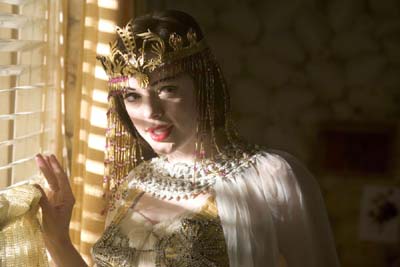
Anybody who knows anything about investigative procedures will laugh themselves sick at this movie. I’m especially thinking of one of the more surreal scenes in which Bleichert attempts to question a young woman (Rose McGowan) who is wearing an Egyptian/Babylonian costume that is only explained at the end of the scene—not that anyone cares by that point.

Running a close second is the interrogation of a juvenile suspect (in the book, her name is Linda Martin). In reality, Lynne Martin had to be questioned by juvenile officers because she was underage, but this becomes another victim of De Palma’s contempt for the past.

From this point, the movie lurches from one absurdity to another. Blanchard dies while fighting a tall, skinny man with steel-rim glasses who looks like James Ellroy’s double (Bill Finley) and they plunge over the railing of a steep staircase, falling several floors. What to do with the bodies? Well this is De Palma, so Bleichert watches as his alleged friend/partner is cremated in the basement incinerator. Think the department might start asking rude questions about what happened to him? And how about Lake?


Then there’s the contrasting love/sex scenes, and it’s obvious De Palma hasn’t a clue how to stage either one. The sex scene, between Harnett and Johansson, occurs in the dining room, when, overcome with passion, Bleichert rips away the tablecloth, sending dishes everywhere, and has his way with Lake. Isham’s score is lushly romantic, an oddly contrasting choice of music, and amour like this is sure tough on the Havilland china and the Baccarat crystal.


The love scene, between Swank and Harnett (above, in a Friday-casual day in the Homicide Division), is just as amusing with Bleichert and Linscott having a little pillow talk while she’s wearing nothing but huge pearl earrings and a long matching necklace with pearls the size of small onions, ensuring, I would imagine, a rather bumpy ride.

And about those crazy—and I mean crazy—Linscotts. (At right, Swank and John Kavanagh grieve over the loss of a Ming vase). Bleichert knows exactly how to make rich people confess to murder: Use their valuable antiques for target practice. The last time I checked, police revolvers hold six rounds, so unless Bleichert was planning to fight off one of them as he reloaded I can’t imagine what he thought he would do after his sixth question. Then again, not everybody can send a crystal chandelier crashing to the floor with one shot—some of us need two. (If J.J. Gittes had taken a few potshots at Noah Cross’ art collection “Chinatown” would have been a much different film).


And while you're at it,
Bucky, take out a couple of those clown paintings, please.

Did I mention Fiona Shaw? Just keep an eye on her.

My prediction? After this movie, the Black Dahlia will be radioactive at the box office for years.

(I just realized something. With that haircut, Josh Harnett looks like Shemp Howard).

Larry Harnisch
Lmharnisch.com

Lmharnisch.blogspot.com

ps: Nathan says:

Nice work!

I've tried to post a comment, but Blogger won't let me (says I have an invalid password, and it won't let me start a new account, oh well). My comment would have read as such --

If you want to get nitpicky about historical accuracy...assuming someone does...please allow me to continue the conversation.

In 1947, the featured Rosslyn Hotel had two neon blade signs, not one. Of course spending the money on the CGI to add the other blade would be too much to ask, as long as I wasn't the one asking it.

And in the alley where Our Heroes beat up GIs, there's a seven-digit phone number on a wall advertisement, ie, 555-4689 or somesuch. I trust I don't have to tell readers here how wrong that is.

The switch from yellow 45 plates with the 46 sticker to 47 black plates is abrupt, and works in theory, but I'd have to see the picture again to make certain it was done correctly. Of course not everyone in Los Angeles switched to the black plate in the first weeks of January.

I will say this, if there's ANY reason to see this movie, it's Fiona Shaw. She will go down as the great guilty pleasure, like watching Mantan Moreland get all googly-eyed in one of his 40s "spook" pictures.


thanks again,

Nathan

Labels: , , , , , , , , , , , ,

Thursday, April 13, 2006

Blogging the Wolfe Book, Request Line IX


I have ceased blogging in real time as I read Donald H. Wolfe’s “The Black Dahlia Files: The Mob, the Mogul and the Murder That Transfixed Los Angeles.” Wolfe uses the “Laura” format, in which the anonymous, butchered body is found and the narrative proceeds in flashbacks.

Yesterday, we looked at a particularly foul and nasty installment, Page 167, at the request of Mary Pacios. Today we’ll do Pages 197-198 at Mary’s request. I hope you are ready for a shocker. Even for Donald H. Wolfe, this is nasty, nasty work. A ruthless, conniving, calculating and cynical attempt to pull off a fraud.

You are so busted, Donald H. Wolfe.

To the haz-mat pile of Dahlia books….

This chapter is titled. Hm. Well Page 196 is labeled “Inside an Enigma” and Page 197 is “Sunshine and Shadow.” OK, Part II is “Inside an Enigma,” echoing Will Fowler’s favorite comment on the case. Of course, Wolfe doesn’t actually credit Will, but you’ll find it on Page 92 of “Reporters.” The chapter is titled “Sunshine and Shadow.”

Page 196 is about organized crime in Los Angeles: Jack Dragna and Bugsy Siegel. And there’s a lot of mumbo-jumbo and Brenda Allen, Mickey Cohen, the mob assassination of Paul “Paulie” Biggons, blah blah blah.

Oh “a hail of bullets.” Now there’s an original phrase. The only thing missing is “shots rang out.”

OK, well here’s an untrue statement:

“The gangland killings and attempted assassinations made headlines for days but remained unsolved. Although neither Homicide nor the press seemed to have a clue about who was responsible, the average cop on the beat and the below-average man on the street knew it was the Mafia Capo of Los Angeles, Jack Dragna.”

Now this is just Wolfe being nasty for the sake of being nasty. I would say that for the vast majority of gangland murders in Los Angeles of the 1940s, there was no mystery as to the killers or their motivation. The problem for the police is locating cooperative witnesses, because oddly enough, most people find it unhealthy to testify in court about mob murders. And although publishing capricious and unverified murder accusations against conveniently dead people (oh, say Bugsy Siegel or Dr. George “Evil Genius” Hodel) may sell lots of books, allegations against living people will get you sued.

Well let’s see, Page 197 is mostly boilerplate about innocent, wide-eyed Elizabeth Short returning to bad old Los Angeles in July 1946 with “little comprehension of the dark side of the movieland maze, where the studios, the nightclubs, the unions and many of the major talent agencies had been infiltrated by the mob.”

The only thing missing is: “Run, innocent little girl, run like the wind back to home and hearth in safe old Boston as fast as your shapely milk-white legs and trademark black suede pumps can carry you!!!”

Now I am skipping around so I may have missed the bogus stuff from “Severed” about Elizabeth Short being at the Hollywood Canteen in 1944 and all that rot (note: she was actually in Florida and Boston). And doesn’t Wolfe have her being a prostitute at some point? And then he turns around and makes her into a lazy tramp. I mean Wolfe really doesn’t have a handle on who she was, does he?

“When her bisected body was found on Norton Avenue in Leimert Park, it wasn’t mentioned by Capt. Jack Donahoe or the press that her remains were found in the weeds approximately 250 yards from the backyard of Jack Dragna’s house at 3927 Hubert Street, near the corner of Thirty-Ninth and Norton.

Nor was it ever mentioned that the letter “D” had been carved by a knife into the pubic area of the victim’s flesh. The D is clearly visible in police photographs held today in the Black Dahlia files of the Los Angeles District Attorney’s Office. Did the D stand for Dahlia—or could the D have stood for Dragna? Whatever the meaning of the psychopath’s message, the silent scream from the sacred setting was certainly heart at the nearby home of the Mafia Capo, Jack Dragna—and La Famiglia.”

And then there’s the this memo. Mary asked if Wolfe cut off something important in reproducing it.

But first. It’s true the police and the press didn’t mention the proximity of Jack Dragna’s house to the crime scene. As I recall, it’s about five blocks. Dragna’s house, by the way, is still there and fairly modest for a mob chieftain.

Luckily, we have Google Earth and Google Maps. So let’s see. Isn’t it weird that Wolfe talks about the distance to Dragna’s backyard? Hm.

More like 6½ blocks. Google Maps says it’s 0.6 of a mile. Now look. This is really important. Out of consideration for the people who own the house, I absolutely never give out the actual address of the crime scene. I always say 54 feet north of the fire hydrant in the middle of the block. I have made up an address for Google purposes that’s fairly close to where Elizabeth Short’s body was found.

How about a little math? Hm. 1,760 yards in a mile, makes it more like 1,056 yards. So Wolfe owe us 806 yards—nearly half a mile off.

This is really funny. Page 375: “Dragna’s address in the 1946 telephone directory place him three short blocks from Thirty-Ninth and Norton [forgetting, of course, that the body wasn’t found there]. Isn’t it interesting that Dragna’s HQ of evil is listed in the phone book? Like maybe people could call him up ask about the latest mob hits or something.

Of course, those of use who have a 1946 L.A. phone book can check. (Thank you, Ebay). Guess who’s not listed.

Go ahead and guess.

Maybe I should check under Evil, H.Q.

Oops.

Whew. Nothing like wrestling with the technology to get the satellite picture I need. Again, note that I have intentionally fed Google the wrong address for the crime scene. IGNORE it.

Now while we’re at it, who else isn’t mentioned by police or the press. Who is it that lives at 3944 S. McClung?

Would you believe it? Detective Lt. Paul W. Freestone, the University Division watch commander who was actually at the crime scene.

<sarcasm>

A coincidence? I think not.

</sarcasm>

So the following are lies:

Jack Dragna’s house wasn’t 250 yards or three short blocks from the crime scene.

Jack Dragna’s address is not listed in the 1946 Los Angeles telephone directory.

Not exactly a good showing is it? Not a real confidence-builder.

Now for Part II.

“Nor was it ever mentioned that the letter “D” had been carved by a knife into the pubic area of the victim’s flesh.”

You know what I like about this paragraph?

Did the D stand for Dahlia—or could the D have stood for Dragna?

Gosh, I don’t know. Maybe it stood for Donald Duck or Donald H. Wolfe.

Wolfe is having fun here because the district attorney’s office won’t let anybody copy the body photographs. I’ve seen them all and I don’t recall anything like that, but then I wasn’t looking for the letter “D” either.

So let’s check this memo Mary was asking about. Because I do have that.

Gosh, this is kind of hard to find.

Weird that it’s not dated. It should be.

Uh-oh.

I’m starting to get a really, really bad feeling about this document.

My spider-sense is tingling.

Now the text is found on Page 13 of “Evidence and Declarations Tending to Connect or Disconnect Leslie Dillon to the Murders of Elizabeth Short, Jeanne French and Gladys Kern.”

The full text is:

ITEM NO. XIII:

SOME PEOPLE BELIEVED that the “D” cut in the shaved pubic region of Elizabeth Short is of the same type as found on the body of the French woman. [Aha. That explains the reference. Jeanne French].

Facts reveal that the pubic region of Elizabeth Short’s body was not shaved.

Experts in handwriting have stated that it would be impossible

[page break]

to determine any type of handwriting from the so-called “D” cut into the pubic region of Elizabeth Short’s body.

ITEM NO. XIV….

The really bizarre thing is the header Wolfe shows:

M E M O R A N D U M

To: H.L. Stanley, Chief of the Bureau of Investigation

ATTENTION: Arthur L. Veitch, Deputy District Attorney

IN RE: Elizabeth Short Murder—Los Angeles Police Department Records, Reports, Statements, Correspondence, Evidence and Information

FROM: Frank B. Jemison, Lieutenant—Bureau of Investigation

Because it’s not there.

I’m starting to think Photoshop, folks. Let’s hope I’m wrong.


BUSTED!

Gosh, it looks like someone lifted the header off an unrelated Oct. 29, 1949, memo from Frank Jemison to H.L. Stanley. Snipped off the inconvenient date and pasted on the material about Leslie Dillon.

I’m short on time so I won’t scan in the material today, but you can rest assured, the document produced on Page 198 of “The Black Dahlia Files” is fraudulent and pasted together from two unrelated reports.

Would someone please remind me again what a well-researched book this is? I keep forgetting.

Shout out to:

National Internet Backbone (59.92.54.60)

Hurry back!

Labels: , , , , , , , , , ,

Monday, March 27, 2006

Blogging the Wolfe Book, Tell It to the Marines


Large ImageI’m blogging in real time as I read Donald H. Wolfe’s “The Black Dahlia Files: The Mob, the Mogul and the Murder That Transfixed Los Angeles.” Wolfe is using the “Laura” format, in which the anonymous, butchered body is discovered and the narrative proceeds in flashbacks. We are at the point in the story when police are questioning Robert M. “Red” Manley, a traveling salesman who gave Elizabeth Short a ride from San Diego to Los Angeles in January 1947.

The two-minute executive summary:

We have seen that although this book is titled “The Black Dahlia Files” half of it is taken from Will Fowler’s “Reporters,” John Gilmore’s “Severed” and the Los Angeles Examiner. The district attorney’s files account for 8% of the book so far. In relying on “Severed,” Wolfe picks up and embellishes Gilmore’s ruthless smear of Elizabeth Short as a lazy tramp. Wolfe also reduces the vast number of detectives working the case to three: Homicide Capt. Jack Donahoe and Detectives Harry Hansen and Finis Brown, forcing them to be supposedly be in San Diego, Los Angeles, Santa Barbara and Lompoc at the same time. A neat trick, you must agree.


Large Image
In addition, “Mogul” shows once again that Wolfe isn’t shy about citing a source and then contradicting it completely, in this case the account of retired Officer Vincent A. Carter. Wolfe states that according to Carter, Red admitted having an affair with Elizabeth Short, while Carter’s own book states the exact opposite.

A regular correspondent writes to share a news release on an upcoming appearance by “Black Dahlia Avenger” author Steve Hodel at the Centre Pompidou. I don’t think anyone has ever accused the French of lacking a sense of humor.

Page 75

Wolfe is doing what Raymond Chandler used to call “passage work” in covering Red’s background and Elizabeth Short’s fairytales to the people who befriended her that Red was a Marine pilot. Then he picks up more of Aggie Underwood’s jailhouse interview with Red.

But not so fast. Wolfe attributes the Red Manley material to the district attorney’s files. Here’s his exact citation: “Manley’s service record and the notations regarding his ‘Section Eight’ are included in the Black Dahlia Case files at the office of the Los Angeles District Attorney.”

I really wish Wolfe could sort out the various agencies in play here. The district attorney is an elected officer for Los Angeles County and Wolfe keeps treating the job as if it were part of the city of Los Angeles bureaucracy. That would be the city attorney, another elective office.


Large ImageBut the real humor, of course, is that Wolfe’s citation leads to two boxes of jumbled paper. Somewhere in there, supposedly, is Red’s service record and material about his discharge from the Army for being mentally unfit.

Let’s go pull the box of district attorney’s files in the Dahlia case and see what we’ve got, eh?

Now I can tell you before I even look, that Red’s Army records (when he enlisted, when he was discharged, evaluations, etc.) are not there. There is a transcript of his interrogation by Frank Jemsion of the district attorney’s office, conducted Feb. 1, 1950, but there’s nothing about his service record in it.

Hm. Nothing about Red’s Army record in the LAPD summary of the case.

Let’s keep looking. Well, how about the list of 22 suspects?

Nope.

Let me check my index of the district attorney’s files.

Guess what.

Nada.


Large ImageThe truth is I could spend an entire day digging through these files and might still come up empty-handed. The point being that the material on Red’s service record isn’t in the main places you’d look: His interview, the LAPD summary and the list of suspects (in fact, in the interrogation, Jemison goes out of his way to emphasize that Red was not a suspect).

Now let me skip over some of the Underwood interview to get to:

Page 76

Because Wolfe is going to fabricate out of thin air, a tryst between Red and Elizabeth Short at the Mecca Motel.

OK, folks, watch a master fabricator at work. If you ever want to know how to make up some bogus material, this is how it’s done:

“At this point Manley hesitated in his story. Correcting himself, he said, ‘No—we started to drive to the Club, and it took us two and a half or three hours to find it… Boy it’s sure easy to get lost in San Diego!’ ”


Large ImageThat’s verbatim from Underwood’s interview, except that she didn’t capitalize “club.” A point apparently lost on ReganBooks, the publishing house without proofreaders or fact-checkers.

Ready? Here we go!

“Before correcting himself, Manley may have been about to say that they left and tried to find a motel. Though Manley told Aggie that he had left Elizabeth Short at the Frenches, and then found a ‘room’ up the coast, and registered ‘for myself,’ the Examiner reporters had discovered that both Manley and Elizabeth Short had registered at the Mecca Motel on the day in question—December 16. The ‘two and a half or three hours’ supposedly spent trying to find the Hacienda Club were more than likely spent at the motel where they had both registered before going to the club, which was only a fifteen-minute drive from the French residence in Pacific Beach and only ten minutes from the Hacienda Club. Manley continued: ‘When we got to the Hacienda Club, we had a few drinks and danced a few times. Then it was twelve o’clock. We went to a drive-in, had a sandwich, and I took her home.’ ”


Large ImageNotice that this makes no sense. Let’s run that again:

The ‘two and a half or three hours’ supposedly spent trying to find the Hacienda Club were more than likely spent at the motel where they had both registered before going to the club, which was only a fifteen-minute drive from the French residence in Pacific Beach and only ten minutes from the Hacienda Club.

In other words, the nightclub is only 10 minutes from itself. OK California geography can be complex, but not that complex. Let’s give him the benefit of the doubt and assume (or “speculate with confidence” as Hodel is so fond of saying) that Wolfe means the motel was 15 minutes from the Frenches’ home and 10 minutes from the Hacienda Club.

Of course, for this to work, Wolfe must have found the Hacienda Club. Think so? Let’s dig through the book and see if he says where it is. I’ll bet he doesn’t know.

Nope. Wolfe hasn’t a clue where the club was. In truth, the reason Red had such a hard time finding the club is because it wasn’t anywhere near Mission Valley.

Oops.

But there’s more.
Large Image
Red didn’t stay at the Mecca Motel on the December trip, but on his second trip in January.

Excuse me? What’s my source? It’s an unidentified newspaper clipping in the Gilmore archives at UCLA. Box 16, Folder 3.

Here’s the headline:

‘Red’ Here Night Girl Slain. L.A. Police Checking His Alibi.

Tell them I sent you.

And here’s something really peculiar. Gilmore doesn’t even use his own material (“Severed,” Page 106).

Time for my walk.

Shout out to:

Riverdale, Ill. (12.100.216.67)

Salem, Ore. (67.166.94.152)

France (80.124.192.14) (Tiens! Going to the Hodel appearance?)

Windows 98 user in Portland, Ore. (24.21.137.251) Upgrade!

Hurry back!

Labels: , , , , , ,

Tuesday, February 07, 2006

Blogging the Wolfe Book, the Boy on the Bicycle

Page 7

What’s this? Another day on Page 7? Theological scholars don’t scrutinize the Bible this carefully and this is a book you could read in a few hours waiting for a plane at LAX. Don’t give up, we’re closing in on Page 8. I warned you from the beginning that this would be tedious. But you asked why I don’t read Black Dahlia books. This is why. It’s painful.

In the small hours after midnight, Bobby Jones, a young man in his early teens, wheeled his bicycle through a vacant lot near Thirty-Ninth Street and Norton Avenue in Leimert Park.

This is the elusive story about the Boy on the Bicycle at the crime scene. It’s one of Will Fowler’s yarns and the original version goes like this: Will was at the crime scene with photographer Felix Paegel (Will usually threw in lots of distracting details about what kind of flashbulbs Paegel used to divert attention from the fact that Will didn’t have a copy of the picture Paegel supposedly took of him with the body. “And nooooooobody around,” Will always said. “All alooonnnnne.”

In his often-told tale, the cops showed up, pulled their guns and Will explained who he was, suggesting they go talk to the Boy on the Bicycle who was standing nearby.

My first hint that anything was wrong with this was when I told Will I’d found one of the first two police officers at the scene and was going to interview him (which I did). Will became extremely uncomfortable and said something like: “Gee, (nervous laugh) I wonder if he’ll remember pulling his gun?”

When I sat down with the officer, Wayne Fitzgerald, he said: “Bullshit!” And then to make sure I got the point, he said it again: “Bullshit!”

And as time proved, Will wasn’t the first reporter at the crime scene. It took me years to untangle the truth and by then Will was in terrible shape, dying of cancer and in mental decline. One time I was coming over to visit and asked if there was anything I could bring him. Will asked me to pick up some Kleenex and toilet paper. At his apartment on Stern in Sherman Oaks, Will told me where to put the items and when I opened the cabinet, the shelves were full of Kleenex and toilet paper. He was embarrassed and said: "I guess I forgot."

He got even worse. Before his death in 2004, Will called up and said he’d been institutionalized for six months because he had become violent with someone (Will was a boxer—or at least claimed he was a boxer in his early years. His father, Gene, was friends with Jack Dempsey so I assume at least some part of his boxing stories is true). I never had the heart to call him after that.

I have never located the Boy on the Bicycle, but it isn’t for lack of trying. He’s never mentioned in any of the news reports or documents in the Los Angeles County district attorney’s files.

Here’s Will’s version of the Boy on the Bicycle from “Reporters,” Page 75: “As [the officers] started their investigation, I pointed toward Crenshaw. There was a pre-teenager straddling his bike a block away. 'Why don’t you question that kid over there? Maybe he knows something,' I said. I was anxious to get to a phone.”

He next turns up in “Severed,” Page 1:

“Shortly after six o’clock that morning, a boy walked his bicycle through the weeds of a stretch of vacant lots south of Hollywood.”

I read something like that and I just sigh. Leimert Park, despite what you read elsewhere is nowhere near Hollywood.

“Severed” continues: “The boy slowed down to glance back at the sound of a car, an older black sedan, possibly a Ford. The early morning light reflected on the windshield and he couldn’t see anyone behind the wheel…. Almost late for his paper route, the boy gave no further thought to that lone car on Norton. But soon he would find out that someone—whoever had been in that car—had left something so terrible in the vacant lot that for the rest of his life the boy would remember that windshield. He would try to picture a face behind the glass but he never could see one.”

Note that Will puts the Boy on the Bicycle a block from the crime scene on Crenshaw at the time the body is found while John Gilmore, in “Severed,” rolls the clock back to dawn and puts him on Norton Avenue. Wolfe places the Boy on the Bicycle even earlier, “in the small hours after midnight.” And “Severed” never identifies him or gives his age, while Will gives his name as Bobby Jones and calls him a preteen. Wolfe, however, makes him a bit older.

But of course there’s more to the story. Let’s flip back to Todd (also known as Tod) Faulkner’s 1971 feature in The Times. Aha! It’s our friend, the Boy on the Bicycle. But wait. Here’s what Faulker says:

"[Harry] Hansen remembers that reporters and photographers were already on the scene when he and [Finis] Brown arrived. So was a man who had been out walking his dog. So was Bobby Smith, an 11-year-old from down the street who usually played in this field and who now sat quietly astride his bicycle and watched and would remember."

Nothing about a paper route, nothing about him seeing a car, nothing about spending the rest of his life trying to visualize the face behind the windshield of the car, as portrayed in “Severed.” Faulker wraps up the story of the Boy on the Bicycle by saying: “Bobby Smith, the 11-year-old who sat and watched it that morning from his bike, works for a motor home company out in Van Nuys.”

I’ve never found this kid, nor the motor home company in Van Nuys where he supposedly worked. The Times did publish his picture, however.

Here’s the genealogy of the Boy on the Bicycle story:

1971, Todd Faulkner, Los Angeles Times (making his debut as Bobby Smith)

1991, Will Fowler, “Reporters” (name changed to Bobby Jones)

1994, John Gilmore, “Severed” (not identified)

2006, Donald H. Wolfe, “Mogul” (using the name Bobby Jones), crediting “Severed” and a 2003 interview with Will, who was barely coherent at that point in his life—at least when I spoke with him.

Fortunately “Black Dahlia Avenger,” either misses or ignores this story, or the Boy on the Bicycle (evil genius George Hodel in disguise perhaps?) would be swept up in the vast, shadowy conspiracy in which the LAPD concealed dozens of murders because Dr. Hodel knew who was walking around Los Angeles with a case of VD. I hope that sounds as absurd to you as it does to me.

So how does the story go from Will Fowler to John Gilmore? Through Mary Pacios, author of “Childhood Shadows.” Will describes his encounter in “Reporters,” Pages 88-91:

“Then there was a 13-year-old boy named John Gilmore, the son of a Los Angeles policeman at the time of the Dahlia murder. The elder had little to do with the case then. But after many years of listening to his father recount the unsolved slaying over and over, young John finally published a Black Dahlia piece in what is known in the industry as a ‘junk magazine.’ ”

“It was my impression that John finally succumbed to the fictional bizarre when he claimed to have met Elizabeth [Short’s] killer, ‘Mr. Jones.’ And… heavens to Betsy… John’s informant, who led him to Mr. Jones, was no other than the reliable source: nationally respected ‘Mr. Smith.’ ”

Will continues to describe meeting Mary Pacios, (then Mary Humphrey).

“As a down payment in order to more closely study this woman who desperately yearned for some kind of recognition, I offered to guide her along the difficult route of writing a first book. In good faith, I handed her my Dahlia chapter, the Crane scenario [too much Dahlia insider stuff even for me—lrh] some photo negatives and John Gilmore’s erroneous magazine piece. This, with the proviso that the material would serve only as a guide, and that she would not publish or publicly refer to any of the same until after ‘Reporters’ was published.”….

“It wasn’t until 1990 when Mary sent me her final letter. She wrote that she and John Gilmore had met and the two were going to collaborate on a Dahlia book.”

“My God,” I thought, “now two confused Dahlia nonentities have coupled.”

“Some time later I happened to catch the two on a television talk show where they starred as the ultimate Black Dahlia authorities. They had unblushingly enlarged on their fancies. Now John claimed the murderer had confessed to him before death, and not to police. And Mary had raised Elizabeth in her social station, having had her double-dating with Marilyn Monroe and appearing at fashionable Hollywood nightclubs with the likes of Franchot Tone.”

Does the Boy on the Bicycle really exist? The Times ran a picture of somebody in 1971. But the smart money says he is fiction.

The larger question, however, is why Wolfe draws on "Severed" as well Will Fowler and "Reporters," which is so dismissive and sarcastic about John Gilmore. Since I'm blogging this as I read in real time, I don't know the answer. Maybe we'll find out and maybe not.

Whew. I have to go for a walk. But as promised we are on Page 8.

Labels: , , , , , , , ,

Saturday, February 19, 2005

Product Placement, 1950s Style


I recently came across my Dave Brubeck albums while going through my old collection of LPs and discovered that "Jazz: Red Hot and Cool," recorded in 1954 and 1955, was done in partnership with the Helena Rubinstein cosmetics company and took its title from a new shade of lipstick Rubinstein introduced. I also noticed that while the tracks were recorded at the Basin Street nightclub in New York, Richard Avedon's picture of a comely young model entirely in red draped over Brubeck's piano was taken at the Hungry i in San Francisco. According to the liner notes by Brubeck's longtime producer George Avakian, women (presumably) who bought the lipstick also got a small Columbia LP with several jazz tracks. I do love the incredibly saturated reds of the '50s, which is how I think of the era. And while the album has been reissued, history has failed to record the fate of the Rubinstein lipstick.

Labels: , , , ,